


A rare or sealed video game can be a childhood favourite, a carefully preserved piece of gaming history or a collectible with a significant resale value. Those motivations often overlap. A collector might want to display a first-print PlayStation title, an unopened Nintendo game, a complete-in-box Xbox release or a game that has been professionally graded. The challenge is enjoying the collection without causing avoidable damage to the packaging, seal, disc, cartridge or label.
If you are researching how to display sealed video games, rare video game display cases, collectible game storage, video game UV protection or how much a sealed game is worth, there are several separate issues to consider. A display should suit the physical format, its condition and its surroundings. An attractive wall arrangement is not automatically a protective storage environment, and an expensive frame cannot make an unsuitable location safe.
This educational guide explains how collectors evaluate condition and value, how to identify sealed, complete-in-box and graded copies, and what matters when choosing shelves, stands, cabinets, protective cases and specialist wall displays. It also covers light, humidity, cleaning, security, documentation and the different requirements of PlayStation, Xbox, Nintendo and retro game packaging.
The essential principle: display and preservation are different goals
Display makes a collection visible. Preservation aims to reduce change over time. A sealed game left permanently on a sunny windowsill can be highly visible but poorly preserved. The same game stored in a stable, dark environment is less accessible to visitors but generally experiences lower light exposure. Neither choice is automatically correct for every owner, but the trade-off deserves to be understood.
A sensible plan begins with the item rather than the furniture: determine what the game actually is, whether the packaging is original, how easily it can be replaced, what parts are vulnerable and how often it needs to be handled. Then choose a display location and method that fit those priorities. For highly valuable items, a photograph, replica cover or reproduction case can sometimes serve as the everyday display while the original remains protected in storage.
What makes a physical video game collectible?
Age alone does not establish value. Demand, scarcity, condition, franchise, region, release history and the number of surviving complete examples all matter. Some mass-produced old games remain inexpensive, while particular editions or packaging variants attract committed collectors. The strongest demand is not always for the oldest release, and the highest advertised asking price is not proof of market value.
Physical collecting can focus on playing original hardware, completing a series, preserving cover art, collecting sealed releases, building a regional library, following a developer or assembling a display of personally important titles. A serious Nintendo Switch collection and a first-generation PlayStation library may require very different preservation priorities despite both being called video game collections.
Loose, complete-in-box, sealed and graded: what the terms mean
The condition category is one of the first details to establish before assessing a game or planning a display. A loose cartridge, a complete retail copy and an unopened copy can look similar from the front in a photograph but are different collecting objects. Terminology also varies among marketplaces, generations and grading companies, so read a listing rather than relying entirely on its shorthand.
PriceCharting describes loose, complete-in-box (CIB), new and graded condition categories in its video game price data. Its definitions provide a useful starting point, though individual collectors may apply more detailed standards to particular editions.
| Term | Typical meaning | Display and valuation consideration |
|---|---|---|
| Loose | Game cartridge or disc without its complete original retail packaging | Best compared with loose sales; a custom cover or replacement box is not the original package |
| Complete-in-box (CIB) | Original game with the original box or case and required original paperwork for the edition | Verify manuals, inserts, maps and other components expected for that release |
| Factory sealed | Original retail package with an apparently unopened original factory seal | Check seal authenticity, damage, region and whether the packaging was later resealed |
| Graded | A copy authenticated or assessed and encapsulated under a grading service’s stated system | The graded holder changes overall dimensions and must be supported without opening it |
| Reproduction or replacement packaging | A replacement box, printed cover, manual or other non-original component | May be ideal for inexpensive display but should never be represented as original |
Why a sealed copy is not automatically valuable
Unopened condition can command a premium for certain titles because fewer copies survive in that state. But a common game with abundant unsold stock can still have modest resale value. The distinction between collectible scarcity and ordinary unused inventory is crucial. Some collectors value a sealed copy because it is untouched; others would rather buy a playable CIB example and use the price difference to expand their collection.
Even when two sealed copies of the same release sell for different amounts, there may be legitimate reasons: a cleaner seal, less box crushing, a specific print run, an unusual rating label, a store sticker, better provenance or simply different auction participants. A single exceptional auction should not be treated as the value of every copy with the same title.
Original factory seal versus resealed packaging
Authenticity is a major issue for sealed video games. Clear wrapping is not proof that a game left the manufacturer in that state. Some releases used specific shrink-wrap patterns, security strips, stickers or factory closures; others varied by market and production period. Stores also sometimes opened, inspected or rewrapped games, which may affect how collectors describe the item.
Avoid universal rules such as “all genuine PS2 games have this seam” or “every original Nintendo game has this sticker.” Those claims can be wrong across regions and print runs. Compare the exact edition with documented authentic examples, and seek a knowledgeable opinion before purchasing an expensive sealed copy. Do not peel a label or break a seal merely to test an assumption.
What complete-in-box means for retro games
For cartridge-based systems, CIB may involve a cardboard box, an internal tray, instruction booklet, promotional leaflets and other paperwork. A Nintendo 64 or Game Boy release can be physically complete yet have visible wear to the outer box. Some collectors also distinguish the carton condition, the manual condition and the cartridge label condition separately.
For disc-based PlayStation, Xbox and later Nintendo releases, the original case, cover insert and manual or included inserts may define completeness. Many newer games were issued without a traditional printed instruction booklet, so missing one is not automatically a defect. The appropriate contents depend on the specific edition, not a universal checklist applied to every game generation.
Evaluating the condition of a collectible game
Use consistent, descriptive observations rather than relying on vague words such as mint or near mint. Look at the front, spine, back, corners, edges, seals and any cardboard flaps. Check whether the box is bowed, crushed or sun-faded. For accessible CIB copies, inspect manuals, disc hubs, cartridge labels and clips without forcing them.
Take photographs under soft, even lighting. Strong directional light can reveal surface marks, but it can also create glare that hides defects in clear cases. Record what is original, what is replaced and what you have not verified. Good documentation helps with your own collection records and makes a future valuation or insurance discussion more reliable.
How to estimate the value of rare or sealed video games
The most defensible starting point is a group of recent, genuinely comparable completed sales. Search the exact title, platform, region, edition and condition, and compare whether the copy was loose, CIB, sealed or graded. Look at the actual sale rather than the seller’s asking price. A high listing that remains unsold for months is not evidence of a completed transaction at that amount.
PriceCharting explains that it aggregates sold data and assigns condition categories through an algorithm. It is useful for finding a baseline and historical direction, but unusual editions, poor listing descriptions and outliers still deserve manual checking. eBay Product Research can provide more detailed completed-sale information, including accepted-offer prices where available.
A practical six-step game valuation process
For a PS2, PS3, PS4, PS5, Original Xbox, Xbox 360, Xbox One, Xbox Series X or Nintendo Switch title, start with the following process. The method is more important than finding one attention-grabbing price online.
- Identify the exact release. Note platform, title, region, publisher, barcode, edition and any known variant.
- Classify the actual condition. Separate loose, CIB, sealed, graded and damaged examples.
- Gather completed sales. Prefer multiple relevant transactions over one unusually high or low sale.
- Inspect the differences. Compare packaging, authenticity evidence, manuals, seal quality and grading details.
- Consider total transaction context. Shipping, buyer premiums, taxes, currency conversion and platform fees can affect comparisons.
- Record a dated range. Keep screenshots or links and update the estimate periodically rather than treating it as a permanent fact.
Asking prices, auction results and replacement cost
An asking price is an invitation to buy at a particular amount. A completed sale is evidence that a transaction occurred. An auction result may represent one moment with unusually strong or weak bidding. Replacement cost asks what it would take to acquire an equivalent example today, which may differ from a theoretical resale price or what an insurer would pay under a specific policy.
For rare sealed games, there may be too few genuinely equivalent sales to produce a tight numerical estimate. In that case describe uncertainty explicitly. A broad evidence-backed range is more useful than a precise-looking figure based on a single unrelated listing. Avoid presenting speculative investment returns as a reason to purchase or display a game.
How grading affects collectible video games
Professional grading adds a third-party condition assessment and usually places the game inside a rigid protective enclosure. The grade can affect how buyers compare examples, but it does not eliminate the need to understand the edition, packaging, authenticity, seller reputation or the grading service’s standards. Different grading providers may use different scales and eligibility rules.
An encapsulated game is a physically different object from an ordinary retail case. A frame or shelf designed around an ungraded PS5 case cannot be assumed to fit a much larger graded holder. If the grading shell becomes scratched, do not assume household polishes or cleaning products are safe for it; follow the service’s guidance and consider specialist reholder options where available.
Should you grade a sealed video game?
It depends on your purpose, the condition, likely market demand, grading costs and whether you want permanent physical access to the original case. Grading is not required to build a meaningful collection, and an ungraded sealed copy can be historically or personally significant. For collectors who prefer handling or playing their games, CIB storage may be more practical.
Before submitting, confirm the grading company accepts the exact game and packaging format. Consider shipping and insurance risks, turnaround, the holder’s display dimensions and the possibility of a condition result lower than expected. The cost of grading does not guarantee a resale premium.
Regional editions: PAL, NTSC-U/C, NTSC-J and local packaging
A title released in Australia, Europe, North America or Japan may have different cover artwork, rating symbols, languages, promotional stickers, barcodes and packaging elements. Historic region labels such as PAL and NTSC are common collecting shorthand but do not describe all modern compatibility or distribution differences.
For valuation, search your particular regional edition rather than using the highest-priced result from another region. For display, region-specific variations can make an interesting comparison wall, but boxes from different hardware generations may have different external dimensions. A single franchise does not necessarily imply a single case size.
First prints, reprints and budget editions
Many platforms have revised covers, new printing runs and budget labels. Examples include PlayStation’s Platinum and Greatest Hits ranges or Xbox’s Classics and Platinum Hits branding, depending on region and generation. A first-print collector may prefer the original artwork, while another collector values a complete gameplay library regardless of packaging variant.
Price differences between original and budget editions are highly title-specific. Check the actual cover, rating mark and barcode before comparing sales. For a wall arrangement, the cover design itself can be a reason to prefer a particular edition, but aesthetic preference does not establish financial rarity.
Limited editions, steelbooks and collector bundles
A steelbook, lenticular sleeve, soundtrack, artbook or outer collector box can change both the character and the dimensions of a release. Limited edition is a marketing phrase whose scarcity depends on the actual print run and later availability; it does not automatically mean valuable.
Before displaying a special edition, identify which parts are original and whether the collector wants the whole package visible. Some collectors choose to show the steelbook while storing the slipcase and accessories safely. Others value a complete untouched package and prefer a shelf or cabinet large enough for the entire set. Never force a bulky edition into an opening designed for a standard plastic game case.
Sealed games, shelf wear and shop stickers
Original retailer price stickers, security labels and promotional seals can be part of an object’s retail history. Some collectors prize them; others prefer a cleaner appearance. Their presence may influence buyer preference, but removing them can cause irreversible damage to the underlying plastic, paper or original seal.
If a sticker has adhesive residue, avoid attempting removal with solvents or heat. For an expensive game, preservation of the original condition is usually more important than making the package photograph better. A transparent protective enclosure can let the item be displayed with its historic stickers intact.
Documenting provenance and purchase history
Keep receipts, auction records, relevant correspondence and photographs of the game as acquired. Record where and when you obtained it, the edition details and any known restoration or packaging replacement. Provenance does not automatically prove authenticity, but a coherent documented history can support more confident identification.
Use a simple spreadsheet or collection database with title, platform, region, condition, acquisition cost, purchase date, storage location and photo links. For a large video game wall, assigning each item a position or ID also makes it easier to keep the collection organised when games are rotated out of display.
Displaying valuable games without touching the original artwork
One of the safest general principles is to avoid adhesives, tape, screws or pins on original packaging. A display should support the outside of the package without puncturing cardboard, compressing corners or scraping printed surfaces. Transparent cases, stands and fitted cradles can each work if their contact points and materials suit the object.
A fitted display should allow reasonable clearance for the actual item, including a removable protector if one is used. A tight fit that bends cardboard or squeezes a game case to keep it in place defeats the point of a protective presentation. For exceptionally fragile packaging, conservation-grade support or closed storage may be preferable to routine handling.
Budget-friendly ways to display video game collections
Shelves, existing bookcases, simple stands and inexpensive display ledges can look excellent when spacing and lighting are considered. For an extensive library of everyday games, storage capacity and convenient access may matter more than a dedicated frame for every case. There is no reason a collector must spend heavily to display a series attractively.
A neat shelf with titles grouped by franchise or generation often produces a stronger impression than expensive accessories crowded into a poorly planned room. Start by editing the selection and leaving enough space for the cover art to be seen.
Shelves and bookcases for rare games
A stable, level bookcase with a solid back is a practical starting point. Arrange boxed games upright with adequate support so they do not lean heavily on one another. For cardboard packaging, do not pack everything so tightly that removing one box abrades the adjacent boxes. Avoid an overcrowded shelf where an item must be pulled out by its weakest edge.
Consider the depth of your shelving. Modern PS5 or Xbox game cases, Japanese imports, large PC boxes and Nintendo 64 cardboard releases have very different footprints. Adjustable shelves are often more versatile than a specialist rack built around one standard DVD or Blu-ray case size.
Clear acrylic stands and individual case protectors
Inexpensive clear display stands can be useful for one or two favourite games. Choose a stand that supports the bottom edge evenly and does not place concentrated pressure on a fragile fold or corner. A stand should also be stable enough not to tip if a table is lightly bumped.
For cardboard game boxes or sealed copies, a separate clear protective case may be appropriate. Check whether the product is a loose dust cover, a rigid protector or a fully enclosed graded-style shell. These terms do not guarantee archival suitability or UV filtration. Confirm actual materials, dimensions and how the game is inserted and removed.
Cabinets and glass-fronted display cases
A cabinet can provide a useful compromise between storage and display. Doors reduce casual handling and some dust exposure, while shelves allow collections to be rearranged. A lock may help deter casual interference, although a standard domestic cabinet should not be confused with a secure museum case.
If the cabinet has glazing, confirm whether it is ordinary glass, acrylic or a specialist UV-filtering material. Glass doors alone do not guarantee protection from all relevant light exposure. Avoid placing cabinets in direct sun, especially when enclosed spaces may accumulate heat.
Floating ledges and wall shelves
Floating ledges make it possible to show front covers rather than only spines. They suit small themed runs such as a selection of Halo releases, a Zelda collection or a set of PlayStation exclusives. A front lip reduces the chance of cases sliding off, but a lip that is too tall may obscure the artwork.
Check wall fixings and shelf load ratings for the wall material, not just the weight of the cases. Arrange the ledges with sufficient height for the actual packaging, including collector slipcovers or protectors, and avoid locations that require frequent reaching over desks or seating.
Premium aluminium wall display frames
A purpose-built aluminium frame is another option when the goal is a deliberate composition rather than maximum storage. A multi-opening frame can give a small selection of cases consistent spacing and a defined border. Compared with an open shelf, the result can look closer to framed memorabilia, particularly when the case artwork is the central visual feature.
The trade-off is cost and specificity. Fitted openings require accurate dimensions; a 14 mm-thick PlayStation case, an original Xbox case and a Nintendo Switch case should not be assumed to share identical footprints. Depending on construction, larger frames may also require substantial acrylic panels, wall fixings and careful installation. These are display products, not a replacement for stable environmental conditions or specialist conservation storage.
Choosing among display methods by collection value and purpose
Value matters, but it is not the sole determinant. A common game may have enormous sentimental value and deserve a prominent wall position. Conversely, a rare sealed first print may be better preserved in a dark cabinet than permanently exposed in a decorative frame. The right answer follows the owner’s priorities and the environment.
Consider how easily you want to change the arrangement, whether you need regular physical access, the room’s natural light and how much security you require. A permanent themed display and an actively played library are different use cases.
| Display approach | Approximate cost position | Best use | Main limitation |
|---|---|---|---|
| Existing shelves | Lowest; often no new purchase | Large playable libraries and frequently accessed games | Mostly spine-on viewing unless extra space is used |
| Basic stands and ledges | Low to moderate | Individual favourites and short themed runs | Open exposure, dust and accidental knocks |
| Rigid protective cases | Variable by case size and material | Fragile cardboard or sealed packaging | Protection claims vary; cases can add bulk |
| Closed display cabinet | Moderate to high | Mixed formats with some handling restriction | Size, glazing performance and room conditions still matter |
| Custom aluminium display frame | Higher, especially at large grid sizes | Curated selections and cohesive wall presentation | Cost, format-specific fit and mounting requirements |
| Dark archival storage | Variable | Very light-sensitive or irreplaceable originals | Limited direct visibility |
What to display and what to store away
Ask whether the exact item needs to be seen or whether its visual story can be represented by another object. For a common PS4 game, displaying the original retail case may be straightforward. For a rare sealed cardboard box, preserving the original and displaying an accurate reproduction of the cover may be the safer long-term choice.
A collector can also rotate items: display a themed set for a period, then return them to stable storage and replace them with another group. Rotation creates variety without requiring every item to remain exposed all year. Note that time in storage does not reverse damage already accumulated during display.
The role of UV-resistant acrylic in game displays
Ultraviolet radiation can contribute to colour change and deterioration of printed packaging. A specified UV-filtering acrylic or glass front can reduce UV reaching the contents. But materials marketed as UV-resistant are not all identical, and a single percentage is meaningful only alongside its tested wavelength range and method.
Even very high UV reduction does not remove the effects of visible light, heat or poor humidity control. The Library of Congress explains that light damage is cumulative and that environmental factors can compound deterioration. Use glazing as one part of a broader display plan, not as a promise that an expensive sealed game cannot fade.
Direct sunlight is a particularly poor display location
A game case on a windowsill or an exterior wall hit by direct afternoon sunlight may receive high levels of visible light and heat. Window glass filters some ultraviolet wavelengths but cannot be assumed to eliminate the conditions responsible for colour loss. The sunlight pattern can also change through the year as the sun’s angle shifts.
If a collection includes valuable sealed games, choose a wall without direct sunlight where possible. Test the room at several times of day before installing shelves or framing. Window treatments, blinds and interior placement often offer more immediate benefit than purchasing an expensive display material while keeping the same unsuitable location.
Visible light can fade cover artwork too
UV protection is not the same thing as complete protection against light-induced fading. Inks, papers, plastic coatings and printed cardboard can react to visible light. The sensitivity depends on the specific materials and their prior exposure. A glossy PS3 cover, a Nintendo cardboard box and an old instruction manual may age in different ways.
For preservation, exposure time matters. A dimly lit shelf visible only occasionally generally receives less cumulative light than a brightly illuminated game wall displayed around the clock. There is no scientifically validated universal safe number of display hours for every video game cover.
LED lighting for collectible video games
LED strips and spotlights can make cover art easier to see while keeping a gaming room relatively tidy. Many modern LEDs produce little UV compared with certain older light sources, but they still emit visible light and may add heat. High brightness and continuous operation are not automatically better for collecting.
If lighting is installed inside a cabinet or near a frame, keep the fittings away from the game and provide suitable ventilation. Turn decorative lights off when no one is viewing the collection. For valuable sealed games, a moderate lighting plan and less exposure usually make more sense than powerful direct spotlights.
Temperature, humidity and environmental stability
Paper, cardboard, adhesive labels, plastic wrap, discs and cartridge shells respond to their surroundings. High humidity can support mould and affect paper packaging; low or rapidly changing humidity can contribute to dimensional changes. Heat can deform some plastics, weaken adhesives or exacerbate other degradation mechanisms.
A stable indoor environment is preferable to an attic, garage, damp basement or space beside a heater. Museum and library recommendations are designed for specific materials and collections, so no single temperature or relative humidity number should be treated as a universal guarantee for all video games. The practical priority is avoiding extremes and repeated fluctuations.
Sealed plastic wrap can trap problems rather than solve them
Factory shrink-wrap is part of an original sealed copy, but it is not the same as a climate-controlled preservation enclosure. The wrap may be under tension, become brittle or stress vulnerable cardboard corners. An outer acrylic display case also cannot be assumed to maintain stable humidity merely because it looks tightly closed.
Avoid introducing moisture when handling or enclosing collectibles. If condensation or persistent dampness is observed, investigate and correct the room environment rather than sealing the object more tightly without understanding the cause. A conservation professional may be appropriate for rare packages showing active deterioration.
Dust, fingerprints and surface scratches
Dust can abrade printed or glossy surfaces if rubbed across them. Fingerprints can leave oils on clear cases or plastic wraps, making them harder to clean. For accessible modern cases, use clean hands and hold the sides rather than touching the cover artwork. Some collectors prefer clean, well-fitting gloves for specific fragile materials, but gloves can reduce grip and increase handling risk.
Use a soft brush or suitable cloth only when the manufacturer or conservation guidance permits it. Avoid generic household sprays, abrasive wipes and solvents on original seals, grading shells, cardboard or coated acrylic. A spotless appearance is not worth creating an irreversible mark.
Can a rigid protector scratch the game it holds?
Yes, if the internal clearance or contact surfaces are unsuitable. Dust or grit caught between the retail packaging and a protector can create abrasion when the game moves. A shell that is too tight may squeeze cardboard edges or scuff a glossy sleeve during insertion.
Inspect the inside of any protective case before use. Check for sharp moulding edges, dust, inconsistent seams and pressure points. Measure the game with any existing slipcover or original sleeve still attached. For high-value packaging, less handling can be safer than repeatedly testing different tight-fitting accessories.
Cardboard boxes need different support from plastic cases
NES, SNES, Nintendo 64, Game Boy and some other retro releases frequently use comparatively fragile paperboard retail boxes. These should not be treated like a rigid PS5 Blu-ray-style case. A thin cardboard flap can crease easily, and an oversized heavy game placed on top of a box can damage its structure.
A well-sized protective shell or supported shelf can reduce handling wear, but a loose shell may still allow movement. Do not apply tape, glue or mounting adhesive to original cardboard. If a box is already torn, crushed or brittle, consider specialist advice before attempting restoration or mounting.
Protecting game manuals, maps and paper inserts
Original manuals, maps, registration cards and promotional inserts can be central to a complete-in-box set. They are also vulnerable to folds, tears, skin oils and light exposure. When a game is kept accessible, return the paperwork to the appropriate original position carefully rather than letting it protrude from the edge of the case.
For separate display, paper conservation principles are useful. The Library of Congress recommends clean handling, avoidance of adhesives and protective enclosures for works on paper. Whether a particular insert should be removed from its original packaging for display is a separate collecting decision.
Disc condition and disc rot concerns
Optical discs can show scratches, manufacturing defects or deterioration over time. Visible discolouration or playback failure does not always establish the same cause. Avoid treating every ageing disc as if it is suffering from a single condition called disc rot, and do not assume a disc is playable merely because the case looks pristine.
For an accessible CIB copy, retain discs in appropriate hubs without forcing them. Store cases upright or otherwise well supported, away from excessive heat and light. If practical, test a valuable playable copy with appropriate hardware, but avoid repeated handling merely to prove it still works when preservation is the primary goal.
Cartridge contacts, batteries and older game hardware
Retro cartridges introduce different materials from disc-based games: circuit boards, metal contacts, plastic shells, printed labels and sometimes internal batteries. Storage and display should limit dust, humidity and handling of electrical contacts. Do not open an original sealed cartridge package to perform maintenance.
For loose playable cartridges, maintenance needs depend on the particular platform and condition. Some save batteries eventually require replacement, which can affect originality and functionality. An owner focused on preservation may document service history and keep it separate from the display description rather than presenting a modified game as untouched.
Protecting autographed or signed game covers
A signed game case or cover adds another material: marker or pen ink. Its stability may differ from the printed artwork beneath it. Sunlight and cleaning products can affect autographs, and a clear protective enclosure does not guarantee a particular signature will remain unchanged.
Keep a record of the autograph’s origin and any supporting provenance. If the signature is on an outer clear case rather than on the paper insert, document that distinction. Avoid attempts to transfer the signature to another case or polish around it. For unusually valuable signed editions, seek specialist conservation guidance.
Graded game holders and display compatibility
Encapsulated video games are not simply regular retail cases with an extra millimetre of clearance. The grading holder can be considerably larger and thicker, and its label position changes how the object reads visually. A framed wall layout should be designed around the exterior of the actual encapsulation, not the dimensions of the game that happens to be inside.
If a graded game is intended for a shelf, inspect its base support and stability. Some holders have squared edges that sit well on flat shelves; others may need a properly sized cradle. Do not remove a graded game from its housing to fit a standard case display.
Rare game display cases: what protection claims mean
Terms such as protective, archival, museum grade, UV-resistant and anti-reflective are often used loosely across online listings. A rigid clear shell may prevent fingerprints and help keep dust off a game while offering no documented UV-filtration performance. Conversely, a verified conservation glazing material might offer technical benefits but does not secure a frame against theft.
Ask what material is used, whether transmission data exists, how the back closes and how the item contacts the enclosure. The best display for a specific valuable game is a product whose physical and optical characteristics match the collector’s purpose, rather than the one with the most impressive adjective in its listing.
How to choose between acrylic and glass
Acrylic is comparatively light and more resistant to ordinary breakage than glass, which can make it convenient for large wall displays. It can scratch more easily and may require careful cleaning. Glass is usually harder but heavier and potentially more hazardous if broken. Both materials are offered in ordinary and specialist UV-filtering grades.
For a rare sealed game, the relevant comparison is not a simplistic claim that acrylic always blocks more UV or that glass always looks clearer. Compare specific products, the support system, reflection, thickness, weight and manufacturer documentation. Large frames also need appropriate mounting and edge support regardless of glazing choice.
What anti-reflective glazing changes
Anti-reflective acrylic or glass aims to reduce the mirror-like reflection that can obscure cover art when a display faces a window or bright room light. That can improve the viewing experience, especially when a wall frame includes two reflective layers: the frame front and the clear game case or graded holder behind it.
Anti-reflective performance should be evaluated separately from UV filtration. A diffuse anti-glare sheet may soften the appearance of an item that sits far behind it, whereas high-end coated anti-reflective glazing is designed for clearer viewing with less reflection. Check the actual optical specification and consider the physical distance to the game.
Spacing and pressure: why precise dimensions matter
A game display with evenly spaced openings can look excellent, but the spacing should not come at the expense of damaging the contents. Measure the outer case height, width and depth, including an existing protective sleeve. Different PS2, PS3, PS4, PS5, Xbox and Switch formats can vary. Even replacement packaging sold for the same platform is not always identical.
Allow an appropriate tolerance for insertion, removal and changes in temperature. If the design uses foam or another compliant material to position cases, it should support them without permanently marking the packaging. A design suitable for ordinary rigid plastic cases may require reassessment for fragile cardboard boxes or unusually thick special editions.
Choosing a layout for an expensive collection
The best layout is usually an edited arrangement rather than a display of every item you own. A single visually important title can stand alone. A four-game frame could illustrate a franchise’s development. A 3 × 3 arrangement can provide a coherent nine-game wall, while a 4 × 4 grid may suit a larger release library or favourite generation.
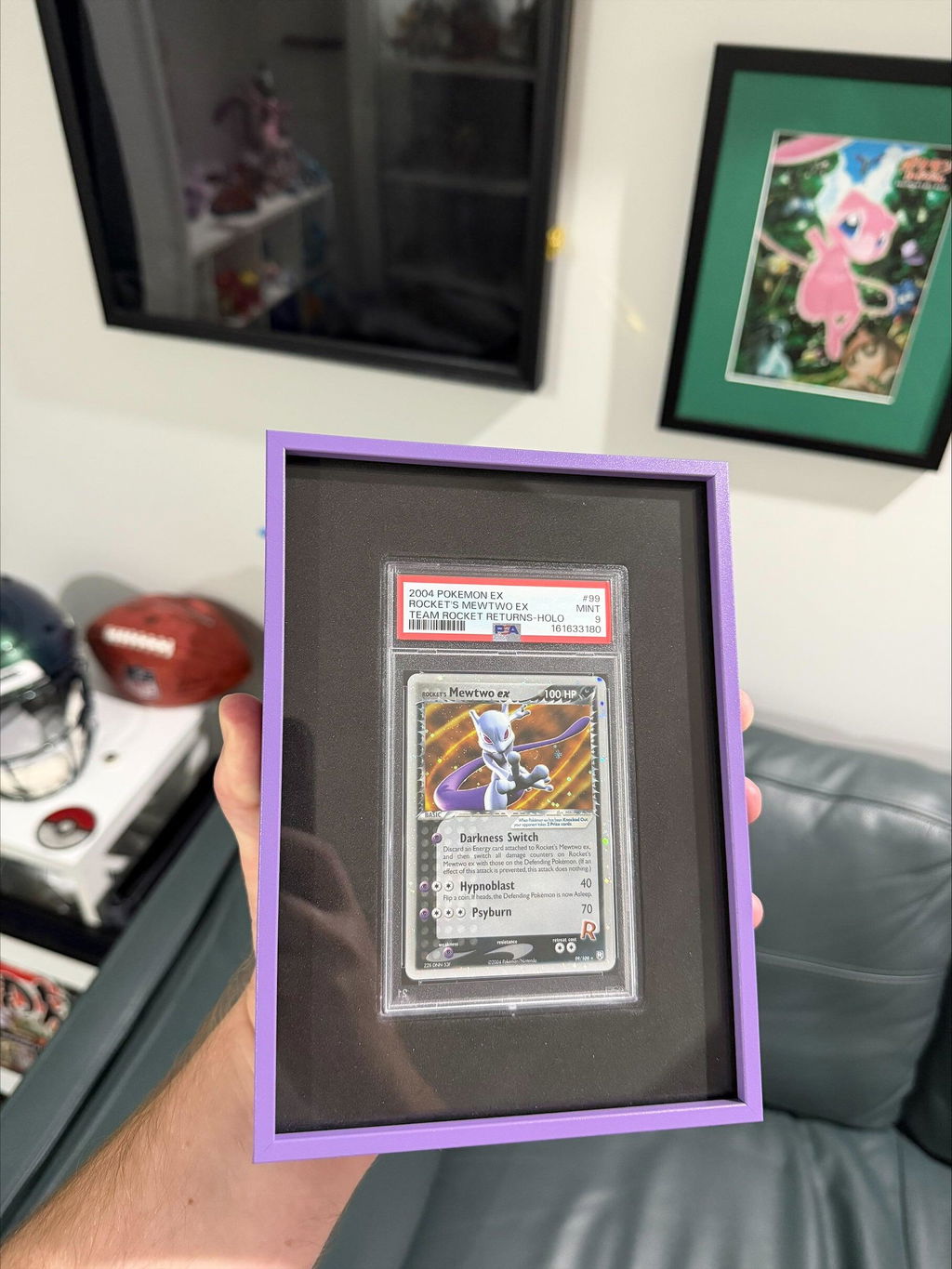
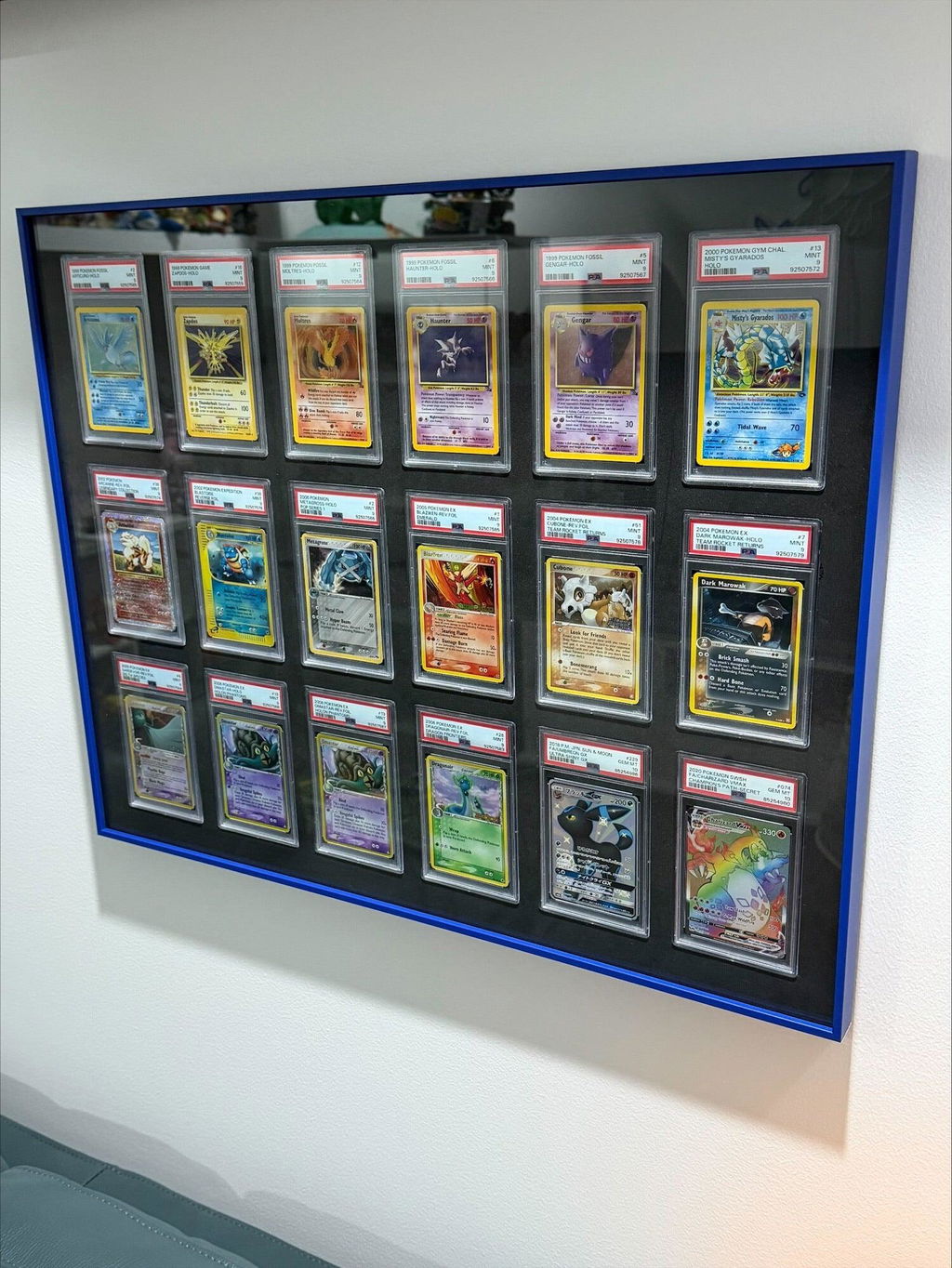
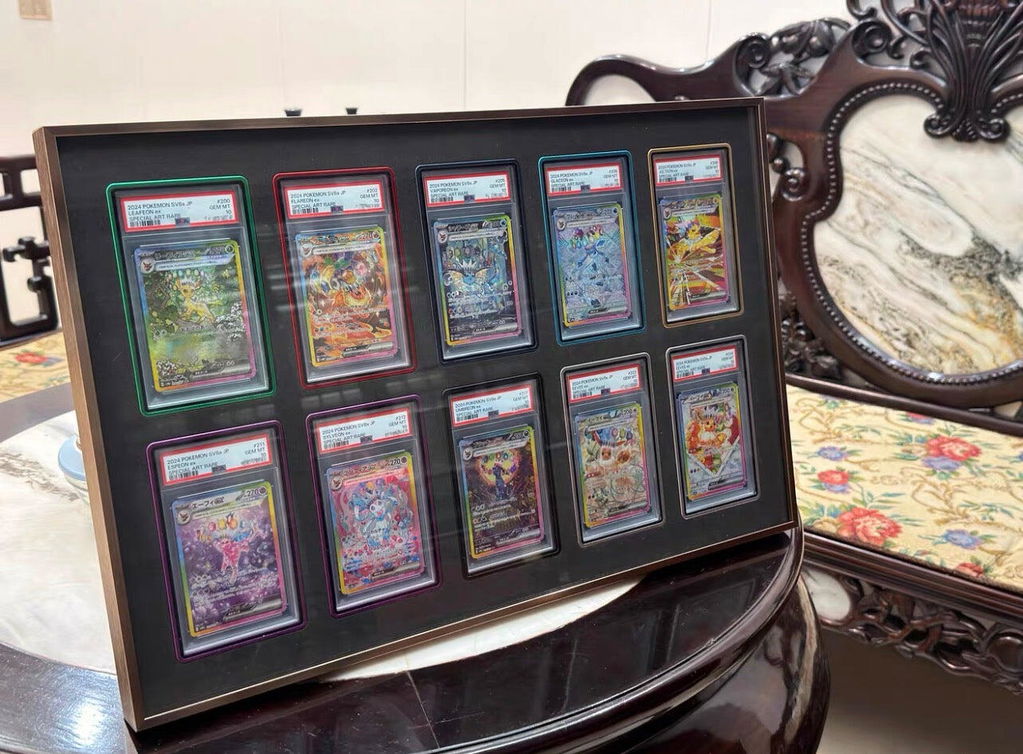
Consider the physical size at the wall. A 16-case composition occupies much more surface area than a 16-card graded slab display. Viewers need room to stand back and understand the arrangement. Leave sufficient border space around the frame so it does not appear squeezed between a door, monitor and adjacent shelving.
Displaying a complete video game franchise
Franchise displays often tell a stronger visual story than arbitrary collections of expensive games. A group of Halo titles can illustrate the evolution of Xbox artwork; a PlayStation run of God of War or Uncharted releases can show changes across generations; a Zelda or Pokémon selection can combine nostalgia with recognisable cover designs.
However, “complete” needs defining. Are you collecting every mainline release, every regional variant, remasters, spin-offs or only standard physical editions? A collector may choose a carefully limited group precisely because displaying every edition would create a very large and costly installation.
Nintendo, Pokémon, Zelda and Mario collecting examples
Nintendo collectors often mix cartridge-era packaging with modern cases. A Game Boy Pokémon box, a Nintendo 64 Zelda release and a Nintendo Switch title do not share the same external form factor. A display made for one era should not be assumed to fit the others.
For a practical themed wall, consider grouping like cases by console generation and placing older cardboard releases in separate, appropriately sized protective displays. Mario, Metroid, Fire Emblem, Kirby and Animal Crossing titles can all support distinctive collection themes without implying that every old Nintendo title is rare or expensive.
PlayStation, Final Fantasy, Silent Hill and God of War examples
PlayStation collectors can face three distinct packaging families in one series: original PlayStation jewel cases, PS2 DVD-style cases and later Blu-ray-style cases. Final Fantasy and Metal Gear Solid collections can also include multi-disc editions, regional artwork differences and reissues.
Silent Hill collectors may pay particular attention to original print and region details, while God of War, Gran Turismo, Ratchet & Clank and The Last of Us can be collected around particular hardware generations. Displaying these games is largely a question of defining the collection and choosing the correct case format, not simply placing every title in identical openings.
Xbox, Halo, Gears of War, Fable and Forza examples
Xbox franchises can be arranged chronologically across Original Xbox, Xbox 360, Xbox One and Xbox Series X-era packaging. Halo and Gears of War are obvious themes for collectors who value the connection between a series and Xbox hardware history. Fable, Forza, Project Gotham Racing and other series offer different visual approaches.
One complication is that later Xbox physical packaging has changed over time, and some special editions use steelbooks or outer sleeves. Before ordering a fitted display for a cross-generation set, make an inventory of the exact cases and measure the real objects rather than assuming the franchise has uniform packaging.
Nintendo Switch 2 game-key cards and future collectibility
Physical packaging can contain a standard game card, a download code or, for some Nintendo Switch 2 releases, a game-key card. Nintendo explains that a game-key card acts as a key that triggers a download rather than storing the full game data itself. That distinction may matter to collectors who value the completeness and future accessibility of physical media.
A game-key card can still be displayed as part of a retail collection, but its relationship to an independently playable physical release is different. For documentation and valuation, record the actual format rather than assuming that every boxed Switch 2 game includes the complete software on the cartridge. See Nintendo’s explanation.
Insurance and security for valuable game collections
If a video game collection has meaningful financial value, check whether household insurance covers it, whether limits apply to collectibles and what evidence an insurer requires. Do not assume a standard home policy automatically covers every rare sealed game at a recent auction estimate. Policies, exclusions and valuation methods vary widely.
Keep purchase records, clear photographs, serial or grading identifiers where relevant and an up-to-date inventory. Avoid publicly advertising the precise location or value of especially valuable items. Lockable cabinets, suitable wall fixings and household security measures address different risks from UV-filtering glazing.
Wall mounting and accidental damage
A visually striking game display can also be heavy, particularly when large acrylic sheets, thick frames or multiple graded cases are involved. Choose wall anchors appropriate for the substrate and verified load. Plasterboard, masonry and timber studs require different fixing methods. Do not assume ordinary picture hooks suit every large display.
Plan the installation height so that people do not accidentally bump the frame and the collection can be examined without climbing or leaning over furniture. If the frame will be opened periodically, ensure there is enough clearance to do so safely. For oversized displays, professional mounting may be appropriate.
Creating a display inventory and rotation schedule
A simple inventory makes it easier to manage a collection that changes. List each displayed title, physical format, protective enclosure, purchase date and photographs. Record where it is mounted and any observable condition issues. Compare photographs taken under similar lighting when checking for fading or surface change.
Rotation is useful when collectors want variety without permanent display of everything. For example, a Nintendo shelf might feature a Zelda group for several months, then be replaced by a Mario or Pokémon selection. A rotation strategy does not establish a guaranteed safe exposure interval, but it can reduce unnecessary cumulative light compared with continuous bright display.
How to photograph sealed games accurately
Photographs are valuable for insurance, valuation, selling and documenting condition. Use diffuse light, a neutral background and multiple views. Photograph the spine, back, corners, seal seams, original stickers and any noticeable defects. Avoid heavy filters that alter colour or obscure scratches.
For a collection record, save the original full-resolution images rather than only a small social-media crop. Include a reference ruler or scale when packaging dimensions matter. Do not expose a vulnerable game to direct sunlight simply to make a dramatic photograph; soft indoor lighting generally gives a more useful condition record.
Should a rare game be displayed at all?
There is no universal answer. A collector who buys physical games for enjoyment may understandably want to see them. Another who owns a historically important sealed release may prioritise long-term condition and choose stable dark storage. A practical middle option is displaying a smaller selection or a high-quality facsimile of particularly fragile packaging.
The question is not whether display is irresponsible. It is whether the chosen method reflects the item’s actual vulnerabilities and the owner’s aims. Being informed about light, materials and handling allows collectors to make a deliberate trade-off rather than relying on a product label that promises perfect protection.
Preservation priorities by game packaging format
Different physical formats have different weak points. A display plan should be chosen around those weak points rather than assuming that every video game is a rigid plastic rectangle. The following table is a practical comparison, not a replacement for condition-specific advice from a conservation specialist.
| Game format | Particularly vulnerable areas | Practical display priority |
|---|---|---|
| Modern PS5, PS4 and Xbox plastic cases | Printed cover insert, hinges, clear outer sleeve and disc hub | Support the case evenly and manage light exposure |
| Nintendo Switch and Switch 2 retail cases | Printed covers, smaller plastic case surfaces, inner card holders | Use format-specific dimensions and avoid tight openings |
| PS1 jewel cases | Clear hinges, brittle clips, printed inlays and multi-disc trays | Reduce handling and avoid pressure on fragile case components |
| Cardboard NES, SNES, N64 or Game Boy boxes | Flaps, corners, inked edges, seams and inner trays | Consider supportive protective cases and limited handling |
| Sealed collector editions | Factory wrap, box corners, stickers, special sleeves and seals | Preserve originality and prevent rubbing against enclosure surfaces |
| Professionally graded video games | Outer grading enclosure and label, plus the original contents | Support the entire graded holder without opening it |
Display options compared with preservation goals
There is no fixed price point at which a game requires specialist framing. An expensive collectible may be most appropriately kept out of light, while a modestly priced favourite may be displayed prominently. The following comparison separates viewing, access and risk management rather than declaring one product universally best.
| Collector goal | Possible approach | Why it can work | What still needs attention |
|---|---|---|---|
| Display a frequently played collection | Open shelving | Easy access and flexible arrangement | Dust, sunlight and accidental handling |
| Show one meaningful title | Small stand or wall display | Focused presentation | Stability and case support |
| Present a curated franchise group | Multiple stands, ledges or an aluminium grid frame | Consistent spacing and visual organisation | Cost, format fit and mounting |
| Protect fragile original cardboard | Suitable protective shell in stable storage or display | Less handling of vulnerable edges | Material quality, internal clearance and light |
| Conserve an exceptionally important sealed original | Dark stable storage plus a display reproduction | Greatly reduces routine light and handling exposure to the original | Secure storage, documentation and environmental monitoring |
Three realistic collectible game display scenarios
The appropriate display varies substantially between owners, even when their collections look similar in photographs. The examples below show how condition, accessibility and surroundings influence the choice. They are illustrative rather than valuations or guarantees of preservation.
A personally important PS3 game with modest resale value
A collector wants to display the copy of a game they played throughout childhood. Its market value may be low, but the sentimental importance is high. A simple stand or small wall display on an interior wall can meet the goal without requiring specialist conservation framing. If the owner still plays it, ease of removal may be more important than permanent encapsulation.
Four original Xbox games from a favourite series
A collector has a tidy group of Original Xbox or Xbox 360 cases and wants a coherent gaming-room feature. Shelves, narrow picture ledges or a purpose-built four-opening aluminium frame can all achieve the visual objective. The decision comes down to available wall space, preferred presentation, budget and whether the cases will frequently be removed. Any fitted design should be measured around the actual external packaging.
A rare sealed Nintendo cardboard box
A sealed or unusually well-preserved cardboard release may be substantially more vulnerable to corner damage, sunlight and handling than a standard modern plastic game case. A protective enclosure and stable, low-light environment become especially important. For a particularly high-value original, the owner might display a replica and keep the authentic sealed box in secure storage instead.
A graded PlayStation game in a rigid enclosure
A professionally graded PlayStation title already has an outer protective shell, but that does not make it immune to sunlight or environmental changes. The correct display supports the graded enclosure at its exterior dimensions, reduces the risk of tipping and does not require breaking the grading seal. Verify any front glazing performance independently rather than assuming the grading shell provides complete UV protection.
Common mistakes when displaying rare or sealed video games
Many display problems arise from assumptions rather than expensive equipment failures. A collector may correctly buy a UV-rated front panel but then hang it in direct sunlight. Another may buy a perfectly sized shelf but pack fragile cardboard boxes so tightly that they crease during removal. A third may overpay for a display case labelled archival without checking what the material is.
- Displaying directly opposite strong sunlight. Even specialist UV glazing does not eliminate visible light and heat exposure.
- Assuming all sealed games are valuable. Market demand and exact condition remain critical.
- Using asking prices as valuations. Use comparable completed sales wherever possible.
- Forcing an edition into a fitted opening. Protective sleeves, steelbooks and regional variants can change dimensions.
- Using adhesives or pins on original cardboard. Reversible non-destructive support is preferable.
- Buying a protector based only on its label. Confirm actual material, fit and claimed test data.
- Ignoring wall and cabinet stability. A display that falls can damage even otherwise well-protected games.
- Confusing graded value with guaranteed future value. A grade is not a market-price promise.
- Overlooking the importance of documentation. Originality and provenance matter when assessing rare releases.
A pre-display checklist for valuable physical games
Before you place a valuable sealed video game or complete-in-box release into a frame, stand, cabinet or protector, run through a short inspection. Document anything that is uncertain. These checks help separate the condition of the object from the qualities of the display equipment.
- Identify the exact title, platform, region, release and whether it is loose, CIB, sealed or graded.
- Photograph the front, back, corners, spine, seal and existing defects.
- Check whether packaging and labels appear original; do not remove stickers to investigate.
- Measure overall external dimensions, including protectors or graded holders.
- Choose a wall or shelf away from direct sunlight, concentrated heat and persistent moisture.
- Check the stability and contact points of the chosen stand, cabinet or frame.
- Confirm any UV, anti-reflective or archival claims using product-specific information.
- Plan how the item will be removed without scraping or compressing packaging.
- Keep purchase and valuation records, and review insurance if appropriate.
- Monitor the collection over time and adjust display conditions if problems appear.
Frequently asked questions about displaying rare and sealed video games
How do you display sealed video games without damaging them?
Avoid direct sunlight, heat, moisture, adhesives and tight-fitting supports. Use a correctly sized shelf, stand or protective enclosure that contacts the exterior packaging gently, and keep handling to a minimum. For particularly fragile or irreplaceable originals, dark stable storage may be preferable.
Are sealed video games worth more than opened games?
Sometimes, but not always. Demand, edition, scarcity, original seal authenticity, packaging condition and comparable sales influence value. A sealed common title may still be inexpensive, while a complete opened copy of a sought-after release can be valuable.
What does complete-in-box mean for video games?
CIB normally means the original game and appropriate original packaging and documentation are present. Which paperwork is expected depends on the exact release. Some modern games never included a paper manual.
Is factory sealed the same as brand new?
Collectors often use both terms, but a listing described as new may not establish that its wrapping is an original manufacturer seal. Assess the exact edition and packaging evidence before paying a sealed premium.
What is the difference between sealed and graded games?
A sealed game retains an apparently original unopened retail package. A graded game has undergone a third-party assessment and is usually encapsulated. A sealed game is not necessarily graded, and grading does not guarantee a particular market value.
Where can I find video game values?
Start with recent comparable sold transactions and tools such as PriceCharting and eBay Product Research. Match the platform, region, edition and condition. Record a date and a reasonable range instead of treating one listing as a universal price.
Does grading make a video game more valuable?
A desirable grade can influence buyer interest, but the outcome depends on the exact item and market. The cost of grading, shipping and insurance can also exceed any additional resale value.
Should I open a sealed game to inspect it?
Opening generally removes the sealed status and may change collector value. If authenticity is uncertain, obtain expert assessment where possible rather than automatically opening the package. The appropriate choice depends on whether you value playability, documentation or preservation.
Does UV-resistant acrylic completely prevent fading?
No. UV filtration can reduce an important source of damage, but visible light, heat and cumulative exposure still matter. Keep valuable printed packaging away from direct sun even behind specialist glazing.
Can glass display cabinets protect sealed games?
Cabinets can reduce some dust and handling, but ordinary glass does not automatically provide specialist UV filtration, temperature control or humidity control. Check the material and position the cabinet sensibly.
Can LED lights fade video game cover art?
Visible light can contribute to cumulative fading even when a lamp emits little UV. Use reasonable brightness, avoid unnecessary continuous illumination and watch for heat buildup.
Are cardboard retro game boxes more fragile than modern plastic cases?
Often, yes. Thin cardboard corners, flaps, printed surfaces and inserts can be more vulnerable to crushing and abrasion than a modern rigid game case. Use supporting enclosures and avoid pressure on weak edges.
Can a protective sleeve lower a game’s value?
A suitable removable sleeve usually aims to reduce wear, but overly tight or abrasive protectors can scratch, crush or distort packaging. An original seal damaged during fitting may affect condition and desirability.
Should I remove old store price stickers?
For valuable or sealed games, removing a sticker may damage the original surface or wrapping and can remove evidence of retail history. Many collectors prefer to preserve the original condition.
Can PS5, PS4, PS3 and PS2 game cases share one fitted display?
Not safely by assumption. Their external packaging formats and thicknesses can differ, particularly PS2 DVD-style cases and later Blu-ray-style designs. Measure each physical case and select a compatible display format.
Are Nintendo Switch and Nintendo Switch 2 cases interchangeable?
Do not assume so based solely on console branding. Check the actual case dimensions and any protective sleeve. Replacement shells and special editions can introduce additional variation.
Can I frame an original Xbox or Xbox 360 game?
Yes, provided the display is engineered for the actual case size and thickness, supports it without damage and is installed securely. Different Xbox generations and special editions may use different packaging.
Should I display a rare game in its graded holder?
If a game is graded, keeping the enclosure intact usually preserves the benefit of that certification and avoids handling the underlying item. A stand or frame must support the grading shell itself.
Are steelbooks suitable for wall displays?
They can be, but steelbooks should be measured and supported separately from ordinary plastic cases. Avoid fittings that scratch printed metal surfaces or bend the case. Outer sleeves can change required dimensions.
Is it safer to store a valuable game in the dark?
For highly light-sensitive printed packaging, stable dark storage reduces light exposure. The trade-off is that the original is not permanently visible. A facsimile or rotating display is one possible compromise.
How should I clean a sealed game case?
Avoid abrasive materials, solvents and aggressive rubbing. A collector should not clean an original seal or cardboard surface as though it were a replaceable plastic case. For high-value items, seek material-specific conservation advice.
How should I store video game manuals and inserts?
Keep them supported, clean and away from strong light and moisture. Avoid glue, adhesive tape and paper clips on original printed material. Preserve their relationship to the original edition in your collection records.
How can I prove what edition I own?
Record product codes, barcodes, region markings, cover artwork, rating symbols, special stickers, packaging details and receipts. Compare the exact details with reliable edition references.
How often should I rotate games on display?
There is no universal safe interval for every package. Rotating displays can reduce continuous exposure, but the best schedule depends on light intensity, material sensitivity and the owner’s preservation goals.
Do expensive game display frames always offer better protection?
No. A higher price may reflect materials, size, finish, workmanship or presentation rather than verified conservation performance. Compare fit, light filtration, stability and environmental conditions alongside appearance.
Can a game display increase a collectible’s market value?
An attractive display can improve the presentation of a collection but does not inherently change the game’s originality, grade or rarity. Market value should still be assessed from comparable sales.
Is a gaming room a safe place for rare sealed games?
It can be if the room has stable conditions, manageable light levels and secure displays. A gaming room with direct afternoon sun, excess heat or exposed shelves may be less suitable for delicate original packaging.
Should I insure a valuable video game collection?
Consider it if replacement value is significant, but check your specific policy and collectible limits. Maintain photos, receipts and dated valuation evidence. Coverage and claims requirements vary by insurer.
Further reading and original sources
The following resources provide information about valuation categories, observed sales, conservation of printed materials and the special packaging formats discussed above. They are useful starting points for checking claims about values, preservation and physical editions. These references do not certify any individual game or guarantee a display outcome.
- PriceCharting: Conditions and video game pricing FAQ
- PriceCharting: How video game prices are calculated
- eBay: Product Research and completed sales
- Library of Congress: Limiting light damage
- Library of Congress: Care and storage of works on paper
- Library of Congress: General preservation guidance
- Canadian Conservation Institute: Light, ultraviolet and infrared
- Nintendo: Switch 2 game-key card overview
Final thoughts: enjoy the collection without overlooking its condition
There is no single correct way to display collectible video games. An open shelf can be an excellent choice for a large playable library. A protective case can make a fragile cardboard game easier to view. A cabinet can provide a controlled arrangement for mixed formats, while a purpose-built aluminium frame can give selected titles a cohesive wall presentation. For particularly rare sealed games, dark stable storage may be the most conservative option.
The most useful habit is to treat the package as a collectible object, not merely as a container for software. Verify the exact edition, understand its real market rather than relying on asking prices, document the condition and choose a display that does not add avoidable pressure, light exposure or handling risk. The visual result is more satisfying when you know the original has been treated thoughtfully.
Continue Exploring
These connected guides cover the wider topic of physical video game collecting, including display ideas for specific console platforms, case dimensions and practical ways to organise a collection.
Collector Guides
-
How to Display Video Game Cases: Complete Guide
Compare budget storage, shelves, cabinets and purpose-built display frames for PlayStation, Xbox and Nintendo collections. -
How to Display Nintendo Switch Games
Discover layouts and display methods for Switch and Switch 2 collections, including Zelda, Mario and Pokémon. -
How to Display PlayStation Game Cases
Explore PS5, PS4, PS3, PS2 and original PlayStation packaging, series collecting and wall display ideas. -
How to Display Xbox Game Cases
Planning collections across Original Xbox, Xbox 360, Xbox One and Xbox Series X. -
Video Game Case Sizes and Dimensions Explained
Understand external measurements, format differences, thickness and display compatibility.
Explore Display Collections
-
GameVault™ Video Game Display Frames
Browse aluminium wall displays for selected PlayStation, Xbox and Nintendo case formats. -
Aluminium Trading Card Display Frames
Explore related display formats for graded and magnetic trading card collections.

0 comments