


Collectibles do not all arrive in the same shape. A PSA graded Pokémon card, a sports card in a One Touch magnetic holder and a boxed PlayStation game have different dimensions, different protective packaging and different reasons for being displayed. Yet collectors often face the same question: how can a collection be presented clearly without turning the room into a storage area?
There is no universal answer. Some collections look best on open shelves. Others benefit from individual stands, shallow cabinets, picture ledges or organised wall displays. A small group of carefully chosen favourites may need a completely different arrangement from a 50-card graded collection or a set of Nintendo Switch games organised by series.
This guide explores different collectibles you can display in aluminium frames, with particular attention to PSA, CGC and BGS graded cards, One Touch magnetic trading card holders and PlayStation, Xbox and Nintendo physical game cases. It explains how their dimensions and display requirements differ, how to choose a layout, when budget methods work well and when a purpose-fitted aluminium wall frame becomes worth considering. The aim is practical guidance rather than treating one display method as the answer to every collection.
Why the type of collectible matters more than the frame style
It is easy to start with a picture of a finished display and work backwards. A more reliable approach begins with the actual objects. A graded card is already inside a rigid plastic holder. A magnetic sports card holder can vary in thickness depending on the card. A standard video game case is considerably wider than a graded trading card slab and may be much thicker. Different formats place different demands on support, spacing, depth and glazing.
A display that looks balanced with nine PSA slabs may not use the same measurements or construction as a nine-game PlayStation display. Likewise, a layout made for one kind of magnetic holder should not be assumed to fit every other holder simply because both are sold for trading cards.
For collectors, the first decision is therefore what format is being displayed. Only then does it make sense to compare overall size, number of openings, background colour or aluminium finish.
The three main collectible formats in the SLABBED display range
| Collectible format | Examples | Main display consideration | Typical presentation |
|---|---|---|---|
| Graded trading card slabs | PSA, CGC, BGS graded Pokémon, sports cards and other TCGs | Holder dimensions, label clearance and consistent spacing | Individual showcases or multi-slab grids |
| Magnetic card holders | One Touch holders for ungraded Pokémon, sports cards, MTG and other cards | Holder model, outer dimensions and thickness | Single-card features or themed card arrangements |
| Physical video game cases | Selected PlayStation, Xbox and Nintendo Switch cases | External case width, height, thickness and edition | Franchise collections and multi-game wall displays |
These formats can share an overall aesthetic, such as slim aluminium edges and orderly grid spacing, without using interchangeable internal openings. That distinction is essential when buying a fitted display.
Graded trading card frames: PSA, CGC and BGS collections
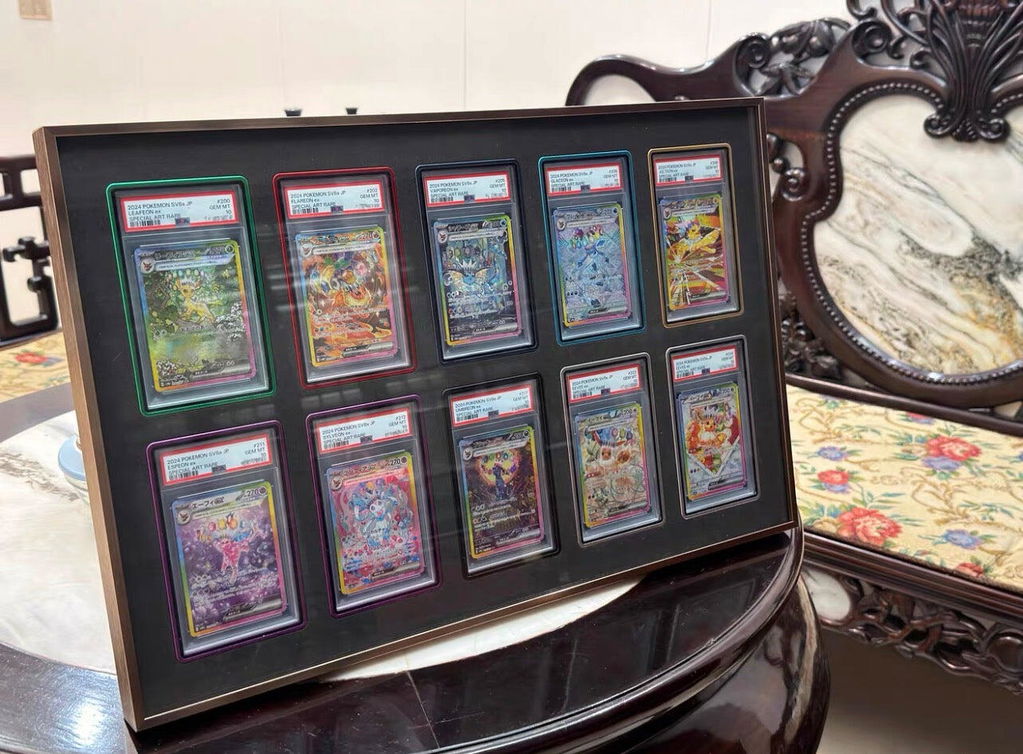
Grading places a trading card inside a sealed, labelled holder that is intended to preserve its identified condition and make handling more consistent. These slabs are popular for Pokémon, sports cards, Magic: The Gathering, Yu-Gi-Oh!, One Piece and many other collecting categories. The slab gives the card a defined outer boundary, which makes it particularly suitable for regular display grids.
Unlike a loose card, a slab has its own visible label. That label is part of how the object is read: collectors may want to see the grade, certification information, card title and set information alongside the artwork. A frame must therefore accommodate the complete holder rather than covering the label as though it were a conventional photograph.
PSA, CGC and BGS slabs should not be treated as identically sized. Different grading services use different cases, and case versions can evolve. For a purpose-cut opening, the correct holder format matters more than the apparent size of the card inside it.
How PSA graded card displays can be organised
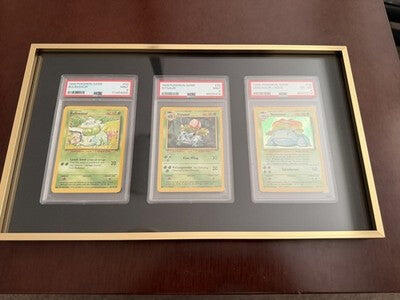
PSA slab displays work well when the collecting theme is already defined. Examples include the original three Pokémon starters, a favourite evolution line, a complete subset of sports rookie cards or a progression from one era of a trading card game to another.
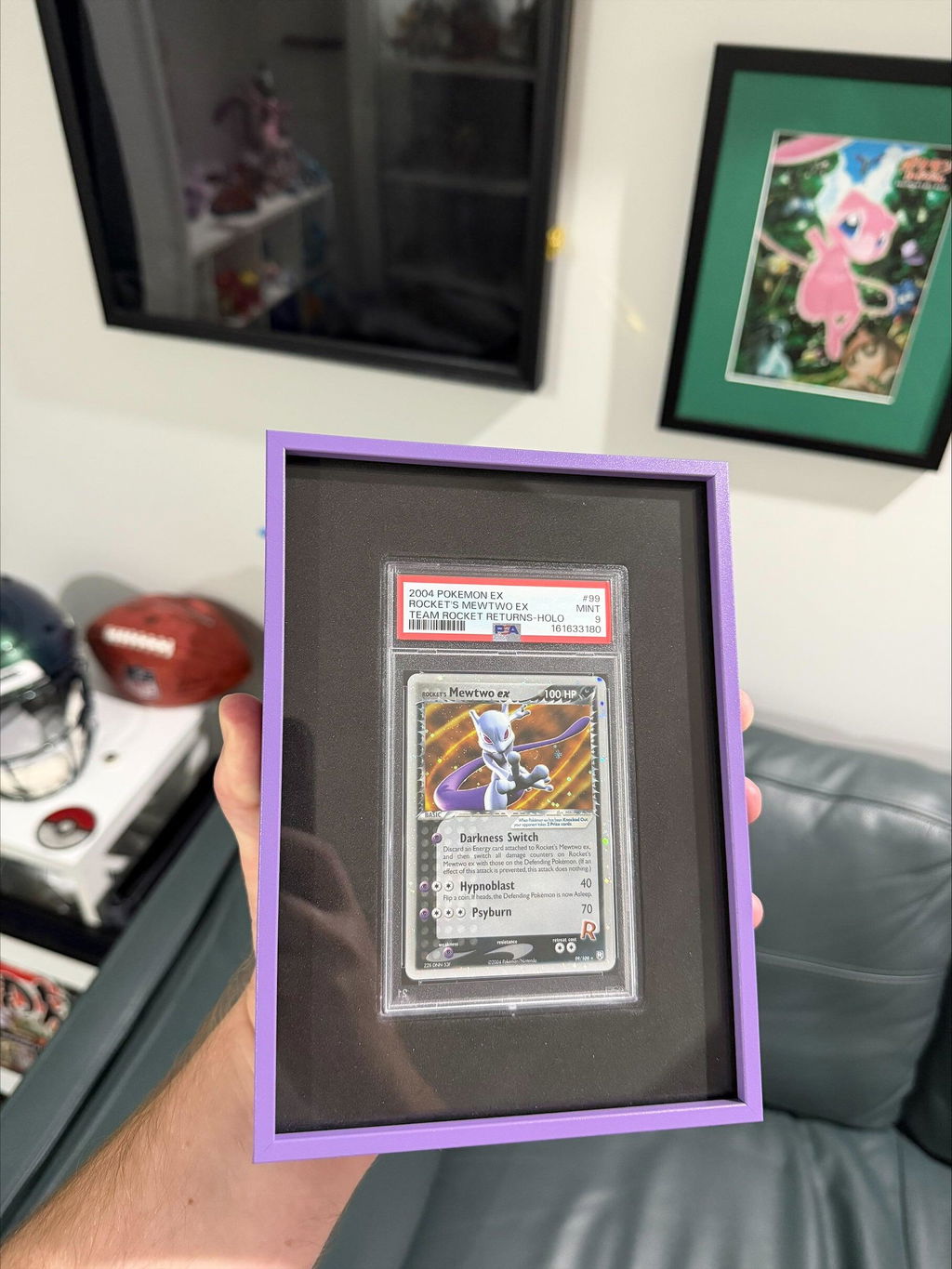
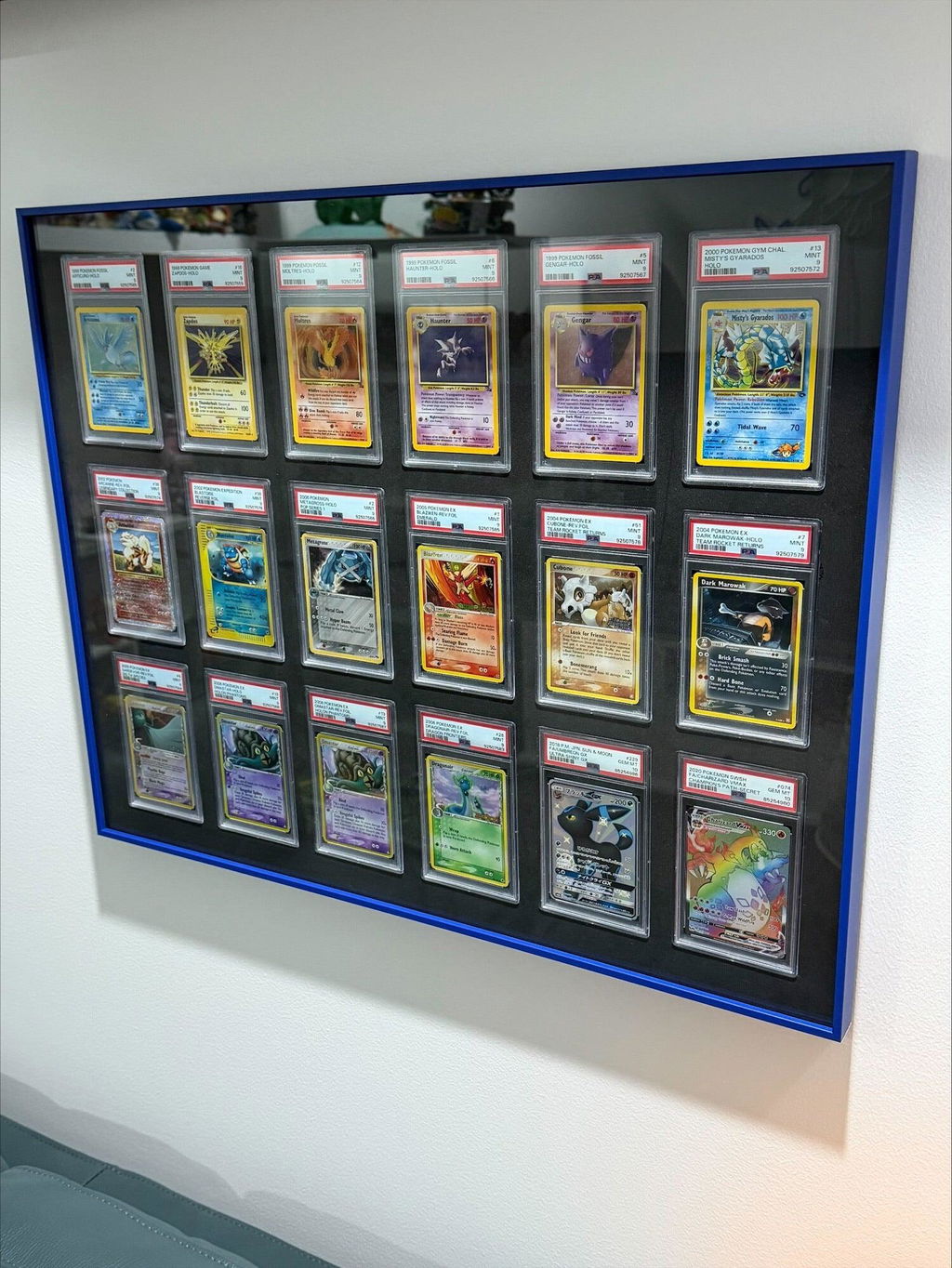
A single PSA card frame gives an especially important card room to stand alone. Three- and four-slab layouts can show a small sequence. Nine- or twelve-slab arrangements work for selected sets, while much larger grids allow a wall to function as a structured collection rather than a row of unrelated objects.
Before choosing a grid, arrange the slabs on a table or in a digital mock-up. Consider the artwork, label colours and the logical order of the cards. Numerical order is useful for a complete set, but colour, character evolution, chronology or personal significance may make the display easier to understand.
What makes CGC and BGS displays different?
Collectors often like the consistent visual appearance of a single grading company's holders. A set of CGC-graded cards can have a unified look, while a BGS collection may be built around specific subgrades, labels or favourite high-grade examples.
Mixing grading companies is also possible in a collection, but it introduces two separate concerns. First, the outer holder dimensions may differ. Second, the label areas can create a less uniform visual rhythm even when the card artwork is similar.
That does not make mixed graded collections unsuitable for display. It simply means the frame openings should be designed for the actual holders, or the collector should choose separate fitted sections. A precise foam cutout is a compatibility feature, not a universal opening that automatically accepts every slab shape.
Displaying Pokémon graded cards without making the wall too busy
Pokémon collections can become visually crowded very quickly. Holographic effects, full-art backgrounds, Japanese and English printing, colourful label designs and varied card borders all appear together. A neutral background can help the individual cards remain distinct.
A black background often creates a contained, high-contrast look for bright artwork. White can make darker slabs and colourful cards feel more separated. The aluminium finish matters too, but it is usually the background around every holder that changes the impression of the entire grid most.
Collectors do not need to frame complete sets. Three meaningful cards can make a stronger composition than an arbitrary group of sixteen. On the other hand, a large graded set displayed in logical order may be exactly what makes a collector's room feel complete. The best size comes from the collection's story, not simply from how much wall space is available.
Sports card display frames: teams, players, seasons and milestones
Sports card collectors often organise their cards around a player, a club, a championship season or a particular rookie class. Graded slabs can give such displays consistency, especially when the cards have been collected over many years.
A three-card layout might show a player's rookie card, an important parallel and a later career milestone. A larger display could organise cards chronologically or feature an entire starting lineup. These are different design problems from filling every possible opening with the highest-priced card.
Signed cards, patch cards and thick memorabilia cards also introduce material differences. Autographs and fabric fragments may need more careful environmental management than ordinary printed cards. A protective holder helps reduce handling, but it should not be confused with an assurance that the contents are immune to sunlight, heat or humidity.
One Touch magnetic holders: displaying cards without grading them
Not every valuable or meaningful card is professionally graded. Many collectors prefer to keep cards in One Touch magnetic holders because they like the uncluttered appearance, want easier access or do not see grading as necessary for their collection.
Magnetic holders are particularly common for modern sports cards, Pokémon favourites, Magic: The Gathering cards and other collectibles where the owner wants a rigid case without a grading label. Their appeal is partly visual: the card remains the focal point.
A One Touch display frame can extend that effect across several cards. Without a grading label, the artwork may feel more prominent, but the arrangement still needs a consistent external holder size. Before ordering a fitted layout, verify the exact holder product and its dimensions rather than assuming every magnetic holder will fit.
Why One Touch thickness and model matter
Magnetic holders are available for different card thicknesses. A thin standard trading card and a thick patch or memorabilia card may require different One Touch models. The measurement used to describe the card accommodation is not necessarily the same as the outer dimensions of the holder.
That means a 35-point holder, a thicker memorabilia holder and a magnetic case from another manufacturer should not automatically be treated as interchangeable. Outer thickness can influence how the holder sits behind the frame's front glazing, while width and height determine the precision-cut opening.
Good compatibility information should identify the actual holder format rather than use the phrase “fits One Touch” without further qualification. For mixed collections, separating holders by model may produce a cleaner and more predictable arrangement.
One Touch frames for Pokémon, MTG, Yu-Gi-Oh! and sports cards
Different card games lend themselves to different layouts. Three Pokémon cards might illustrate an evolution line. A Magic: The Gathering display might group cards by colour identity, artwork or a favourite commander. Yu-Gi-Oh! collectors may prefer a character-themed arrangement, while sports card collectors may display a set of matching parallels.
What matters is not the number of cards alone but how the objects relate to one another. An orderly frame can make a small selection feel intentional. A larger multi-card display is useful when the collection has a repeatable theme, such as a full colour cycle or a complete series of related releases.
For a more detailed comparison of holder types and wall layouts, see the One Touch trading card wall display guide.
Video game case frames: another way to display physical collections
Physical video games are usually stored with their spines facing outward. That is practical, because games are easy to identify and retrieve. It also means that most of the cover artwork remains hidden. For collectors who value the artwork, an open shelf is not always the presentation they have in mind.
A video game case wall display treats the case as a collectible object rather than just a container for a disc or cartridge. A single game might represent a childhood favourite. Four games might belong to one franchise. A twelve- or sixteen-game arrangement can show a carefully curated selection from a console generation.
This is a different purpose from storing an entire game library. If fast access and compact storage matter most, a conventional bookshelf is often more efficient. A fitted wall display becomes more relevant when the cases are being chosen for presentation.
PlayStation display ideas across PS5, PS4, PS3 and PS2
PlayStation collecting spans multiple physical packaging eras. PS2 games commonly use DVD-style cases, while later PlayStation generations use packaging derived from Blu-ray-case formats. Original PlayStation games often use jewel-case styles, with regional and edition variations.
Those differences matter for collectors deciding between a shelf and a precision-fitted display. Two cases that look similar from the front may have different thicknesses, while a limited edition can be larger or differently shaped than a standard retail copy.
Franchise-based displays are a particularly natural fit. A God of War collection, a selection of Gran Turismo releases or a series of Uncharted titles can be arranged chronologically. A mixed-era PlayStation display may require separate opening dimensions rather than one universal case size.
The PlayStation game case display guide explores these generations in more detail.
Xbox display ideas: Original Xbox, Xbox 360, Xbox One and Series X
Xbox game collections also span several case styles. Original Xbox and Xbox 360 packaging often resembles DVD-era cases, while Xbox One and Xbox Series X retail packaging includes later variations. SteelBooks, special editions and some region-specific releases can depart from the standard format.
A series-focused display might feature Halo games, Gears of War releases, Forza titles or a personally selected group of Xbox 360 favourites. The strongest arrangement is not always a complete run. Sometimes one title from each console generation communicates the history of a series more clearly than a wall full of similar artwork.
Xbox green cases create a strong repeated colour in many collections. Neutral aluminium finishes and a black or white background can help keep the artwork readable without creating another competing border colour.
For layout and case-generation considerations, see the Xbox game case display guide.
Nintendo Switch and Switch 2: small cases with distinctive artwork
Nintendo Switch packaging differs noticeably from full-size PlayStation and Xbox cases. The standard Switch game case is smaller and narrower, making it easier to arrange several covers within a relatively compact wall area. Switch 2 packaging should be checked separately rather than assumed to fit every existing Switch cutout.
Nintendo collectors also tend to have strong franchise themes. A display might follow The Legend of Zelda across releases, feature a selection of Mario titles, group Pokémon games or showcase Metroid titles. Case spines create one look on a shelf, while face-out covers create a completely different one.
For people who already organise Nintendo games by series, framing a carefully selected group can complement rather than replace the main shelf. The full library stays accessible, while favourite titles become part of the room's décor.
See How to Display Nintendo Switch Games for more on case layouts and collecting themes.
Are SteelBooks, boxed editions and graded games suitable for the same frame?
Not automatically. A standard retail plastic game case, a metal SteelBook, a cardboard collector's edition and a professionally graded sealed game are distinct physical objects. Even when two formats contain the same game, their external dimensions and surface requirements may differ.
SteelBooks can vary by edition and may need particular care around metal edges and surface finishes. Boxed retro games often have vulnerable cardboard corners and panels. Professionally graded games have their own large outer holders, which are not the same size as the original retail cases.
For a fitted frame, measure the actual item and confirm that the listing explicitly supports its format. A standard GameVault video game case configuration should not be assumed to accommodate an oversized collector's box, a graded game or an unlisted SteelBook format.
Comparing shelves, stands, cabinets and aluminium frames
There is a good reason inexpensive display methods remain popular. Most collectors need somewhere practical to keep an entire collection, not just a few important items. Open shelves are usually the easiest and cheapest way to do that, while stands and picture ledges can highlight selected favourites.
| Display method | Best suited to | Main advantage | Main limitation |
|---|---|---|---|
| Bookcase or media shelf | Large mixed collections and frequently used games | Affordable and easy to reorganise | Most cover artwork faces sideways |
| Small easels or acrylic stands | One or several favourite items | Flexible, inexpensive and easy to move | Can look inconsistent across larger groups |
| Floating ledges | Rotating front-facing displays | Easy to change the displayed selection | Requires wall space and secure placement |
| Display cabinet | Mixed valuable collections | Organised viewing with some physical separation | Cabinet depth and overall footprint can be substantial |
| Purpose-fitted aluminium wall frame | Selected cases or holders in a fixed composition | Consistent spacing, finish and coordinated background | Higher cost and format-specific sizing |
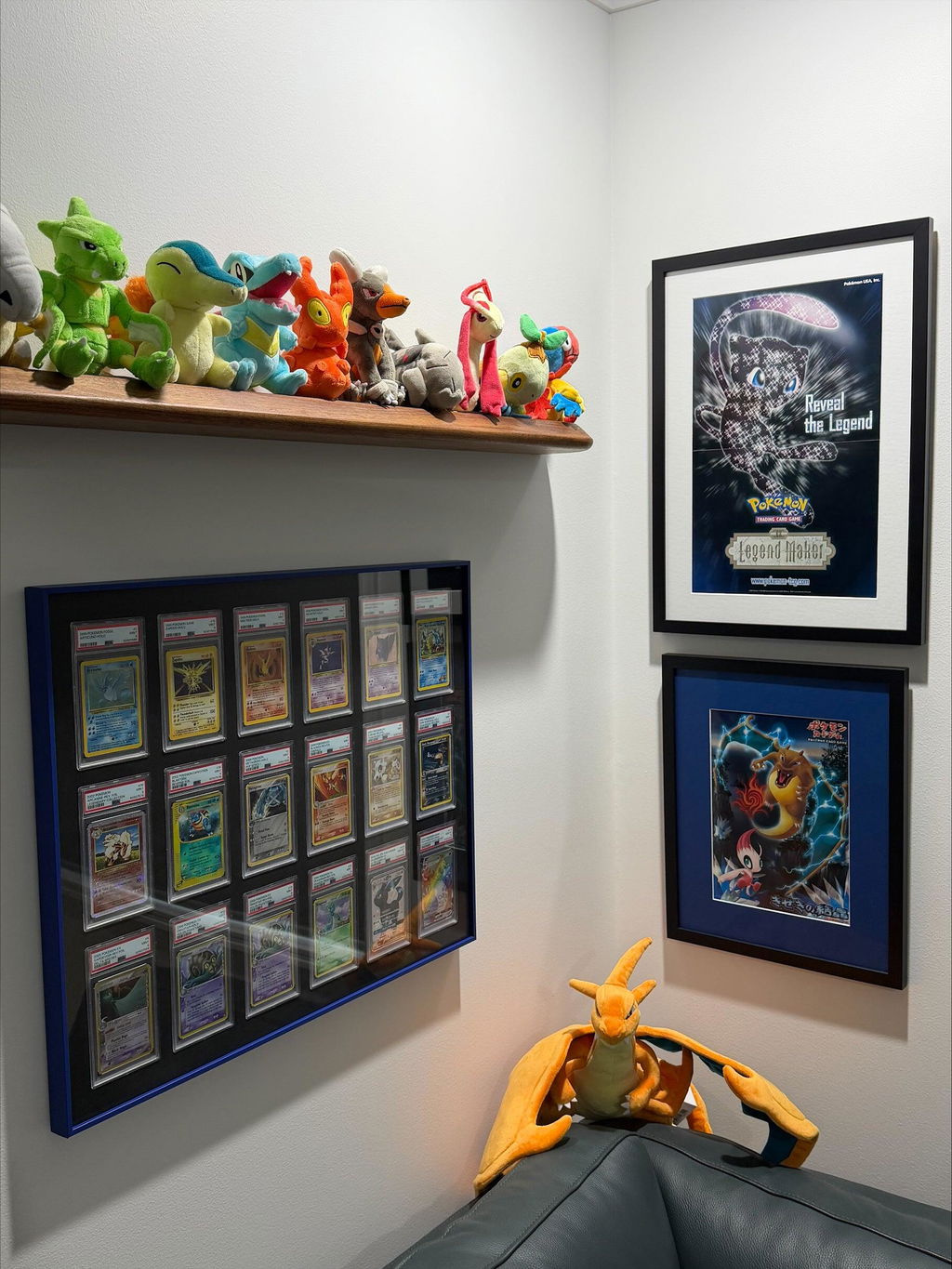
The most appropriate solution depends on access, budget, wall space and the purpose of the collection. An attractive collector room can combine several methods: practical shelving for the full library, a cabinet for delicate boxes and a wall display for especially significant pieces.
When a single-item display makes sense
One collectible can carry more significance than an entire set. A graded sports rookie card, a favourite childhood Pokémon card or the first PlayStation game someone bought may deserve a dedicated location. A single-item frame can work because it gives the object space instead of asking it to compete visually with neighbouring pieces.
However, a frame is not essential to make a single item meaningful. An inexpensive stand can be just as effective on a well-chosen shelf. A dedicated frame becomes more attractive when wall placement, visual consistency or a particular aluminium-and-background combination is part of the desired result.
Small grids: two, three, four and six collectibles
Small groups work best when the viewer can understand the relationship almost immediately. Three Pokémon evolutions, four related football cards or four games from a favourite franchise are examples of naturally coherent displays.
In these layouts, the visual spacing matters. Too much empty space can make the group feel disconnected; too little can make the items difficult to distinguish. The objects should align cleanly without creating the impression that they are forced into the frame.
For game cases in particular, a four-game frame can be significantly larger than a four-slab frame. A collector should compare the overall external dimensions of the finished display rather than rely on grid count alone.
Medium grids: eight, nine, ten, twelve and sixteen items
Medium-size grids can begin to function as a visual catalogue of a collection. They are useful for favourite games from one console generation, a curated set of graded cards or a thematic group of One Touch holders. The selected items do not have to be the most valuable; they just need a reason to appear together.
A nine-card arrangement can be balanced around a central favourite. Twelve items can support several rows of related pieces. Sixteen game cases can create a substantial feature on a wall, especially where the cases are physically large.
The balance between a grid's width and height is often as important as its capacity. A 4-by-3 arrangement may suit a wide wall better than a tall narrow layout. Always consider the furniture, power points, windows and walking space around the intended location.
Large graded card walls: why the format scales differently from game cases
Some collectors want to display entire graded sets across dozens of PSA, CGC or BGS holders. A large wall frame can give the collection a consistent order, and the individual slabs remain smaller than full video game cases.
The difference becomes significant at higher grid counts. A large trading card display may be practical in a space where the same number of game cases would produce a very wide or tall installation. Glass or acrylic sheet spans, total weight, transport dimensions and mounting requirements all change with size.
SLABBED's graded-card range includes large multi-slab configurations. Its standard video game range is more selective in size, with larger requirements better assessed individually. A layout that is practical for one type of collectible is not automatically sensible for another.
Mixed displays: should different collectible types share one frame?
It is tempting to imagine a single display containing a graded Pokémon card, a One Touch sports card and a game case. The theme could be excellent, but the engineering is more complicated than arranging three objects with equal dimensions.
Each format has a different depth, external shape and preferred support. A mixed-format display would need a design that accommodates those differences without pressing delicate materials against the glazing or leaving items inadequately supported.
For most collectors, separate frames with a matching finish and background offer a simpler way to create a coordinated wall. A matching black aluminium finish, for example, can visually connect a SlabVault graded card display and a GameVault video game display without pretending the internal fittings are interchangeable.
Choosing the right opening size and internal spacing
Fitted displays are different from ordinary picture frames because the openings are planned around the actual outside dimensions of a holder or case. That can create a particularly orderly arrangement, but it also makes compatibility more specific.
Check the external height, width and thickness of the object. Consider protruding labels, hinges, closures and any protective sleeve surrounding the item. A nominally similar case from a different manufacturer may be slightly different.
For valuable items, test the fit without forcing the case into place. A display should hold the item in its intended position without relying on pressure that could deform packaging or damage corners. For unusual formats, custom measurements may be more appropriate than selecting the nearest standard opening.
Black and white EVA foam: background as part of the design
In a precision-fitted aluminium display, the foam around the object does more than fill unused space. It creates the visible background, establishes consistent gaps and helps define the boundaries around the holder or case.
SLABBED offers black and white EVA foam options for compatible displays. Black can give colourful Pokémon cards or Nintendo covers a strong perceived contrast. White can provide more visible separation around dark holders and suit lighter interiors.
Neither colour is universally better. A predominantly dark collection on black can look restrained, while the same arrangement on white may emphasise the individual shapes. The choice is largely one of presentation and the surrounding room.
Why coordinated acrylic backing changes the finished look
The appearance of the rear surface is often overlooked. When the backing colour does not align with the visible foam, small changes in viewing angle or light can make the layers feel visually disconnected.
In SLABBED's fitted aluminium range, the acrylic backboard colour is coordinated with the selected black or white EVA foam. This helps the background read as one visual system rather than several unrelated surfaces. The result is subtle, but these details become noticeable when the same design is repeated across an entire wall.
That is an aesthetic feature, not a claim that the frame is airtight or a complete conservation enclosure. Backing material, front glazing, environmental conditions and protective holders serve different purposes.
Aluminium frame finishes and their effect on different collections
Black, silver, titanium, gold, bronze and more expressive coloured finishes can all suit collector displays. The appropriate finish depends on the artwork and the room. A collection containing many different colours often benefits from a neutral outer edge. A tightly themed display can sometimes carry a stronger finish without looking excessive.
For graded sports cards, a subtle metallic frame may complement the slab labels. For One Touch cards, the frame can provide visual definition without introducing another grading label or decorative border. For video games, the variety of cover artwork often makes a consistent frame finish useful for unifying the whole arrangement.
The guide to choosing aluminium display frame colours explores these combinations in more detail, including black versus white foam and how to preview finishes in different lighting.
Clear acrylic, glass and the role of the front panel
The front glazing affects the way a collection is viewed. It can add a physical barrier between the displayed items and everyday handling, while its optical properties influence clarity and reflections. Glazing also adds weight, and large panels need adequate support.
Acrylic generally offers lower weight and greater impact resistance than ordinary glass, while conventional glass is harder and often more scratch-resistant. The actual UV-filtering performance depends on the specified grade, not simply whether the sheet is called acrylic or glass.
For a small display the weight difference may be modest. For a large multi-card or multi-game wall frame, glazing weight and physical rigidity can become more important. Anti-reflective options are useful where windows or room lights create persistent reflections, but they should be evaluated separately from UV-filtration claims.
What UV resistance does and does not protect
UV-filtering glazing can reduce ultraviolet radiation reaching the collection. It does not remove all the visible light or heat associated with bright sunlight, and it does not guarantee that printed artwork will never fade. This matters for Pokémon cards, signed sports cards, game cover artwork and original cardboard packaging alike.
A good starting point is to avoid regular direct sunlight and excessive heat. Then consider documented glazing performance, lighting intensity and exposure duration. A specialist glazing upgrade can offer additional features, but even a high-grade product does not make an unsuitable wall location risk-free.
For detailed technical explanations, see UV Protection for Video Game Cases and the Acrylic vs Glass for Video Game Displays guide.
Rare and sealed games: presentation versus preservation
Collectors sometimes associate a sealed game with a high valuation, but actual value depends on the specific title, edition, condition, authenticity, market demand and recent comparable sales. A sealed copy of a common game is not automatically valuable, and an unsealed game with rare original packaging can still attract serious interest.
For an expensive game, preservation may take precedence over permanent display. Original shrink-wrap, cardboard edges and printed cover art can be vulnerable to handling and light. A dark, stable storage environment may be the better choice for the most sensitive items, with a display reserved for less vulnerable or temporarily exhibited pieces.
Where a game is displayed, choose a method that supports the packaging without unnecessary contact, pressure or adhesives. See How to Display Rare, Sealed & Valuable Video Games for more detailed considerations.
How to organise a collection by series or character
A series-based arrangement is immediately understandable to other collectors. Pokémon can be grouped by a character or game generation. Zelda can be arranged across major releases. Halo or God of War can be organised chronologically or around a particular story arc. A sports collection can follow a player through different teams or seasons.
When choosing a theme, be clear about what belongs in the group. A complete franchise run might include releases from different physical formats, which means different case sizes. A more practical display might select a consistent subset, such as four games on the same console, while the rest of the franchise stays on a shelf.
Completion is not the only measure of a good display. A focused group of meaningful objects is often easier to read from across a room than a crowded display assembled only to fill every opening.
How to organise collectibles by release year, grade or visual colour
Chronological order works for game generations and trading card sets where the sequence is part of the appeal. Grade-based order makes sense for collections built around PSA, CGC or BGS results. A colour-based layout can be effective when the artwork is more important than release history.
These choices can create very different arrangements from the same group of collectibles. Before committing to a permanent multi-grid frame, photograph a few possibilities on a table. Comparing the full composition is often more useful than rearranging one card or game repeatedly.
How to plan a mixed collector wall without making it chaotic
A collector wall does not need every frame to be identical. It does benefit from a repeated principle. That might be a shared aluminium finish, matching foam backgrounds, consistent alignment along the top edge or equal gaps between frames.
For example, a wall could feature a nine-card graded Pokémon display, a smaller One Touch sports card frame and a four-game PlayStation display. The objects are very different, but consistent external finishes can create visual continuity.
Leave space around larger pieces. Consider the room's lighting and where people naturally stand to view the collection. A wall that looks balanced in a product close-up may be too dense or too high once installed above furniture.
What to check before buying any collectible display
- Object dimensions: measure the full protective holder or game case, including thickness and any protruding components.
- Compatibility: confirm the exact graded slab, magnetic holder or game case format supported by the display.
- Capacity: choose the number of openings based on the collection you actually want to show.
- Overall frame size: check the outside dimensions, especially for multi-game layouts.
- Materials: understand the frame construction, background material and front glazing.
- Access: consider how often the collection will change and how easily the items can be removed.
- Lighting: avoid harsh direct sunlight and consider reflections at typical viewing angles.
- Mounting: choose fixings appropriate to the wall, total weight and manufacturer's instructions.
- Budget: compare the result you want with the costs of shelves, stands, cabinets and specialist frames.
Should you spend more on the display or on the collectible?
This is a reasonable question, especially for collectors working within a fixed budget. Sometimes the best use of money is to buy another card or game and keep the collection on an ordinary shelf. Sometimes the collector already owns everything they want and is looking for a more considered way to present it.
The decision can also change with the role of the item. A frequently played game benefits from easy access. A rare card that is seldom handled may be more naturally suited to a dedicated display. Neither approach is a sign of collecting more or less seriously.
Premium aluminium framing makes sense when the owner values a consistent finish, repeated spacing, coordinated backing and a wall-mounted presentation. It is not automatically the correct purchase for someone whose main requirement is economical storage.
Three practical collector room scenarios
A Pokémon collector with graded and ungraded favourites
A collector owns nine PSA slabs and several ungraded cards in magnetic holders. The slab collection has consistent dimensions and could form one large grid. The magnetic holders are a separate format and may work better in a smaller matching display. Keeping the two formats distinct avoids pretending that one set of openings will suit everything.
An Xbox collector with a large working game library
A collector owns 80 physical Xbox games but regularly plays them. A shelf remains the practical home for most of the library. Six favourite titles can be displayed face-out on stands or in a fitted wall frame. This keeps the collection accessible while giving the most meaningful games visual prominence.
A mixed Pokémon and Nintendo collector
A collector has three graded Pokémon cards and four Nintendo Switch titles. The two groups have different physical dimensions but share a theme. Two display frames with the same aluminium finish and background can make them feel connected, while each frame remains fitted to its own collectible format.
Common mistakes when displaying different collectible formats
- Assuming similar-looking cases are identical: outer dimensions and thickness can vary.
- Mixing incompatible holders in one cutout pattern: a PSA opening is not automatically suitable for BGS, CGC or a magnetic holder.
- Choosing a grid before measuring the wall: full-size game cases can make a frame much larger than expected.
- Displaying everything at once: selected favourites can make a clearer composition than filling every available opening.
- Ignoring access: a display intended for permanent presentation may be less convenient for frequently used games.
- Using adhesives on valuable packaging: some tapes and mounting materials can damage surfaces or finishes.
- Overlooking environmental exposure: glazing does not remove all risks from direct sunlight, heat or moisture.
- Equating expensive framing with preservation: presentation quality and conservation performance are separate considerations.
Frequently asked questions
Can you display graded Pokémon cards in an aluminium wall frame?
Yes, provided the frame is configured for the correct external holder dimensions. PSA, CGC and BGS slabs are not universally interchangeable, so confirm the supported holder format before ordering.
Are PSA and BGS slab frames the same size?
Not necessarily. Grading companies use different cases. A purpose-fitted display should identify the supported slab type rather than assume one opening fits all.
Can CGC graded cards be displayed alongside PSA cards?
They can be arranged as part of the same collector wall. A single precision-cut opening pattern may not accept both formats, so check whether a mixed-format configuration is supported.
What is a One Touch trading card display frame?
It is a display designed around rigid magnetic card holders rather than graded slabs. The exact One Touch model and outer dimensions matter when selecting a fitted frame.
Can thick memorabilia cards fit the same magnetic holder frame?
Only if the relevant holder's external dimensions and thickness match the display specification. Different holder models can vary even if the card dimensions are similar.
Are game case frames suitable for PlayStation and Xbox games?
Some are, but the case format must be selected correctly. DVD-style and Blu-ray-style packaging, special editions and regional variants can differ.
Do Nintendo Switch cases fit ordinary PlayStation game frames?
Generally not in a precision-fitted layout. Standard Nintendo Switch cases have different dimensions from typical PlayStation packaging.
Do Nintendo Switch 2 cases fit standard Switch displays?
Do not assume so. Check the actual case dimensions and the display's supported format. Even small dimensional differences matter in a tight cutout.
Can a video game frame hold a graded sealed game?
Only if it is specifically designed for that graded holder. A standard retail game case and an encapsulated graded video game are not the same physical size.
Can I display SteelBooks in a regular video game case frame?
SteelBook dimensions and edges may differ from standard plastic cases. Confirm fit and support before using a display designed for another case format.
What is better for a large collection: shelves or frames?
Shelves are usually more economical for storing many items and keeping them accessible. Frames are more suitable for a selected group intended to be viewed as a fixed arrangement.
Is black or white foam better for Pokémon cards?
Either can work. Black often creates strong perceived contrast around bright artwork, while white can separate darker holders more clearly. Room lighting and personal preference matter.
Can frame finishes match across card and video game displays?
Yes. A consistent aluminium finish and background colour can create a coordinated wall even when the frames hold different formats and use different internal openings.
Does a frame protect collectibles from UV?
That depends on the specific glazing material and its documented transmission characteristics. UV filtration can reduce exposure but cannot guarantee against fading from all light or environmental conditions.
Is museum-grade acrylic necessary for every display?
No. Specialist acrylic may offer broader UV filtering or lower reflections, but the most appropriate choice depends on the displayed object, wall location, budget and actual material specification.
Can you display a mixture of Pokémon, sports cards and video games?
They can be presented together in a coordinated wall arrangement, commonly using separate format-specific displays. A single combined frame needs a suitable custom design rather than a generic opening pattern.
Do expensive collectibles always need expensive frames?
No. Secure storage and a suitable environment may be more important than presentation. Framing is a design preference, and its value depends on how the owner wants to enjoy the collection.
What is the best way to start a collectible wall?
Choose a small, meaningful group, measure the objects and wall, decide on an organisational theme and compare simple stands or shelves with purpose-fitted framing before committing to a larger layout.
Final thoughts
Graded cards, magnetic card holders and video game cases are different collecting formats, but they can be approached with the same design discipline: understand the object, choose a meaningful group and use consistent spacing, colour and materials to make the arrangement clear.
A budget shelf may be exactly right for a large working library. A few stands might be ideal for rotating favourites. For collectors who want selected items presented together on the wall, a precision-fitted aluminium frame offers another level of control over arrangement, finish and background. The goal is not to display everything in the most expensive way. It is to choose the display that suits the collection and the room.
Continue Exploring
These related guides cover individual display formats, materials and practical collection planning.
Collector guides
-
How to Choose Display Frame Colours
Compare aluminium finishes, black and white EVA backgrounds, and coordinated display design. -
The Ultimate Trading Card Display Guide
Different ways to organise and display trading cards, including graded and ungraded collections. -
How to Display Graded Cards on a Wall
Layout planning for PSA, CGC and BGS holders. -
How to Make a One Touch Trading Card Wall Display
Magnetic holder sizing, display decisions and construction considerations. -
How to Display Video Game Cases
PlayStation, Xbox and Nintendo collection ideas from shelves to wall displays. -
Video Game Case Sizes Explained
Why dimensions and thickness matter when selecting a fitted display. -
UV Protection for Video Game Cases
Understanding acrylic, fading, sunlight and display conditions.
Display collections
-
CardVault® Aluminium Trading Card Displays
Browse aluminium frames for different trading card layouts and finishes. -
SlabVault® Graded Slab Displays
Layouts configured for selected PSA, CGC and BGS graded holders. -
MagVault® One Touch Displays
Display options for compatible magnetic card holders. -
GameVault™ Video Game Displays
Aluminium wall displays for selected PlayStation, Xbox and Nintendo game case formats.

0 comments