


A trading card collection does not have to cover an entire wall to become a meaningful part of a room. A few favourite Pokémon cards on a desk, a carefully selected group of graded sports cards on a bookcase or a series of illustrations arranged in a wooden display can be just as interesting as a large collection wall. The difference is how the cards relate to one another and to the space around them.
Collectors searching for wooden Pokémon card display ideas, graded card desk displays, wooden trading card display cases, PSA slab stands and ways to display cards on shelves often have similar questions. How many cards should be displayed together? Which wood colour works with the room? Can valuable cards sit near a computer or inside a cabinet? Is a wooden display preferable to an aluminium frame or a transparent acrylic arrangement?
This guide looks at practical arrangements for Pokémon, sports cards, Magic: The Gathering, Yu-Gi-Oh!, One Piece and other trading card collections. It focuses on wooden displays for desks, shelves, cabinets and collector rooms, while also explaining where wall-mounted aluminium and frameless acrylic displays can complement them.
Why wooden trading card displays work in different rooms
Wood is familiar in everyday interiors. Desks, bookcases, television cabinets, sideboards and shelving often already feature natural timber, timber veneers or wood-effect surfaces. A wooden card display can therefore sit among ordinary furniture without making an entire room feel dedicated to collecting.
The visible grain and tone of wood also change the way a card is framed visually. A dark stained surface can emphasise lighter illustrations, while a pale birch finish can make a series of colourful cards feel less visually crowded. Neither effect requires the furniture and display to be made from exactly the same species.
This is one reason we introduced wooden displays at SLABBED™ Studio alongside our aluminium and frameless acrylic ranges. We wanted to give collectors an option that works with furniture and supported freestanding arrangements, rather than designing every collection around a wall. Birch plywood was selected for its smooth face, fine grain and suitability for decorative staining. The individual card recesses and removable acrylic cover make the wooden body part of the arrangement itself.
Choose the collection before choosing the display
It is easy to begin by looking at a large frame and then trying to find enough cards to fill it. A more useful starting point is to identify what the cards have in common. Are they an evolution line, a particular player, a favourite illustrator, a complete set or simply the cards you remember owning as a child?
Write down the cards that belong in the arrangement and decide whether the group is complete or still growing. A display with a specific theme often has a clearer visual identity than an assortment chosen solely because the cards share a high market value. If the collection is still developing, a smaller complete arrangement may be more satisfying than a large grid with numerous empty openings.
Wooden card display ideas by collection size
Card count affects both the visual arrangement and the physical space required. Three upright holders placed side by side create a different shape from a nine-card square. The dimensions of the holders, rather than the printed cards alone, determine the overall footprint.
| Card count | Example layout | Possible collection theme | Potential location |
|---|---|---|---|
| 1 | 1 × 1 | Favourite card or milestone grade | Desk or small shelf |
| 3 | 3 × 1 | Evolution line or three favourite players | Cabinet or sideboard |
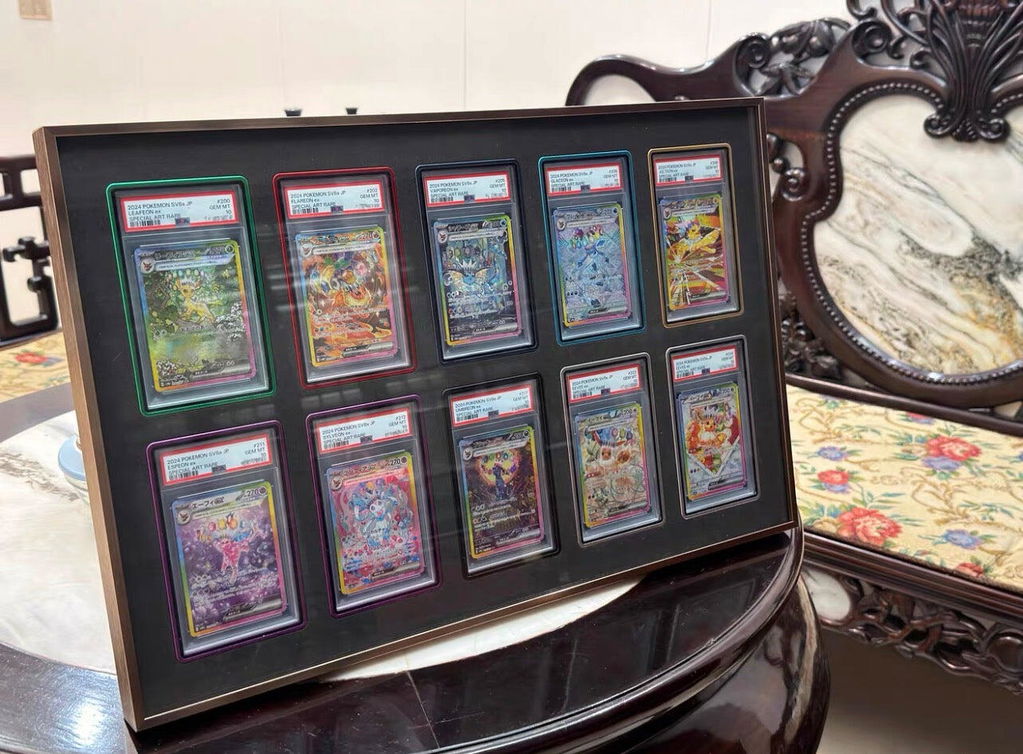
| 9 | 3 × 3 | Eevee and its eight evolutions | Supported cabinet display |
| 12 | 4 × 3 | Selected illustrations or team collection | Wide, strong display surface |
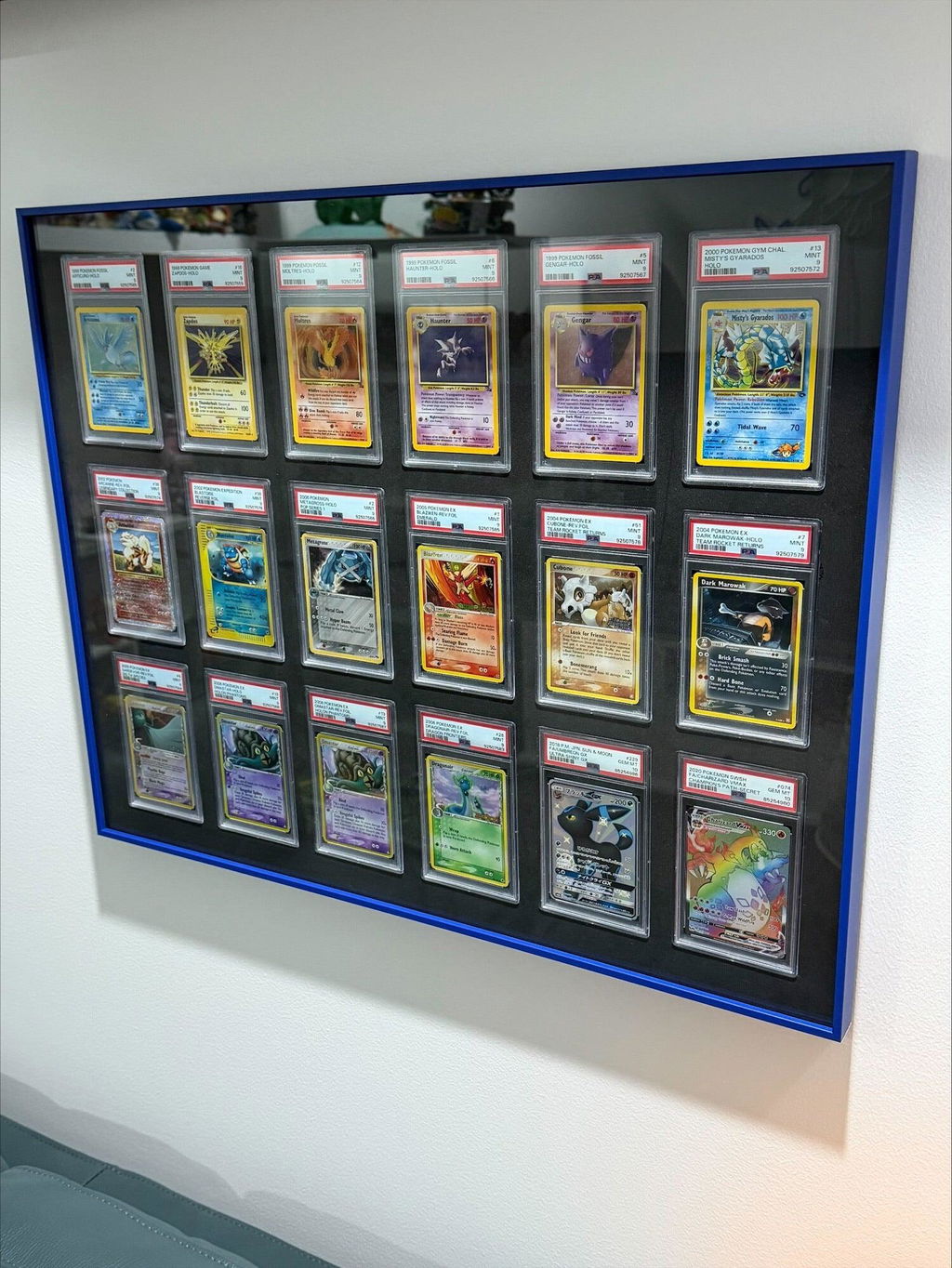
| 18 | 6 × 3 | Two coordinated groups of nine cards | Dedicated collector cabinet |
| 24 | 6 × 4 | Curated set or themed collection | Substantial supported display area |
| 35 or more | 7 × 5 or larger | Extensive set or long-term collection project | Purpose-planned support or an alternative wall frame |
These examples describe possible arrangements, not a guarantee that a particular shelf or stand can support the finished display. Large wooden panels require adequate support and more space than the card count alone suggests.
Wooden Pokémon card display ideas for a single favourite card
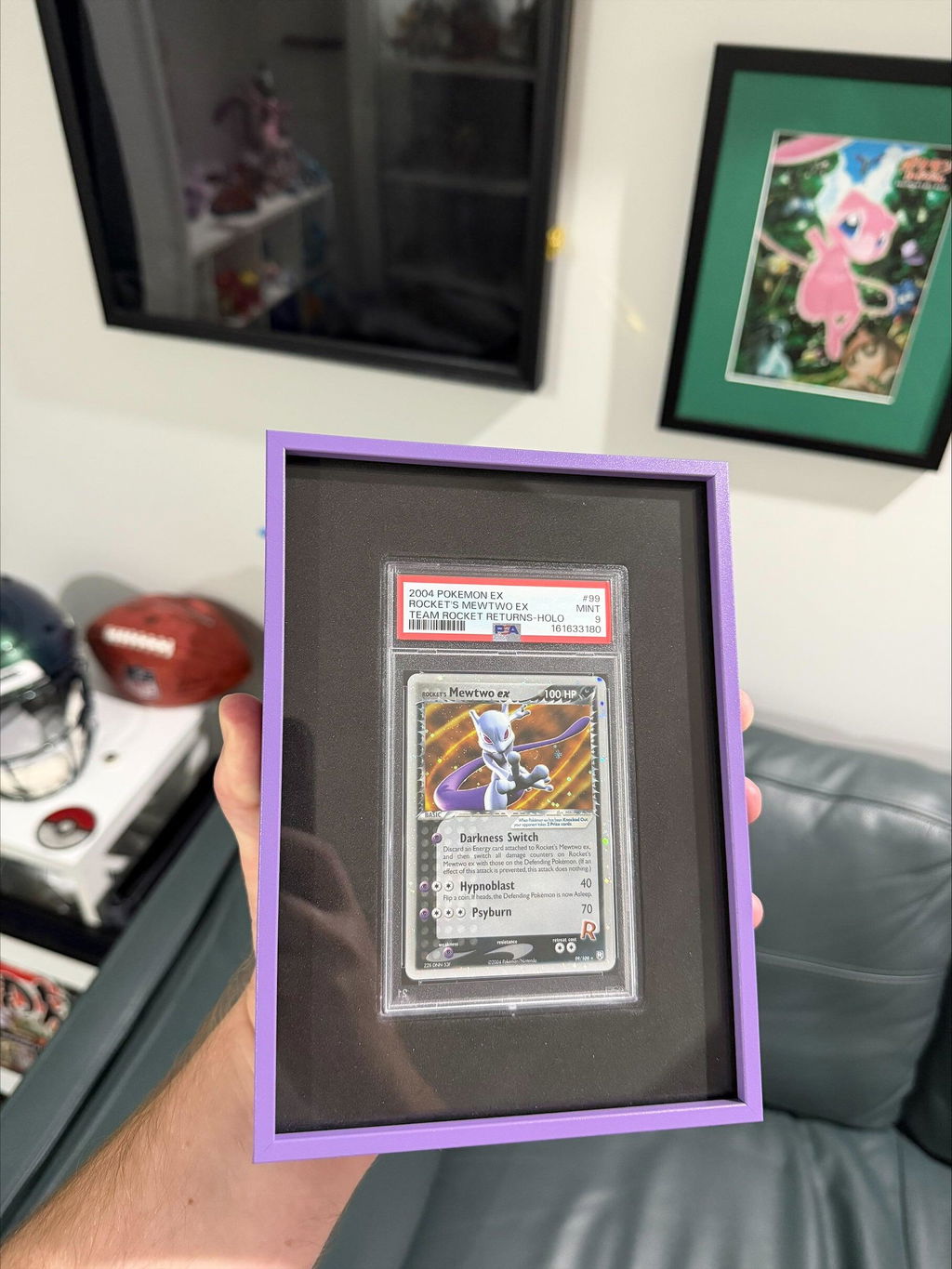
A single graded Charizard, Pikachu, Mew or other favourite can carry an entire display without needing additional cards. This approach works especially well on a home office desk, beside a book collection or on a small cabinet where a large frame would dominate the available space.
Think about what surrounds the card. A warm wooden finish can complement an older illustration, while a black stain can create a stronger boundary around a bright modern card. If you plan to swap the featured card regularly, choose a format that allows access without dismantling furniture or moving several surrounding objects.
A simple individual stand is often sufficient for this purpose. A single-card wooden display with a recessed acrylic cover is another option if you prefer a more defined wooden surround and an additional front panel.
Displaying Pokémon evolution lines in wooden frames
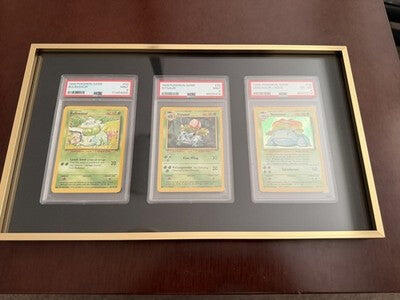
Evolution lines provide a natural reason to group cards in threes. Bulbasaur, Ivysaur and Venusaur; Charmander, Charmeleon and Charizard; and Squirtle, Wartortle and Blastoise are familiar examples. Arranging each line in evolution order helps the viewer understand the relationship immediately.
Collectors can choose cards from the same expansion for a coordinated appearance or deliberately mix different eras to show how the artwork has changed. Matching grading holder formats can help preserve consistent spacing even when the printed artwork differs considerably.
A three-card wooden display is suited to this kind of sequence when supported on an appropriate surface. Three individual stands also work, especially when a collector wants to rearrange cards frequently or accommodate different holder sizes.
How to display the original Pokémon 151
A collection based on the original Kanto Pokédex can become a long-term display project. The appeal is not necessarily owning the most valuable version of every Pokémon, but completing a recognisable group. The official Pokémon TCG Scarlet & Violet 151 expansion overview provides one example of a set organised around the original 151 Pokémon.
Displaying all 151 cards at once requires considerable space, particularly when each card is encapsulated in a grading slab. Instead of treating the collection as one large rectangle, consider dividing it into smaller arrangements. Starter evolution lines, legendary birds, favourite Kanto Pokémon and groups organised by Pokédex number can all stand independently while remaining part of the same project.
Keep an inventory of which cards are represented and which remain in storage. A collector can reserve the wooden display for a changing selection of favourites and use an aluminium trading card wall display for a more extensive permanent arrangement. It is not necessary to force the entire collection into one display format.
Wooden Eeveelution display ideas
Eevee and its eight evolutions make a natural nine-card theme. A three-by-three grid can place Eevee in the centre, with the evolutions surrounding it, or follow a consistent order chosen by the collector. The visual balance changes depending on how the different card colours are distributed.
One approach is to arrange the original evolutions together and then group later additions by generation. Another is to build a coordinated set of illustration cards, irrespective of release date. Collectors who own both Japanese and English versions can choose one language for consistency or use separate groups to compare the artwork and text.
A nine-card wooden display in a 3 × 3 layout creates a compact square arrangement relative to a single long row. A dark or neutral wood finish can help visually unite the variety of colours across the different Eeveelutions.
How to display a Charizard collection
Charizard collections can span vintage holographic cards, promotional releases, modern alternate artwork and different languages. Rather than grouping cards by price, try creating a chronology or choosing cards that show distinct interpretations of the same Pokémon.
A small three-card arrangement might contain one vintage favourite, one modern illustration and one personally meaningful card. A larger collection could be split into rows by release era. This makes it easier to expand or rotate without losing the original theme.
Dark walnut, mahogany-toned or black-stained wood may complement the orange and red elements of many Charizard cards. Pale oak or natural birch can work equally well if the surrounding furniture is light. Use the actual card artwork as the starting point rather than assuming one stain suits every Charizard illustration.
Displaying Base Set, Jungle and Fossil Pokémon cards
Vintage Pokémon cards often evoke a particular period in a collector's life. A display might recreate the memory of opening early booster packs, highlight favourite holographic artwork or bring together the cards that were difficult to obtain at the time.
For Base Set, Jungle and Fossil collections, consider separate groups by expansion or a smaller selection of personally significant cards. A natural wood finish can complement a nostalgic theme without requiring the rest of the room to adopt a retro aesthetic.
Older cards can differ considerably in condition and financial value. If a rare original is particularly important to preserve, a rotating arrangement can allow it to spend less time exposed to room light. The card that is most valuable is not necessarily the card that needs to be permanently on display.
Japanese Pokémon card displays
Japanese cards offer opportunities to collect distinctive releases, promotional artwork and alternative print versions. A Japanese-only arrangement can have a consistent visual rhythm, while pairing Japanese and English versions can show how the same illustration appears in different formats.
For a side-by-side comparison, try pairs arranged in columns. If both versions are graded, use matching external holder dimensions wherever a fitted display requires them. A card's language does not determine its fit; the surrounding grading slab or magnetic holder does.
Illustration Rare and Special Illustration Rare displays
Some modern Pokémon collectors focus primarily on artwork. Cards that share an illustrator, setting, colour palette or visual story can make an interesting arrangement even if they come from different sets. A sequence might move from a woodland scene to a city scene, or group cards whose illustrations depict related environments.
Wood is useful in these arrangements because it adds a visible background between individual artworks. A subdued finish can help the cards remain the dominant visual element. Avoid choosing a stain solely because it appears dramatic in a sample image; consider whether the colour competes with the illustrations when viewed together.
Can you display an entire Pokémon master set in wood?
A master set can mean different things to different collectors, particularly when reverse holos, promotional cards, variants and languages are included. Define what completion means before deciding on a grid. A binder is often the most practical way to keep a large set together and accessible.
A wooden display can serve as a curated selection from that binder rather than replacing it. Display the most memorable illustrations or a completed subsection, then rotate the selection as new cards arrive. This avoids buying a large piece of furniture or a frame solely to accommodate every variation of a card.
For a collector who wants dozens of graded cards visible simultaneously, wall-mounted aluminium or frameless acrylic displays can be worth considering. They use vertical room space rather than requiring a broad supporting surface for a large wooden body.
Wooden sports card display ideas
Sports cards lend themselves to arrangements that tell a story: one player's career, a championship roster, favourite rookie cards or a series of cards from a particular season. Wooden displays can fit naturally into a study, office, sports memorabilia room or home entertainment area.
For signed or memorabilia cards, the outer holder can be thicker than a standard slab or magnetic case. Confirm the dimensions before choosing a fitted wooden opening. A card's listed thickness in points is useful when selecting a magnetic holder, but the display must accommodate that holder's external size and shape.
Baseball and Topps card collections
A baseball display could group a favourite player's rookie card, a later career card and a memorable season. Another approach is to select cards from different decades of Topps designs, showing how photography, borders and printing styles evolved.
Traditional wood tones may complement vintage baseball memorabilia, while lighter finishes can help modern colourful cards stand out. A wooden multi-card display can sit beside a baseball or small signed photograph, provided the other objects do not obstruct access to the acrylic panel.
Basketball and Panini card displays
Basketball collectors may choose a starting five, a particular team era, a favourite player or a group of modern parallels. A display of five cards in a row is useful for a starting lineup, while a square arrangement may be more suitable for a wider selection of favourite players.
Foil finishes and reflective card surfaces can look different under directional lighting. Test the arrangement in the intended room before adding strong spotlights. A card that is easy to see on a desk during the day may become difficult to read when a ceiling light reflects from the holder and acrylic cover at night.
NFL, soccer and other football card collections
American football and soccer collections can be organised by position, team, country, competition or career milestone. A collector might display a small group of favourite players while keeping a much larger collection in storage.
Consider including cards with visually related team colours, but do not assume the wooden stain must match those colours exactly. A neutral wood surround often makes it easier to combine cards from different teams without creating too many competing accents.
Wooden Magic: The Gathering display ideas
Magic collectors may focus on favourite commanders, artists, iconic spells, lands or cards associated with a memorable deck. A wooden arrangement can work particularly well for artwork-led collections, where illustrations rather than grading labels are the main visual focus.
Cards that are still used in play need convenient access. It may be better to display spare or collected copies in protective holders and keep active decks separate. A fitted wooden display intended for slabs or magnetic holders is not a substitute for deck boxes or a binder.
Wooden Yu-Gi-Oh! card display ideas
Classic monsters such as Blue-Eyes White Dragon, Dark Magician and Red-Eyes Black Dragon can form a recognisable small collection. Other collectors prefer archetypes, different print rarities or cards connected to a particular character.
Yu-Gi-Oh! cards are smaller than many standard trading cards, so appropriate sleeves and protective holders matter. Once a card is placed in a compatible grading slab or magnetic holder, the external holder dimensions determine the fit in a wooden display. Do not place loose cards directly into openings designed for rigid cases.
Wooden One Piece and anime trading card displays
One Piece collectors might arrange cards by crew, favourite character, story arc or artwork style. A Straw Hat-themed group can be developed over time, while alternate art cards can create a more focused arrangement for collectors who prefer the illustrations.
Similar principles apply to Dragon Ball and other anime trading card games. Decide whether the cards are being grouped by character, set or personal significance before choosing the physical layout. The display should follow the collection rather than dictate it.
How to display graded cards on a desk
A desk display needs to work around the activities that already take place there. Measure the space left after the computer, keyboard, speakers and other everyday items have been positioned. A narrow wooden display may fit beside a monitor, while a deeper arrangement might be more practical on a separate cabinet.
Avoid locations where the display can be hit by a chair, dragged by cables or exposed to drinks. Keep wooden displays away from hot exhaust vents and leave room to remove the acrylic cover while the body is safely supported.
A gentle viewing angle can make cards easier to see from a seated position. For our recessed wooden displays, the angle must remain shallow enough that the holders and acrylic stay seated under their own weight. A stable stand supporting the substantial wooden body is more important than achieving a particular visual angle.
Wooden Pokémon card displays for gaming setups
Gaming rooms often combine monitors, figures, controllers, RGB lights and wall decorations. Adding a trading card display works best when it has a clearly defined place rather than occupying a gap that is already crowded.
A dark wooden display can relate to black desk accessories without having the same reflective appearance as a metal surface. A warm walnut or cedar tone can provide a contrasting natural element in a predominantly technical setup. A pale finish may suit rooms with white peripherals and lighter furniture.
RGB lighting is primarily decorative. Coloured light can change how printed card colours appear, and bright illumination left on for long periods adds to cumulative light exposure. Use moderate lighting, test reflections and switch decorative lights off when the collection is not being viewed.
How to display trading cards on a bookcase or shelf
A bookshelf arrangement can combine cards with art books, set guides, figures and other objects that share a theme. Start by checking the shelf's usable width, depth and load rating. A stand and the rearward tilt of a wooden display may require more depth than the display body appears to need when viewed from the front.
Leave enough clearance above the display to access the acrylic and card holders safely. Do not allow books or other objects to press against the panel or wooden edges. If a shelf is narrow or positioned high above the floor, individual secure stands or a properly designed wall display may be a better fit.
Displaying wooden card frames inside cabinets
A cabinet provides a defined area for a collection and, when fitted with doors, may reduce routine dust accumulation. It can also allow a collector to arrange cards at several levels without filling the room with separate shelves.
Measure the interior rather than relying on the external cabinet dimensions. Door hinges, shelf supports and lighting fixtures can reduce the usable space. Account for the combined weight of the wooden body, acrylic, holders and stand, and check that the cabinet and shelf are rated to carry it.
Cabinet glazing and the acrylic cover of a wooden display add separate reflective surfaces. If glare is excessive, adjust the lighting or viewing position before assuming that an acrylic upgrade is necessary. A cabinet with doors is also not automatically a humidity-controlled or UV-filtering enclosure.
Card display ideas for renters and apartments
Freestanding arrangements can be useful for collectors who do not want to drill into walls, whether because of a rental agreement or simply because the furniture arrangement is likely to change. A small wooden display can move with a desk or cabinet rather than becoming attached to one room.
Choose a location that is stable and unlikely to be bumped. Larger wooden displays still need substantial support, even though no wall fixings are involved. Avoid balancing heavy objects on lightweight decorative stands or on furniture not intended to carry the load.
If space is limited, a small collection with periodic rotation can provide more enjoyment than trying to display every card at once. Where permitted and appropriate, wall-mounted displays may reclaim furniture space. The decision depends on the room rather than the material alone.
Choosing a stand for a wooden trading card display
There is an important difference between a stand designed to hold one grading slab and a stand designed to support a substantial wooden multi-card display. The latter needs a suitable base, contact points and load capacity for the complete assembly.
Our recessed wooden displays are designed for supported freestanding presentation at a gentle viewing angle. Both the card holders and the acrylic cover rely on gravity to remain in their shallow recesses. They are not mechanically secured. Wall mounting, fully vertical positioning and steep angles are unsuitable because the holders and acrylic may become dislodged or fall out.
We do not include a stand because collectors have different furniture, spaces and presentation preferences. A chosen stand must support the body adequately and keep all components seated. There is no universal safe angle for every size and support arrangement, so check stability and seating before adding valuable cards. For loading or changing cards, place the display securely on a level surface.
Wood stain colours and how they relate to card artwork
Choosing a wood finish is less about identifying the best colour and more about understanding contrast, room lighting and existing furniture. Dark surfaces can help pale card borders stand out, while a lighter finish can make darker illustrations easier to distinguish. Warm stains can bring a sense of continuity to timber furniture.
Our nine wood finish choices include an unstained option for collectors who prefer to finish the birch plywood themselves. The following table describes possible visual relationships, not exact colours or a prediction of the finished shade. Birch grain, veneer layers and stain absorption can vary.
| Wood finish | Possible room or collection pairing |
|---|---|
| No Stain | Light furniture or a personal finishing project |
| Black | Dark gaming setups and high-contrast artwork |
| Cedar | Warm interiors and earthy illustration palettes |
| Jarrah | Rich warm timber accents |
| Mahogany | Traditional furniture and vintage collection themes |
| Maple | Light, warm interiors and colourful cards |
| Oak | Natural furniture and neutral room palettes |
| Teak Oak | Warm mid-tone furniture arrangements |
| Walnut | Darker desks, cabinets and understated interiors |
Stain names describe the decorative finish; they do not mean a birch plywood display is made from walnut, oak or mahogany timber. View colour references in the context of the room, and expect natural variation rather than an exact match to a piece of furniture.
Why holder compatibility matters more than card size
PSA, CGC and BGS graded slabs and One Touch magnetic holders have different external dimensions and shapes. Even within a holder family, specialised or older formats may differ. A fitted wooden recess cannot be expected to accommodate every case merely because it contains a standard-sized trading card.
Before planning a display, identify the holder used for each card. Measure the actual outer dimensions if there is any uncertainty, including protective sleeves that will remain around the slab. Confirm the selected product supports the required holder type, particularly for larger layouts where available formats may differ.
| Holder format | Arrangement consideration |
|---|---|
| PSA | Check slab format and consistency of label alignment |
| CGC | Check the actual generation and dimensions of the holder |
| BGS / Beckett | Account for holder proportions and depth |
| One Touch | Check magnetic case dimensions, thickness and brand compatibility |
| Mixed holders | Consider separate fitted displays or flexible individual stands |
Should wooden card displays have an acrylic cover?
An open wooden stand can be convenient for a card that is handled regularly. A recessed clear acrylic cover provides an additional physical barrier against incidental contact and settling dust while keeping the artwork visible. It can also help a multi-card arrangement read as one coherent piece.
We chose a removable recessed acrylic cover for our wooden range so that the protective panel integrates with the surrounding wood without protruding above the surface. It is not intended to secure the holders in a vertical position. The gravity-based design is why the recommended presentation differs from our wall-mounted ranges.
Clear acrylic grades also differ in ultraviolet filtration and reflection performance. The standard premium clear acrylic and optional PLEXIGLAS® museum-grade upgrade address different optical preferences. The acrylic choice does not replace sensible room lighting, particularly for valuable or light-sensitive cards.
Where should valuable trading cards be displayed?
Direct sunlight is an avoidable source of light exposure and heat. A shaded interior location, away from windows receiving strong sun, is a better starting point for a wooden, metal or acrylic card display. Observe the room at different times of day, because sunlight can reach a shelf that appears shaded when first inspected.
Printed cards may also be affected by visible light. The Canadian Conservation Institute's guidance on light, ultraviolet and infrared explains why exposure and material sensitivity matter when displaying collections. There is no fixed display duration that guarantees every card will remain unchanged.
For an especially rare or irreplaceable card, consider whether occasional display or a less valuable representative card better meets your preservation goals. Our complete trading card display guide discusses broader display and storage approaches.
Combining wooden, aluminium and frameless acrylic displays
A collector room does not need to use a single material throughout. Wooden displays can sit on cabinets or desks, while aluminium frames organise larger collections on walls. Frameless acrylic displays can suit areas where a more minimal border is preferred.
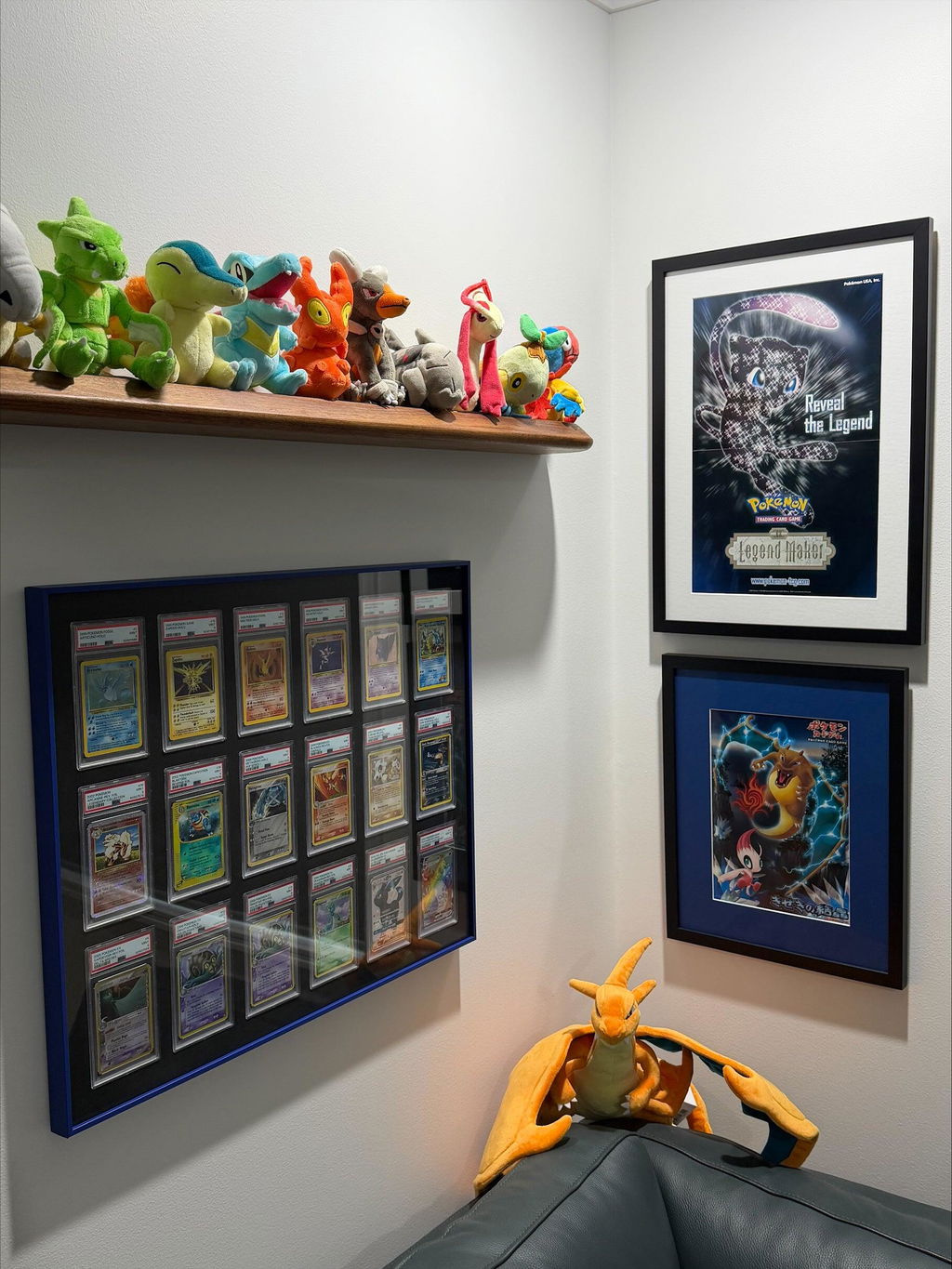
For example, a Pokémon collector might display favourite evolution lines in wood on a sideboard, a larger graded collection in aluminium on an adjacent wall, and a small group of modern illustrations in a frameless acrylic display. A sports collector might use a wooden desk display for a favourite rookie card and reserve wall space for a team collection.
Consistency can come from repeating a visual feature rather than using the same construction. Similar spacing, related colours or an organising theme can connect the pieces across the room.
| Display style | Role in a collector room | Practical consideration |
|---|---|---|
| Recessed wooden display | Natural wood presentation on suitable supported furniture | Weight, stability and gentle viewing angle |
| Aluminium wall frame | Structured collection using vertical space | Suitable wall, mounting hardware and total weight |
| Frameless acrylic wall display | Minimal border and contemporary presentation | Panel support, reflections and mounting requirements |
| Individual card stand | Flexible display of one or a few favourites | Stability, holder fit and exposure to dust |
| Binder or storage box | Organising cards that do not need continuous display | Suitable protective materials and storage environment |
Our frameless acrylic collection and aluminium display guide explain those alternatives in greater detail. The best arrangement may combine several approaches.
Three practical collector room examples
A small home office with three favourite Pokémon cards
The collector has a light timber desk and limited free space. A three-card evolution line is placed on a separate stable side cabinet in a natural or oak-toned wooden display. The computer desk remains clear for work, and the cards are visible from the chair without sitting close to a drink or computer exhaust vent. If the collection grows, additional cards can stay in a binder and be rotated rather than immediately expanding the arrangement.
A sports memorabilia room with rookie cards and team collections
A collector owns several graded rookie cards and a larger team collection. A walnut-toned wooden arrangement on a sturdy cabinet presents a curated group of favourite players. An aluminium wall frame accommodates the larger themed collection, with both arrangements placed away from direct window light. Signed memorabilia is positioned separately so that it cannot knock against the removable acrylic cover.
A rental apartment with a mixed Pokémon and One Piece collection
Instead of hanging a large frame, the collector uses a compact supported wooden display on an adequately rated bookcase and separate individual stands for holders that do not share the same dimensions. A few cards are rotated periodically. This maintains a manageable footprint and allows the collection to move when the furniture changes. If the collector later moves to a home with suitable walls, the collection can expand into wall-mounted frames without replacing the wooden display.
A practical checklist for planning a wooden card display
- Decide which cards belong together and why.
- Identify the actual external holder dimensions.
- Choose a grid that fits the group rather than filling empty openings unnecessarily.
- Measure the available width, height and depth of the furniture.
- Check the load capacity of the surface and selected stand.
- Choose a wood finish that complements the actual cards and room.
- Allow enough room to safely remove the acrylic cover.
- Keep gravity-retained holders and acrylic securely seated at a gentle viewing angle.
- Observe sunlight and reflections throughout the day.
- Decide which cards should be rotated or stored separately.
Frequently asked questions about wooden Pokémon and trading card displays
What is the best way to display Pokémon cards on a desk?
Use a stable stand or fitted display sized for the holders, positioned away from drinks, heat and direct sun. Choose a card count that leaves the desk usable.
Can I display PSA slabs in a wooden frame?
Yes, where the wooden display is designed for the specific PSA slab format. Confirm holder dimensions and the recommended display orientation.
Are wooden card displays suitable for CGC and BGS slabs?
They can be, provided the recess is configured for the actual holder. Grading companies use different case dimensions, and not every layout supports every holder type.
Can I display One Touch magnetic holders in wood?
Yes, using a compatible fitted opening or stand. Check the external magnetic holder dimensions rather than relying only on the card thickness rating.
Can wooden Pokémon card displays be mounted on a wall?
Some wooden frames are designed for wall mounting, but our recessed wooden displays are not. Their card holders and removable acrylic rely on gravity to remain seated, so fully vertical positioning is unsuitable.
Do I need a stand for a wooden trading card display?
A suitable stand can provide a gentle viewing angle, provided it supports the complete display. Our wooden displays do not include stands, allowing collectors to choose an arrangement suited to their space.
What wood colour works best with Pokémon cards?
It depends on the artwork and room. Natural birch and oak tones can suit light interiors, while darker finishes may provide contrast for colourful illustrations. There is no universally best stain.
Does a walnut stain mean the display is made from walnut?
No. A walnut-coloured stain can be applied to birch plywood or another suitable material. The finish name and underlying wood species are separate descriptions.
How many cards should I display together?
Start with the theme. Three cards can tell an evolution story, nine can represent Eevee and its evolutions, and a larger layout can show a curated set. Choose a count that fits the available space.
Can I mix different grading companies in one wooden display?
Only if the openings accommodate each holder correctly. Different slab shapes and dimensions may require separate layouts or flexible stands.
Are wooden displays suitable for ungraded cards?
Ungraded cards can be displayed in compatible protective magnetic holders. Avoid placing bare cards into recesses intended for rigid holders.
Can I display cards inside a glass cabinet?
Yes, if the cabinet provides adequate depth, shelf capacity and stable support. Consider glare from the cabinet doors and any acrylic panel.
Is a wooden display better than a plastic card stand?
They serve different purposes. A simple stand can be inexpensive and flexible, while a fitted wooden display can present a coordinated group with a natural material surround and protective cover.
Are wooden or aluminium displays better for large collections?
It depends on available space and support. A large wooden display requires substantial supporting furniture, whereas a purpose-built aluminium wall frame can use vertical space if correctly mounted.
Does acrylic stop Pokémon cards from fading?
Not completely. UV filtration depends on the acrylic grade, and visible light can still affect printed cards. Avoid direct sunlight and unnecessary prolonged illumination.
Can I use LED lighting around wooden card displays?
Yes, with sensible brightness, positioning and exposure duration. Avoid heat buildup and use lighting that does not create distracting reflections.
Should I rotate my most valuable cards?
Rotation can reduce continuous light exposure for individual cards, although handling also needs care. For rare items, stable dark storage may be preferable to permanent display.
Can I stain a wooden card display myself?
Where an unfinished option is available, you can choose your own suitable finish. Follow the finish manufacturer's preparation and curing instructions, and keep acrylic and card holders away from the finishing process.
Further reading and original sources
- Pokémon TCG: Scarlet & Violet 151 (official expansion information).
- Canadian Conservation Institute: Caring for paper objects (environment, display and preservation considerations).
- Canadian Conservation Institute: Ultraviolet filters (the distinction between ultraviolet filtration and light-driven deterioration).
- Library of Congress: Limiting light damage (managing light exposure for collections).
Final thoughts: making the collection part of the room
A considered wooden trading card display begins with the cards and the space, not the largest possible grid. A favourite evolution line, a collection of vintage illustrations or a few sports cards with personal significance can all become meaningful arrangements without occupying an entire wall.
We introduced wood because it provides a different relationship between collectibles and furniture. The natural surface, selectable finishes and recessed compartments are suited to certain collectors and rooms, while aluminium and frameless acrylic remain useful for other presentation goals. A collection can use all three approaches, or rely on simple stands and binders where those are more practical.
Ultimately, the most suitable display is the one that supports the holders correctly, fits the room, allows the cards to be enjoyed and respects the collector's priorities for condition and preservation.
Continue Exploring
- Wooden Trading Card Display Frames: The Complete Guide (birch plywood, construction, wood finishes and acrylic).
- How to Choose the Best Display Frame for Pokémon Cards (holder formats and layout decisions).
- Best Trading Cards to Display and Collect (themes, sets and collector ideas).
- How to Display PSA, BGS and CGC Graded Cards on a Wall (alternatives for larger collections).
- How to Choose the Right Trading Card Display Frame (comparing different display approaches).
Explore Displays
For examples of the different construction and presentation styles discussed above, explore the wooden birch plywood trading card display collection, aluminium wall display collection and frameless acrylic collection from SLABBED™ Studio.

0 comments