


A graded trading card collection is often built one card at a time. A collector might own a set of PSA-graded Pokémon cards, a selection of CGC slabs featuring favourite illustrations, a group of Beckett-graded sports rookie cards or several ungraded cards protected in Ultra PRO ONE-TOUCH magnetic holders. The cards may share a theme, but their protective cases do not necessarily share the same dimensions.
When choosing a wooden trading card display frame, the first decision is therefore not the wood colour or the number of openings. It is the type of holder the display needs to accommodate. A fitted wooden PSA slab display and a wooden magnetic card holder display can have a similar appearance while requiring different internal geometry.
This guide explains how to choose wooden displays for PSA, CGC, BGS and One Touch holders, how holder dimensions and thickness affect fit, and what collectors should consider when arranging cards on a desk, shelf or cabinet. It also explains the reasons behind our wooden display design at SLABBED™ Studio and when an aluminium or frameless acrylic wall display may be more appropriate.
What is a wooden graded card display?
A wooden graded card display is an accessory designed to present cards that have already been encapsulated in protective grading holders. The holder, commonly called a slab, remains intact. The outer wooden frame or display positions the slab and provides a more deliberate arrangement for viewing the card and its label.
Some wooden displays are conventional timber frames surrounding a separate backing and insert. Others resemble small individual stands or cabinet compartments. Our wooden trading card displays use a single-piece birch plywood body with individual recessed holder compartments and a removable clear acrylic cover. This construction makes the wood visible between cards, rather than using it solely as an outer border.
The term graded card display is sometimes used for magnetic card holders too. That can be convenient when searching for display furniture, but an ungraded card placed in a magnetic case has not thereby received a professional grade. Both holder families can be attractive to display, and both require suitable physical support.
Why the holder matters more than the card size
Standard-size Pokémon cards and many modern baseball, basketball and football cards have broadly similar underlying card dimensions. That does not mean their encapsulated versions occupy the same space. A grading label adds height, the plastic case adds width and thickness, and the perimeter design introduces edges and corners that vary between manufacturers.
When a display has precisely fitted recesses, it is the outside of the holder that interacts with the wood, not the printed card inside. A recess must accommodate the case without pressing on its edges or interfering with the surrounding acrylic. A display made for one holder should not be assumed to accept another simply because the cards themselves are the same size.
PSA, CGC, BGS and One Touch compared
| Holder format | Purpose | What to check before choosing a wooden display |
|---|---|---|
| PSA graded slab | Professional authentication and grading | Holder generation, external width, height, depth and any protective sleeve |
| CGC graded slab | Professional authentication and grading of TCG and other cards | Holder generation, overall dimensions and thickness variant |
| BGS / Beckett graded slab | Professional grading in a Beckett holder | Specific Beckett case, perimeter profile and depth |
| One Touch magnetic holder | Removable protective case for an ungraded or previously unencapsulated card | Manufacturer, model, external size, card thickness rating and closure profile |
These categories are useful starting points, not universal dimensional standards. Oversized cards, unusual formats, thick memorabilia cards and specialist encapsulation cases need individual attention.
Wooden PSA card display frames
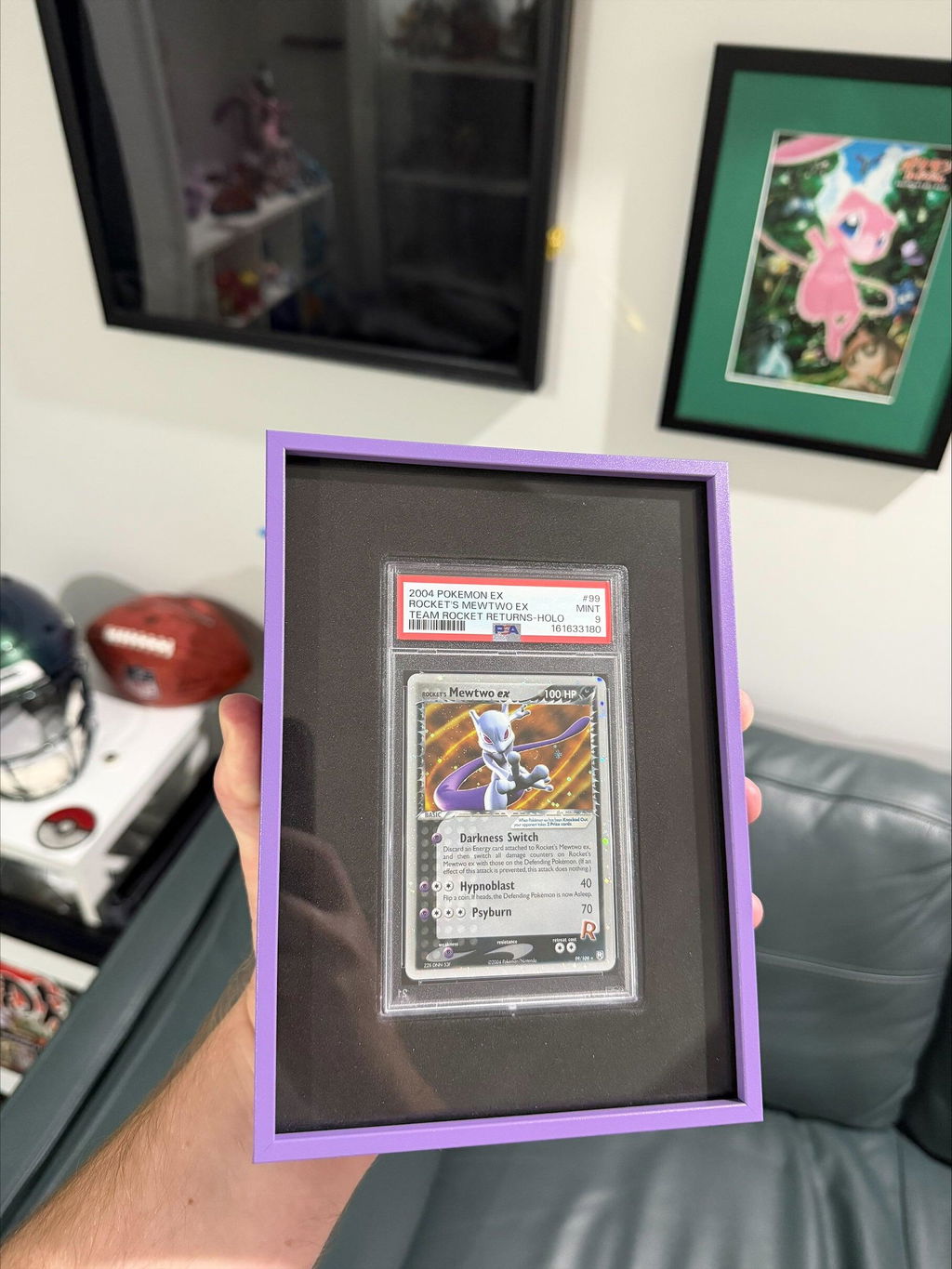
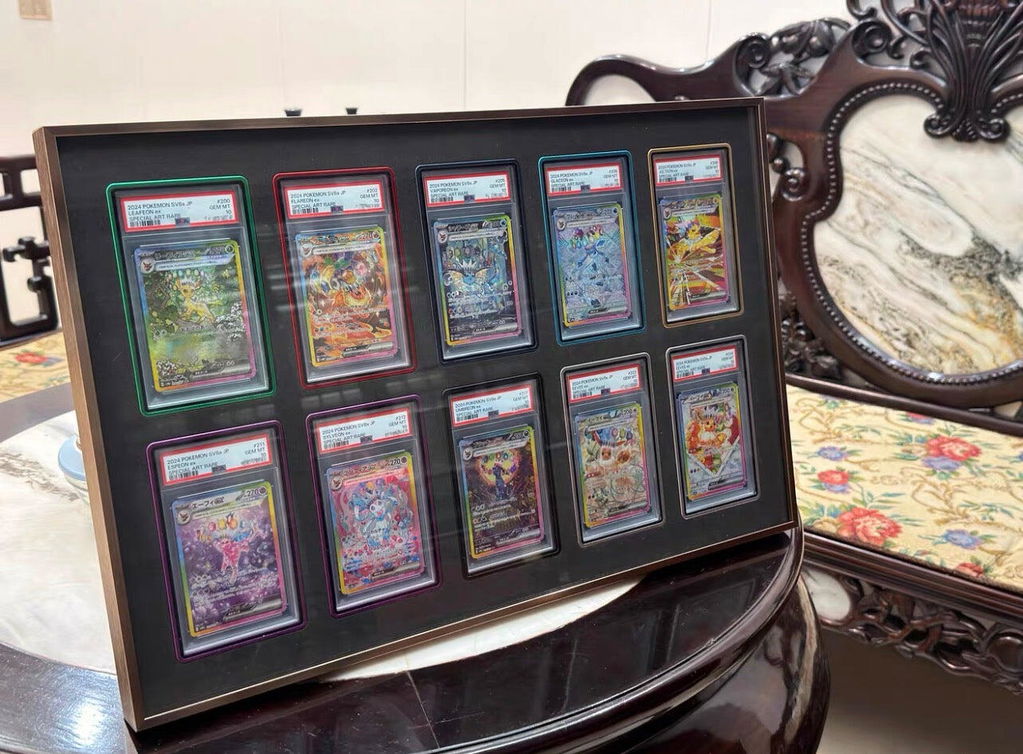
PSA slabs are a familiar format for Pokémon, sports cards and many other collectibles. A typical display arrangement presents the grading label above the artwork, making both the identity of the card and its assessed condition visible. A wooden PSA display can emphasise that consistent label position across a group of cards.
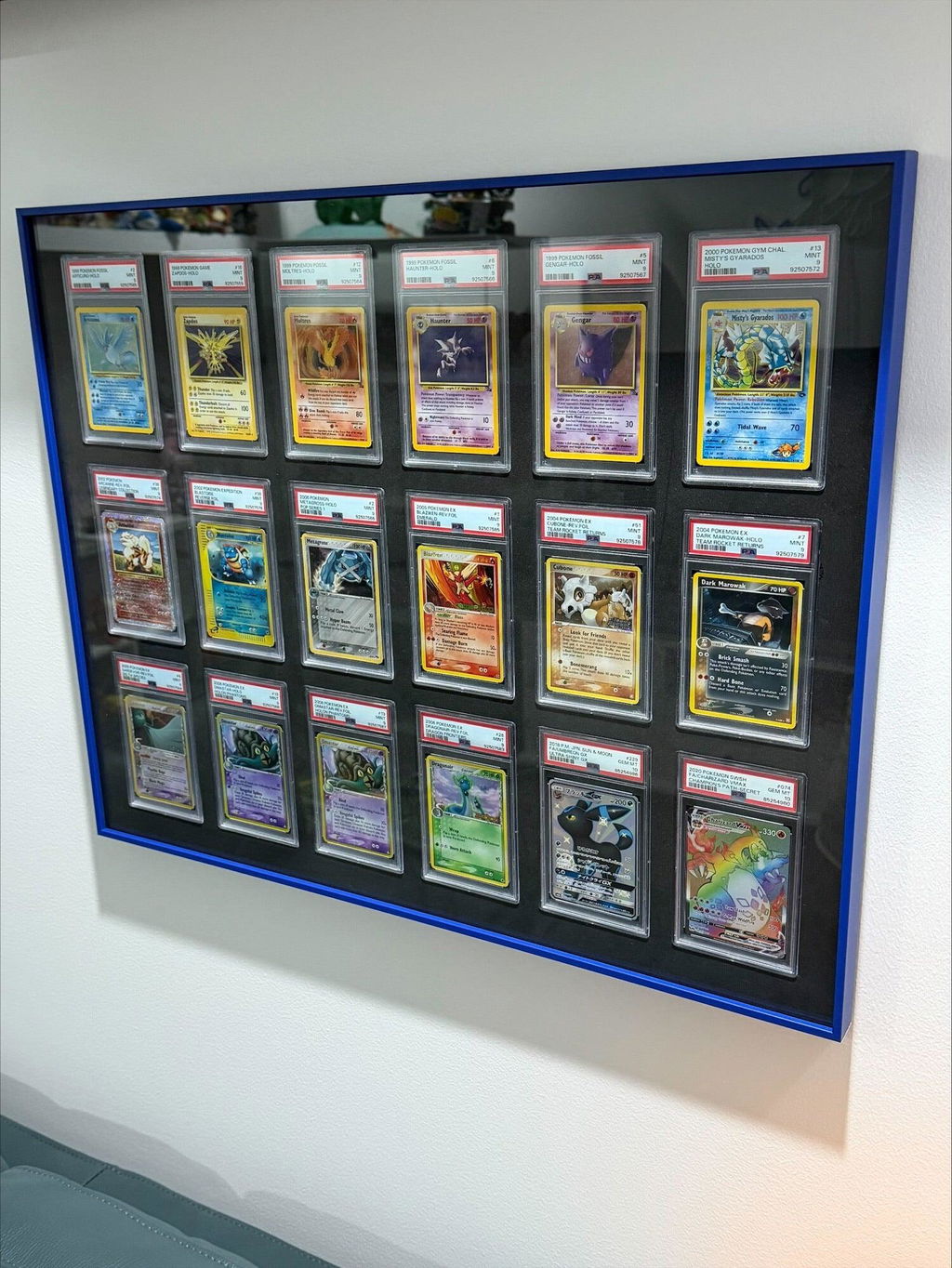
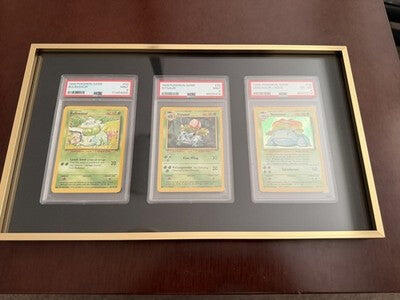
For example, a collector with three vintage Pokémon PSA slabs can choose a horizontal three-card arrangement on a cabinet. A collector building a larger baseball rookie card collection might prefer a rectangular grid. The holder choice is the same, but the number of rows and columns changes how much furniture space is required.
Do old and new PSA holders fit the same wooden display?
PSA described its redesigned standard-card holder in its holder announcement, noting that the overall dimensions of that particular redesign were maintained. That is helpful for collectors with standard slabs from different periods. It should not be extended to every PSA holder type, especially non-standard and oversized formats.
If your collection contains several generations of holders, compare a representative sample before ordering. Protective slab sleeves can also change the external fit of a case. The simplest approach is to confirm the holder format rather than rely exclusively on the year the card was graded.
Which PSA card collections work well in a wooden display?
Consider a compact display for the cards you most enjoy seeing: a favourite Pokémon evolution line, three cards from a memorable tournament, a sequence of baseball rookie cards or different printings of the same character. The consistent outline of the holders helps tie the arrangement together even when the artwork is very different.
Light birch can provide a neutral background for colourful modern artwork. Walnut and darker stains can create a stronger contrast with white labels. The choice is visual, and does not affect the grade or authentication of the card.
Wooden CGC graded card displays
CGC grading holders are used by collectors of Pokémon, Magic: The Gathering, Yu-Gi-Oh!, One Piece, sports and other trading cards. A fitted wooden CGC display should be selected for the actual CGC case, particularly where a collection contains different label and holder generations.
CGC publishes information about its card holders and labels, including several holder thicknesses. Its holder FAQs give approximate dimensions for a conventional holder, but those figures alone cannot establish whether every version of a case fits a particular wooden recess.
Displaying CGC cards with different labels
A collection can include older CGC Trading Cards labels, newer labels and cards carrying a distinctive grade designation. Some collectors like to organise these by holder generation, while others prefer to group cards by artwork or set. If the physical cases are compatible, the different label appearances need not prevent a coherent arrangement.
Before committing to a large CGC grid, check the thickest and widest holders in the intended collection. A frame that comfortably accommodates one ordinary slab might not have enough depth for another case containing a thick sports card.
Wooden BGS and Beckett graded card displays
Beckett Grading Services is another common option for sports cards and trading card games. Beckett describes its grading and encapsulation service as placing graded cards in protective holders with the grade information displayed. Depending on the label and grading service, collectors may see different label styles or additional condition information.
For a wooden BGS display, the full outer case is the relevant object. Do not assume that a Beckett holder will fit a recess prepared for a PSA slab or a CGC case. Width, corner shape, height and thickness all affect how comfortably it can be placed and removed.
Displaying BGS sports cards and high-grade TCG cards
A group of Beckett-graded basketball or baseball cards can be arranged by player, season or card manufacturer. Pokémon and other TCG collectors may prefer to group cards by character, rarity or illustration style. Natural wood offers a different backdrop from the transparent plastic of the individual holders.
For collectors who value the appearance of a Beckett label as part of the presentation, a display with unobstructed individual recesses can make the label easy to read. Choose the exact holder option rather than selecting a PSA version for a visually similar collection.
Wooden One Touch magnetic card holder displays
Not every card needs to be professionally graded to be worth displaying. A magnetic card holder allows collectors to present favourite cards in a protective case while retaining the option to remove them according to the holder manufacturer's instructions. Ultra PRO ONE-TOUCH is a familiar example of this type of case.
A wooden One Touch card display positions these magnetic holders as individual objects. Unlike a typical graded slab, a conventional magnetic holder does not have the same extended grading-label area. The resulting arrangement can be more focused on the artwork itself, which is especially useful for illustration cards, signed cards and curated sports card sets.
What does 35pt, 55pt or 130pt mean on a magnetic card holder?
The point rating is a card thickness measurement: one point is one thousandth of an inch. A 35pt rating therefore refers to a nominal card thickness of 0.035 inches, not the thickness of the assembled magnetic holder. Manufacturers provide different ratings to accommodate different kinds of cards.
| Card thickness rating | Equivalent nominal card thickness | What it tells the display buyer |
|---|---|---|
| 35pt | 0.035 in (about 0.89 mm) | Card capacity, not outer case size |
| 55pt | 0.055 in (about 1.40 mm) | Card capacity, not outer case size |
| 75pt | 0.075 in (about 1.91 mm) | Check the actual case profile |
| 130pt | 0.130 in (about 3.30 mm) | Thicker card capacity; verify the entire assembled case |
These conversions illustrate the meaning of the rating and are not a compatibility list for our wooden displays. The manufacturer's ONE-TOUCH product range includes different holder formats. Its standard 35pt model, for example, is intended for conventional 2.5 × 3.5 inch cards within its stated thickness capacity. Always establish the external dimensions of the assembled holder separately.
Are all magnetic card holders the same size?
No. The closure design, outer border, manufacturer and card format may change the dimensions. A holder marketed as suitable for a standard trading card is not necessarily identical to an Ultra PRO holder. Vintage-size magnetic cases and holders with decorative borders are further examples where compatibility should be checked.
Collectors with thick patch cards, memorabilia cards or unusually shaped inserts should be especially attentive to holder depth. A magnetic case that protrudes beyond its recess may interfere with the acrylic cover. Do not force the cover down over a holder that does not fit.
How to measure a graded slab or magnetic holder for a wooden display
Use a ruler or suitable calliper to measure the outside of the protective case. If a slab sleeve is going to remain in place, measure the assembly with the sleeve fitted. Keep the case clean and avoid dragging measuring tools across its viewing surfaces.
- Measure the maximum external width, including any raised edges.
- Measure the maximum external height, including the label section or closure.
- Measure the maximum depth of the closed holder, including any protruding features.
- Observe the corner shape and any lip or perimeter profile.
- Check several representative holders if the collection includes multiple versions.
- Compare the results with the display manufacturer's compatibility guidance before selecting the layout.
Do not measure the bare card and use those measurements to choose a slab display. Likewise, do not confuse the thickness of the card inside a magnetic case with the thickness of the case itself.
What makes a recessed wooden holder compartment useful?
Individual recesses provide a defined location for each case. In a multi-card wooden display, that means the spacing between neighbouring cards is established by the design rather than by the collector placing a series of separate stands. A grid can remain visually consistent when the collection is arranged correctly.
We introduced this construction because we wanted wood to perform a functional role as well as a decorative one. Birch plywood was selected for its smooth face, fine grain and suitability for staining, and the individual compartments are formed directly in the wooden body. The result is a different form of presentation from a frame assembled around a separate insert.
Our guide to birch plywood, MDF and solid wood explores the material selection in more detail. The relevant question for a collector is whether the construction, holder fit and finish suit the intended display location.
Why a tight fit is not always a good fit
A well-defined compartment does not need to grip a case by force. The holder should be able to sit in its recess and be lifted out without levering against the wood or scratching the plastic. An extremely tight opening can become inconvenient if the case has a protective sleeve or if natural wood variation changes the fit slightly.
Finger access can make removal more straightforward. When lifting a holder, handle its perimeter and avoid using screwdrivers, knives or other hard tools against the case. If a holder does not settle correctly, stop and confirm that it is the intended type.
Why the acrylic cover sits in a recess
The removable clear acrylic cover on our wooden displays sits below the surrounding wooden surface when properly seated. It provides an additional barrier against incidental contact and helps reduce dust settling directly on the card holders. The wood remains the visible perimeter of the display.
The acrylic should sit naturally in its own recess. It is not a clamp intended to hold the cases down by pressure. If an unusually thick slab prevents the cover from seating, the appropriate response is to check compatibility, not to bend the acrylic or modify the grading holder.
Can wooden PSA, CGC, BGS and One Touch displays be wall mounted?
Some wooden card frames on the market are built with mechanical retention and wall-mounting hardware. Our recessed birch plywood displays are a different design. Both the holders and the acrylic cover depend on gravity to stay in their shallow recesses. They are not mechanically fixed in place.
For that reason, our wooden displays are intended for supported freestanding presentation at a gentle viewing angle. They are not suitable for wall mounting, fully vertical positioning or steep angles. If a display is tilted too far, either the card cases or the acrylic cover may move out of its recess and fall.
Use a stable stand appropriate for the dimensions and loaded weight, with sufficient support for the wooden body. A stand is not supplied because collectors may prefer different furniture and support arrangements. There is no universal safe angle for every stand and configuration; check that the display is stable and the components remain seated. Remove the cover and holders before repositioning or transporting the display.
If the goal is a vertical collection wall, our aluminium trading card wall frames and frameless acrylic displays are designed for that kind of presentation. The wooden collection was introduced to provide a different option, not to replace those designs.
How many graded cards should a wooden display hold?
Begin with the collection and the available support surface. A compact three-card frame can make sense for a small desk. A nine-card grid can become a larger feature in a collector cabinet. A much larger wooden display requires careful planning for its footprint, weight, support and acrylic span. A card count alone cannot tell you whether a display fits the intended location.
| Collection arrangement | Example | Planning consideration |
|---|---|---|
| 1 card | A favourite PSA slab or signed sports card in a magnetic holder | Small support and clear viewing position |
| 3 cards | Pokémon evolution line or a three-player sports selection | Horizontal furniture space |
| 4 to 9 cards | A small themed set or illustration collection | Row and column arrangement, viewing distance |
| 12 or more cards | A larger group of rookies, characters or graded favourites | Loaded weight, suitable support, sufficient furniture depth |
The wooden trading card display collection offers many different layouts. The available holder options vary by configuration, particularly in larger sizes, so check the Card Type selector rather than assuming that every wooden display can be ordered for all four formats.
Can you mix PSA, CGC, BGS and One Touch holders in one wooden display?
A uniform grid designed for a particular holder normally uses the same recess geometry throughout. Different slabs may look similar in photographs but have different dimensions. A magnetic case may also be shorter than a graded holder, leaving uneven spacing if placed in an opening intended for a slab.
One practical way to present a mixed collection is to use separate displays for each holder format and arrange them together on a cabinet or across a room. Matching the wood stain can unify their appearance without compromising physical fit. A specifically designed mixed-format display would need suitable openings for each case, rather than an assumption of interchangeability.
Choosing a wood finish for graded card labels
Wood colour changes the visual relationship between the background and the labels. A dark stain can emphasise lighter grading labels, while a lighter finish can produce a more subdued transition between the holder and the wood. Black, Cedar, Jarrah, Mahogany, Maple, Oak, Teak Oak and Walnut are among the stained finishes in our range, alongside the unfinished No Stain option.
These are finish names rather than different timber species. The underlying construction remains birch plywood. Grain, exposed layers and absorption differences can produce variations in the finished surface. Choose a tone that suits the collection and furniture rather than expecting a stained sample to match every piece exactly.
Collectors planning their own finish should remove the acrylic and all holders before staining or varnishing, follow the finish manufacturer's directions and wait for the surface to cure before reassembling the display.
Displaying graded Pokémon cards in a wooden frame
A three-card display can be used for Bulbasaur, Ivysaur and Venusaur, or for Charmander, Charmeleon and Charizard. The cards could come from the same set, different eras or different illustration treatments. The important point is that the selected holders match the display format.
A collector with nine PSA or CGC slabs could arrange them around a theme such as the original Kanto starters, a favourite illustrator or cards from a particular expansion. If the collection includes several grading services, separate matched displays may be a better choice than trying to fit incompatible cases into one grid.
Our three-card wooden display is an example of this kind of compact arrangement. For broader collection ideas, see our wooden Pokémon and trading card display guide.
Wooden sports card displays for baseball, basketball and football
Sports collectors often build groups around players, teams, rookie seasons or particular releases from Topps, Panini and other manufacturers. A wooden display can give a curated selection a dedicated place on furniture without requiring the entire collection to be displayed at once.
Pay particular attention to thick memorabilia and patch cards. Their protective holders may differ substantially from ordinary slabs or magnetic cases. Check the case used for every card before ordering, especially if the theme includes both standard cards and thicker premium inserts.
Wooden displays for MTG, Yu-Gi-Oh! and One Piece cards
Magic: The Gathering collectors might choose alternate-art cards, favourite commanders or cards associated with a particular deck. Yu-Gi-Oh! collectors could display nostalgic monsters or a group of tournament favourites, while One Piece collectors might organise cards around a character or a manga-art theme.
The underlying cards can have different dimensions across games, yet a compatible grading case may present them in a similar external format. For magnetic holders, verify that both the card fits its own holder and the holder fits the wooden display. These are separate compatibility questions.
Do grading holders already provide enough protection?
Grading cases provide encapsulation and physical protection, but an outer display serves a different role. It can organise the cases, reduce incidental contact and place several cards in a coherent viewing arrangement. Adding acrylic glazing also introduces another material through which light passes.
Do not infer a particular ultraviolet filtration percentage from the grading brand alone. Where a holder manufacturer publishes UV performance, consider that information separately from the glazing specification. Neither a grading case nor a wooden display should be understood as a climate-controlled archival enclosure.
Premium clear acrylic versus museum-grade acrylic for graded cards
Our wooden, aluminium and frameless displays offer premium clear acrylic, with an optional PLEXIGLAS® Gallery & Museum anti-reflective upgrade where available. The standard material is selected for transparency and supplier-rated UV resistance. The specialist option is intended to improve optical performance through its surface treatment and additional documented UV filtration.
Read our acrylic specifications and UV protection guide and the supplier's museum acrylic information for details of the specific materials. Check the applicable technical data rather than assuming that all acrylic products have the same optical characteristics.
With graded cards, a viewer sees the card through both the slab and the outer acrylic. Reducing reflections on the outer panel cannot eliminate reflections from the slab itself. Viewing distance and the gap between surfaces can also influence apparent sharpness, particularly with specialist glazing intended for close placement to artwork.
Where should valuable graded cards be displayed?
Choose a dry, stable indoor location away from direct sunlight, concentrated heat and moisture. A desk beside a bright window may seem convenient, but the light exposure can change throughout the day. A shaded cabinet or an interior shelf with controlled lighting may offer a more sensible location.
The Canadian Conservation Institute's guidance on light explains the importance of cumulative illumination. Visible light can contribute to fading even where UV is reduced. For original paper-based collectibles, its paper care guidance provides further background on environmental risks. Valuable or especially sensitive cards may benefit from limited display periods rather than continuous illumination.
How wood, aluminium and frameless acrylic compare for different holders
| Display construction | Intended presentation in our range | Typical reason for choosing it |
|---|---|---|
| Birch plywood | Supported freestanding, gently angled | Natural wood character, recessed individual compartments and selectable stains |
| Aluminium | Wall-mounted | Metallic perimeter, structured layout and configurable finishes |
| Frameless acrylic | Wall-mounted | Minimal visible perimeter and a simpler visual transition around the collection |
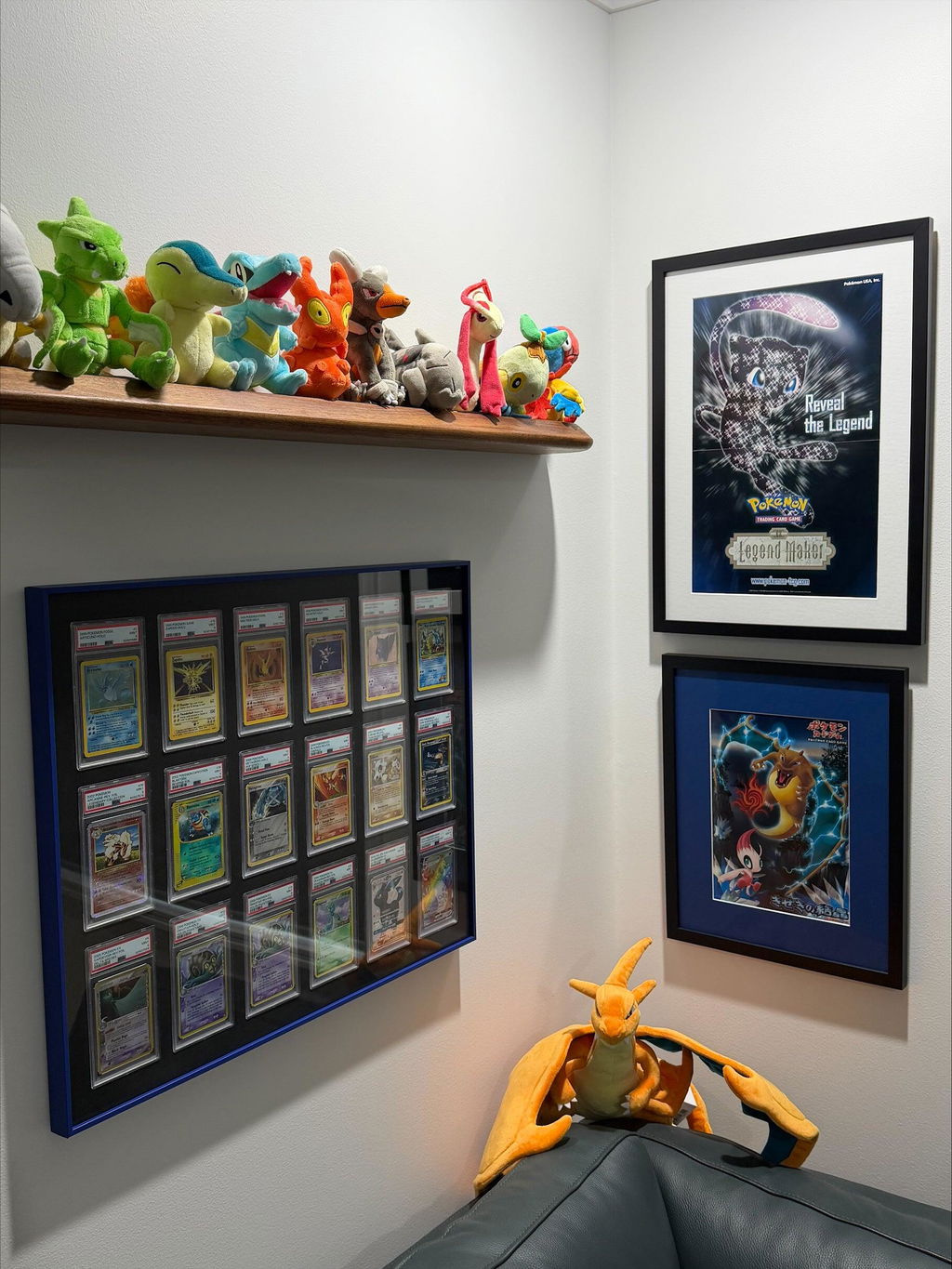
A collector can use all three materials in the same room. A wooden display on a cabinet might hold three favourite cards, while a wall-mounted aluminium frame accommodates a larger PSA collection. A frameless acrylic display could present another group where a minimal border is preferred. The choice is about the location, holder compatibility and visual arrangement, rather than one material being universally better.
When individual card stands are sufficient
A simple plastic or acrylic stand may be perfectly appropriate for one card that is frequently rotated. It is inexpensive, easy to move and occupies little space. For a collector who wants several cards displayed together with defined spacing and an outer acrylic cover, a fitted wooden body provides a different function.
Compare complete arrangements rather than just the material prices. Nine separate stands and one nine-card wooden display are different ways to organise the same group. A fitted display becomes more relevant when the collector wants a consistent layout and a particular wood finish that complements surrounding furniture.
A practical checklist before selecting a wooden graded card display
- Decide which cards will be displayed and whether they are graded or in magnetic holders.
- Identify the exact case brand, version and any non-standard dimensions.
- Measure the complete holder, including sleeves if retained.
- Choose a grid and confirm the selected holder option is available.
- Check the loaded display dimensions, support surface and stand capacity.
- Select a wood finish that suits the room and understand natural material variation.
- Choose suitable acrylic glazing based on viewing needs and technical data.
- Keep the display at a gentle supported angle, never vertical or wall-mounted.
- Remove the acrylic and cases before moving the wooden body.
- Keep the collection away from direct sunlight and excessive heat or moisture.
Frequently asked questions about wooden graded card displays
What is the best wooden display for PSA graded cards?
Choose a display prepared for your actual PSA holder format, with an appropriate number of compartments and enough support for the finished display. The best layout depends on the collection and furniture space.
Can a wooden PSA frame hold CGC slabs?
Only if the manufacturer confirms compatibility with the specific holders involved. Do not assume fit from the card size alone.
Are BGS and PSA slabs the same thickness?
They should not be treated as universally interchangeable. Measure the actual cases and use the appropriate holder option.
Can I display a thick sports memorabilia card in a wooden One Touch display?
Possibly, if the specific assembled magnetic case fits the recess and permits the cover to sit correctly. The card's point rating alone cannot establish compatibility.
Can I leave a protective sleeve on a graded slab?
Check whether the complete sleeved holder fits without binding. A sleeve changes the external dimensions and can create folds around the case edges.
Can I put an unprotected Pokémon card directly in a wooden recess?
Our wooden compartments are intended for the selected protective holders. Use a compatible holder before placing the card into the display.
Can I hang a wooden graded card display on a wall?
Our wooden design is not suitable for wall mounting because its card holders and acrylic are not mechanically secured. Choose a purpose-built wall display for vertical installation.
Does the wooden display include a stand?
No. Select a stable stand suited to the loaded display's size and weight, maintaining a gentle viewing angle.
Will the acrylic cover press against the graded cards?
It is intended to sit within its own recess, not press the holders into place. If a case obstructs the cover, check the holder compatibility.
Does a wooden frame protect cards from fading?
The wood itself is not the optical filter. Glazing specifications and display conditions determine light exposure. Avoid direct sunlight and prolonged intense illumination regardless of acrylic option.
Do wooden displays work for sports cards and TCG cards?
Yes, provided the external protective holder is compatible. The display is selected by the case format, not by the sport or game printed on the card.
Is walnut stain the same as walnut wood?
No. In our range, Walnut describes a colour finish applied to birch plywood. The same distinction applies to the other named stains.
Can I stain my wooden graded card frame myself?
The No Stain option is supplied without stain or varnish. Remove the acrylic and cards, follow the finish instructions and allow it to cure before use.
Can a large wooden display be perfectly flat?
Natural wood characteristics and internal stresses can cause variations in flatness, particularly in larger panels. Provide appropriate support and check the way the cover seats.
Is it better to use wood or aluminium for a large graded card wall?
For a vertical wall installation, choose a product engineered for wall mounting. Our aluminium and frameless ranges serve that purpose; our wooden range is designed for supported freestanding use.
How do I clean the acrylic over graded cards?
Follow the glazing supplier's cleaning guidance. Avoid abrasive cloths and inappropriate household cleaners, and keep the cases protected while cleaning the removable cover.
Further technical reading
- PSA: Standard trading card holder update
- CGC: Card holders and labels
- Beckett: Trading card grading and encapsulation
- Ultra PRO: ONE-TOUCH magnetic holder range
- Canadian Conservation Institute: Light, ultraviolet and infrared
- Canadian Conservation Institute: Ultraviolet filters
Final thoughts: choosing the display around the holder
The appeal of a wooden graded card display comes from the combination of natural material, an organised arrangement and a finish that suits its surroundings. Correct holder fit is fundamental to that experience. A display selected for the right case, placed on suitable furniture and viewed under sensible lighting gives collectors a practical way to enjoy a group of favourite cards.
We chose to introduce a recessed birch plywood design because it offers a different visual and functional option alongside our wall-mounted ranges. The most suitable display for a collector may be wood, aluminium, frameless acrylic or a simple individual stand, depending on how the collection is used.
Continue Exploring
- Wooden Trading Card Display Frames: The Complete Guide – construction, finishes and acrylic glazing.
- Wooden Pokémon & Trading Card Display Ideas – arrangements for desks, cabinets and collector rooms.
- Birch Plywood vs MDF vs Solid Wood – understanding display materials.
- Acrylic UV Protection & Technical Specifications – glazing properties and supplier data.
Explore Displays
For examples of the different construction methods described in this guide, explore our wooden trading card displays, aluminium wall frames and frameless acrylic displays. Our SlabVault® graded slab collection and MagVault® One Touch collection are additional starting points for collectors planning wall-mounted arrangements.

0 comments