


A wooden trading card display offers a different way to enjoy a collection. Some collectors prefer the clean appearance of an aluminium wall frame, while others want their Pokémon cards, graded sports cards or favourite One Touch magnetic holders to sit alongside books, furniture and other collectibles. Wood introduces natural grain, colour and texture into that arrangement.
Searches for wooden trading card display frames, wood Pokémon card display cases, wooden PSA slab holders and birch plywood card displays can lead to very different products. A traditional timber picture frame, a painted MDF box, a wooden stand for a single graded card and a fitted wooden display for an entire collection may look related, but their construction and intended use are not necessarily the same.
This guide explores the different ways wooden card displays are made, why the choice of wood matters, how stain and varnish change the appearance, and how acrylic glazing and holder compartments affect everyday use. It also explains why we introduced a birch plywood display range at SLABBED™ Studio alongside our aluminium and frameless acrylic designs.
What is a wooden trading card display frame?
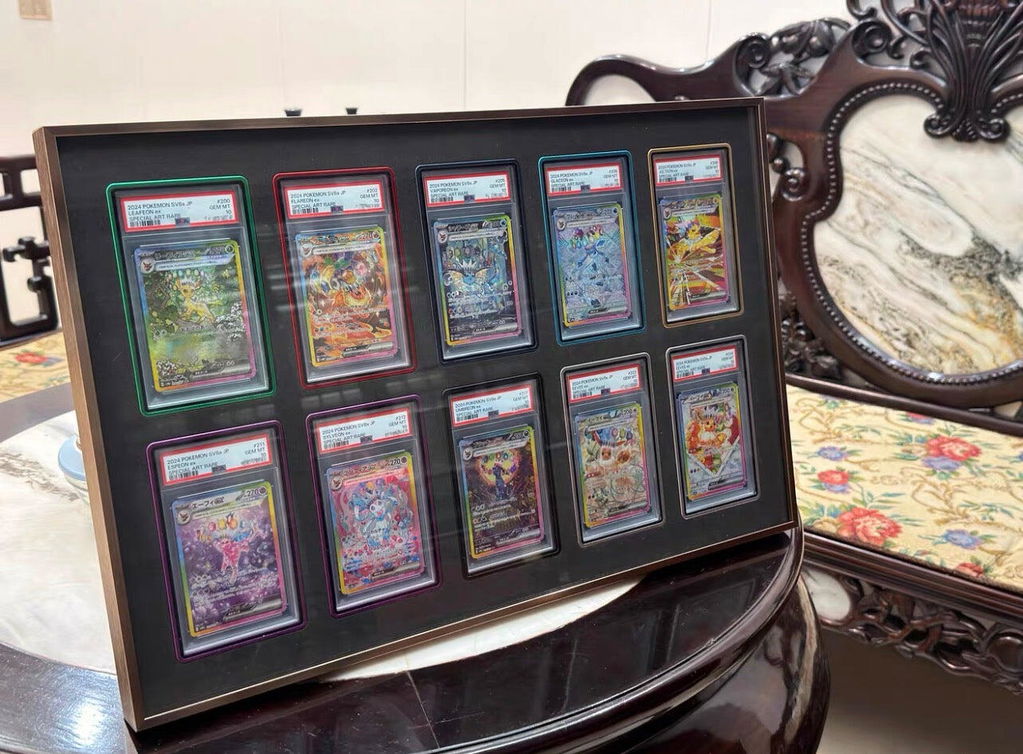
A wooden trading card display is an arrangement made to present one or more cards using a wood or wood-based structure. It may take the form of a wall-mounted picture frame, a shadow box, a tabletop stand, a fitted tray or a recessed wooden body with a clear protective cover.
These designs have different purposes. A small wooden stand might present a single PSA slab on a desk with no additional cover. A shadow box can accommodate holders behind a front panel. A machined wooden display instead incorporates the spaces for the card holders directly into the wood, so the body itself becomes part of the arrangement rather than just a border.
For collectors, the first decision is not simply whether to choose wood. It is whether the display suits the cards, their protective holders, the available space and the way the collection will be viewed.
Why choose wood for a Pokémon or graded card collection?
Trading cards often combine detailed illustrations, foil effects, colourful borders and prominent grading labels. A wooden surface creates a different visual background from polished metal or transparent acrylic. Depending on its colour, it can provide strong contrast or sit quietly alongside the cards.
Wood also connects a collection with the furniture around it. A walnut-coloured display on a dark desk, a pale birch display on a light bookcase or a black-stained wooden display in a gaming room can look like part of the room rather than a separate storage accessory.
That does not make a wooden frame inherently better for every collection. A collector building a large, vertically mounted feature wall may prefer a design intended for wall hanging. Someone with limited wall space may prefer a supported tabletop arrangement. The value of wood is that it offers another approach to presentation.
Different types of wooden trading card displays
Wooden display products vary in how they support the cards, whether they include glazing and how they are positioned. Understanding those differences is useful before comparing prices or deciding which format to use.
| Display type | Typical use | What to check |
|---|---|---|
| Single-card wooden stand | One favourite slab on a desk or shelf | Base stability, holder fit and viewing angle |
| Traditional wooden picture frame | Cards arranged within a separate insert | Internal depth, backing and mounting system |
| Wooden shadow box | Deeper holders or mixed memorabilia | Internal supports, glazing and access |
| Recessed wooden display | Multiple cards arranged directly in a wooden body | Holder dimensions, recess design and retention |
| Wooden display cabinet | A collection of cards and other objects | Shelf strength, enclosure design and lighting |
A collector does not need the same solution for every card. A small stand can be useful for a frequently rotated favourite, while a fitted display can create a more consistent arrangement for a selected set.
Why we introduced wooden trading card displays
Our existing aluminium and frameless acrylic ranges were developed around the idea of arranging protected trading cards into consistent, purpose-built layouts. When introducing wood, we wanted to preserve that principle while offering a substantially different material and a different way of displaying the collection.
Rather than creating another conventional wall frame with a wooden border, we chose a continuous birch plywood body with individual recessed compartments. The surrounding wood forms the visible spacing between cards, and a removable acrylic cover sits within the perimeter of the display.
This design is intended for supported freestanding presentation at a gentle viewing angle. It gives collectors another option for desks, cabinets, shelves and collection rooms, particularly where drilling into a wall is not desirable or where a natural finish suits existing furniture.
The wooden collection is not intended to replace our aluminium trading card wall displays or frameless acrylic trading card displays. Each serves a different presentation preference. Introducing wood allows those choices to extend beyond metal finishes and acrylic panels.
Understanding the materials behind a wooden card display
The term wooden display can describe a wide range of construction materials. A natural timber surface, a plywood panel, painted MDF and a wood-effect laminate are not interchangeable descriptions. What matters is the actual body material, surface finish and way the card holders are supported.
What is birch plywood?
Birch plywood is a wood-based panel made with bonded veneer layers, typically arranged with neighbouring grain directions alternating. Depending on the panel specification, the core may use birch throughout or include other wood species. The face and edge can therefore look quite different from one another.
The layered arrangement helps distribute the effects of wood movement across the panel, which is useful when working with a broad, flat shape. WoodSolutions explains the dimensional benefits of cross-laminated plywood in its technical overview of plywood. Those benefits do not eliminate variation between sheets or guarantee perfectly flat finished objects.
Why we selected birch plywood
For our wooden trading card displays, birch plywood was selected because of its relatively smooth face, fine grain, pale natural colour and suitability for a range of decorative stains. A lighter starting colour allows us to offer different finish tones while retaining visible wood characteristics.
The panel construction also suits the geometry of a display containing multiple recessed card compartments. Rather than joining narrow frame sections around a separate insert, the recesses can be formed directly in one continuous wooden body.
Birch is not a perfectly uniform material. Different veneer areas can absorb stain differently and exposed layers may have different colours. It is a good choice for this design because its natural appearance and construction suit the intended result, not because it can be made identical to a painted plastic surface.
Is plywood the same as solid wood?
No. Solid timber is wood cut from a tree, while plywood is made by bonding layers of wood veneer. Both contain real wood, but the construction is different. A single-piece plywood display means the main body is made from one panel, not that it is a solid piece of unlaminated birch timber.
Solid hardwood can be an attractive material for small card stands or handcrafted frames. However, when selecting material for a wide panel containing many cutouts, grain direction and changes in moisture become relevant. The layered construction of plywood offers a different balance of appearance, workability and dimensional behaviour.
How does birch plywood compare with MDF?
Medium-density fibreboard, commonly called MDF, is made from wood fibres bonded into a panel. Its relatively even composition makes it useful for painted furniture and routed decorative profiles. It is often an economical choice when a smooth opaque colour is the desired finish.
Birch plywood has a visible wood face and layered edges. For a display intended to show natural grain through stain, this is an important distinction. Standard MDF does not have the same natural grain pattern; a wood appearance can instead be achieved using veneer, printed laminate or a decorative coating.
Neither name alone determines whether a finished product is well made. The quality of the panel, the design, surface preparation and the final finish all influence the result. A well-made painted MDF display may be appropriate for one collector, while a stained birch plywood display may be more appropriate for another.
Wood, plastic, aluminium and acrylic compared
| Material | Typical visual character | Relevant considerations |
|---|---|---|
| Birch plywood | Natural grain and layered edges | Stain selection, machining quality, moisture and panel flatness |
| Solid timber | Distinctive grain and natural colour | Species, grain direction, knots and dimensional movement |
| MDF | Uniform painted or veneered finish | Edge preparation, coating and suitability for the environment |
| Moulded or 3D-printed plastic | Repeatable shapes or varied surface textures | Polymer, design, finish, rigidity and heat sensitivity |
| Aluminium | Metallic, anodised or coated finish | Profile construction, connections and intended mounting |
| Acrylic | Transparent, coloured or minimalist appearance | Optical grade, thickness, surface scratching and support |
These are material families, not a ranking of quality. A useful comparison starts with the finished object's purpose. A lightweight plastic stand for a single card has a different job from a large machined wooden panel with a separate protective cover.
How recessed wooden card compartments work
In a fitted wooden display, each compartment is shaped around the outer dimensions of the selected card holder. The cards remain in their existing graded slabs or magnetic cases, and the recesses establish their positions within the layout.
Our design uses precision CNC machining to form the holder compartments and the surrounding acrylic recess in a single birch plywood body. The manufacturing process allows the arrangement to be prepared for the selected holder format and grid size. The finished appearance still depends on the underlying wood and the subsequent preparation.
Spacing between compartments matters visually as well as physically. Sufficient surrounding material separates neighbouring holders, while consistent alignment helps a group of cards read as a single collection. Finger-access areas assist with lifting the holders out without needing to prise against their edges.
Why not just put trading cards directly into the wood?
Raw cards and sleeved cards are thinner and more flexible than graded slabs or rigid magnetic cases. A recess intended for a rigid holder is not automatically suitable for an unprotected trading card. Paper edges, foil surfaces and corners are easily affected by unnecessary handling or contact.
The wooden displays discussed here are designed for the specified protective holders, not for loose cards sitting directly against a wood surface. For collectors who prefer ungraded cards, a correctly sized One Touch magnetic holder can provide a rigid outer format without requiring professional grading. Other raw-card display designs use different support systems.
Choosing the correct holder type: PSA, CGC, BGS or One Touch
The dimensions of a trading card and its outer case are two different measurements. A standard-size card can be encapsulated in a number of holders that differ in height, width, depth, corner design and label area. A wooden opening must accommodate the holder, rather than merely the dimensions of the card inside it.
| Holder type | Common collector use | Display considerations |
|---|---|---|
| PSA graded slab | Pokémon, sports and other professionally graded cards | Outer case dimensions and label visibility |
| CGC graded slab | Trading card game and sports collections | Case generation, shape and fit |
| BGS (Beckett) graded slab | Graded cards, including sports and TCG collectibles | Holder profile, thickness and external size |
| One Touch magnetic holder | Ungraded cards protected in rigid cases | Specific holder brand, outside dimensions and card thickness |
Collectors should check their actual holders before selecting a fitted display. Oversized slabs, special cases, protective slab sleeves and different magnetic-holder thicknesses can change the required clearances. One Touch is also used as a general search term, even though magnetic cases from different manufacturers need not share the same outside dimensions.
Our wooden range is offered in different holder-specific configurations, with availability varying by layout. A larger display may be offered in fewer holder formats than a smaller one. The selected product and card type determine compatibility.
How the recessed acrylic cover changes the presentation
A wooden card stand without an outer panel leaves the holder surface exposed to routine dust and accidental contact. Adding a separate clear acrylic cover creates another physical layer between the collection and its surroundings.
In our wooden design, the acrylic sits within a shallow perimeter recess below the surrounding wood surface when properly seated. This keeps the visible outline of the display continuous and avoids a raised sheet dominating its appearance. The cover can be removed to access the cards without permanent attachment to the wooden body.
The panel is not a sealed enclosure. It provides a covering layer but does not create a controlled humidity environment or eliminate dust ingress. The original grading or magnetic holder remains the primary enclosure around each card.
Why our wooden displays are not designed for wall mounting
Wooden frames can be wall-mounted if their construction, hardware and card retention system are designed for that purpose. Our recessed wooden displays are a different design. Both the card holders and the removable acrylic cover rely on gravity to remain in their respective shallow recesses.
When the display is positioned at a gentle viewing angle, the components can remain seated while the cards are visible. If it is stood vertically, tilted steeply or moved with the components installed, either the holders or the acrylic may become dislodged and fall out. The substantial weight of the wooden body is another consideration.
For that reason, these displays are intended for supported freestanding use, not wall hanging. Choose a stable stand or easel appropriate for the full size and loaded weight, provide adequate support, and keep the viewing angle gentle. Remove the acrylic and card holders before moving or repositioning the display. No universal safe angle is specified because support, layout and component fit vary.
Display stands are not included in our wooden range. A collector may prefer a small easel, a supported furniture arrangement or another suitable stand, and the best choice depends on the display dimensions and available space.
If a wall-mounted collection is the priority, a frame designed with mechanical retention and wall-mounting hardware is more appropriate. Our aluminium displays and frameless acrylic range are alternatives designed around wall presentation.
Wood stains, varnish and the appearance of birch plywood
Choosing a stain is a way of changing the visible colour of wood without necessarily concealing its grain. A transparent or semi-transparent stain can create a darker, warmer or more neutral tone while allowing natural patterns to remain visible. An opaque paint, by comparison, generally places more emphasis on a uniform surface colour.
Varnish is a separate finishing step. A compatible protective finish can help the surface resist routine handling and improve the appearance of the completed display. Its sheen and colour can also influence how the stained wood looks under room lighting.
With our stained wooden displays, the body is individually prepared, sanded, stained and varnished in Australia. The No Stain option is supplied without stain or varnish for collectors who prefer to finish the wood themselves.
Nine wood finish options
| Finish | General colour character | Possible collector arrangement |
|---|---|---|
| No Stain | Natural pale birch | Light furniture or a personal finishing project |
| Black | Dark, understated wood tone | Gaming setups and colourful modern cards |
| Cedar | Warm reddish-brown | Earth-toned rooms or vintage collections |
| Jarrah | Rich warm brown with red undertones | Traditional furniture and warmer interiors |
| Mahogany | Deeper reddish-brown | Dark furniture and selected vintage cards |
| Maple | Warm, lighter golden tone | Bright rooms and colourful illustrations |
| Oak | Natural-looking warm brown | Neutral interiors and timber shelving |
| Teak Oak | Warm golden-brown | Natural-toned furniture and mixed collections |
| Walnut | Medium to deep brown | Dark desks, cabinets and understated arrangements |
These descriptions are general visual guides, not exact colour specifications. The finish names describe stains applied to the same birch plywood body. Selecting Walnut does not change the body material to walnut timber, and selecting Oak does not mean the display is made from oak.
Why does the same stain look different on different wooden displays?
Birch has variations in grain and local absorption. The face veneer, exposed layers and machined areas may take up stain differently. A darker stain may emphasise these differences rather than hide them. Even matching finishes applied to two pieces from the same panel need not produce an identical result.
Woodworkers often test stains on an offcut and consider a suitable conditioner or wash coat before applying a finish, particularly on birch and other blotch-prone woods. WOOD Magazine's guide to consistent staining illustrates how preparation changes results on birch veneer plywood.
Reference photographs and digital colour illustrations are useful for narrowing down a choice, but they should not be treated as a guarantee of an exact colour. Screen calibration, lighting, grain, surface preparation and the final varnish all influence how a completed display appears.
Can collectors stain their own wooden card display?
An unfinished wooden display gives collectors more control over the colour and type of finish. This can be useful when matching a specific desk or a piece of furniture that already has a particular timber treatment.
Use a product suitable for the wood and the intended indoor environment, follow its preparation and curing instructions, and test on a separate sample where possible. Excessive sanding can damage a thin face veneer, so avoid treating plywood exactly like a thick piece of solid hardwood. Remove the acrylic and all cards and holders before applying any finish. Allow the complete finish to cure before the collection is installed.
Natural wood grain, plywood layers and manufacturing variations
A wooden display will have material characteristics that are not present in the same form on an aluminium extrusion or clear acrylic panel. The visible wood face can include grain changes, knots, localised differences in colour and surface repairs or other marks associated with the panel. Machining can expose internal veneer layers, making differences within the material more apparent.
Some areas of a panel may be more brittle than others, depending on the local grain and veneer composition. Small chips, splinters, internal voids or variations in texture may be visible around cutouts or edges. Careful preparation and sanding can improve the finish, but not every characteristic of the underlying material can be removed.
We aim to produce a refined display while retaining the natural appearance of wood. This is also why we show manufacturing photographs in our product imagery. Unfinished pieces, exposed layers and illustrative stained previews help explain the construction and finishing process. They should be distinguished from photographs of an actual completed stained display.
Can a large plywood trading card display bow or warp?
Yes. Cross-laminated construction improves dimensional stability, but plywood is still a wood-based material. Moisture changes, internal stresses and differences in finishing or storage conditions can affect the shape of a panel. The larger the display, the more noticeable small variations in flatness may become across its surface.
For a recessed display, slight bowing can also affect how evenly a removable acrylic panel sits. Our wooden range discloses these possible variations rather than promising perfectly flat natural wood across every size. Store and display the panel in a dry, stable indoor environment with suitable support, rather than trying to force it flat or relying on a small stand to support an oversized body.
Natural material character is not the same as unsafe construction. A display that is damaged or cannot safely support its components should not be used until the issue has been addressed.
Does a wooden trading card display protect cards from UV light?
The wooden body establishes the appearance and supports the card holders. It is the transparent glazing specification, rather than the wood stain, that determines how much ultraviolet radiation passes through the front panel.
Clear acrylic can filter certain wavelengths while still transmitting visible light. Specialist glazing can provide broader documented UV filtration and reduce reflections, depending on the product. However, visible light can still contribute to fading of printed material. The Canadian Conservation Institute's guidance on light, ultraviolet and infrared radiation explains why exposure intensity and duration matter when displaying sensitive objects.
Keep valuable cards away from direct sunlight, excessive heat and prolonged bright lighting. A graded holder and an acrylic cover do not make a card immune to ageing or environmental changes.
Premium clear acrylic versus museum-grade acrylic
We offer premium clear PMMA acrylic as the standard cover in our wooden displays, with an optional PLEXIGLAS® Gallery & Museum acrylic upgrade where listed. These choices also feature in our other display ranges.
| Specification | Premium clear acrylic | Optional museum-grade acrylic |
|---|---|---|
| Visible-light transmission | Up to 92%, as specified by our supplier | Approximately 99%, as listed by the specialist supplier |
| UV filtration | Our supplier's reported test shows filtering below approximately 330 nm; higher-wavelength transmission varies | Specialist UV filtering; consult the current wavelength-specific technical data |
| Surface reflections | Normal clear acrylic reflections | Specialist anti-reflective finish |
| Viewing considerations | Suitable for many normal indoor displays | Optical performance can depend on distance from the displayed object |
The Australian supplier's PLEXIGLAS® Gallery & Museum AR listing describes its optical properties, but also warns that separation between the acrylic and the object can affect perceived sharpness. In a trading card display, the card is inside a holder and may sit behind the glazing with some separation. That is worth considering when selecting a specialist panel.
For a more detailed explanation of wavelengths and glazing choices, see our trading card display UV protection guide and acrylic versus glass comparison.
Choosing a wooden trading card display size and layout
The size of a collection does not have to dictate the size of an individual display. Some collectors want to see every card from a particular set together. Others prefer a few carefully selected cards in a smaller arrangement, with the remaining collection stored separately.
| Example layout | Possible use | Planning consideration |
|---|---|---|
| 1 card (1 × 1) | A personal favourite or milestone grade | Small stand and comfortable viewing distance |
| 3 cards (3 × 1) | A Pokémon evolution line or three related sports cards | Horizontal furniture space |
| 4 cards (2 × 2) | A compact themed arrangement | Balance of width and height |
| 9 cards (3 × 3) | A curated set of illustrations or favourite players | Stand footprint and loaded weight |
| 35 cards (7 × 5) | A larger themed collection | Substantial support, panel size and access |
The single-card wooden display and three-card wooden display illustrate how the same construction can be used at smaller scales. Larger layouts need to be planned around their actual dimensions and weight, not just the number of openings. A purpose-built wall display may be more practical when suitable freestanding furniture or support is unavailable.
Wooden Pokémon card display ideas
A wooden Pokémon card display can organise a collection around a theme rather than the total number of cards owned. A Bulbasaur, Ivysaur and Venusaur evolution line might suit a three-card arrangement. A Charizard collection could be organised by release or artwork, while Eeveelution collectors might select a grid based on their favourite cards.
Vintage Base Set, Jungle and Fossil cards can look particularly at home alongside natural wood tones. Modern Illustration Rares and Special Illustration Rares can also work well against a quieter background that does not compete with the art. The best finish is a matter of visual balance and personal taste, not a rule that older cards must be displayed in darker wood.
A collector who owns hundreds of Pokémon cards could place a smaller wooden display on a desk and reserve a larger wall-mounted aluminium or frameless display for a different part of the collection. This lets each presentation serve a purpose without needing to change the holders themselves.
Wooden sports card displays for baseball, basketball and football
Sports card collectors often build arrangements around players, teams, seasons, rookie cards, autograph cards or a specific manufacturer such as Topps or Panini. A wooden display can fit naturally into a study or office alongside other sports memorabilia.
A three-card display could show a player's rookie card, a later autograph and a favourite insert. A larger grid could group a team's starting lineup or a selection of players from a particular era. For thick patch cards, memorabilia cards and unusual graded holders, confirm the complete outer dimensions before choosing a fitted recess.
Display location matters just as much for sports cards as it does for Pokémon. An office desk that receives strong afternoon sunlight is not ideal for a valuable rookie card merely because the card is encapsulated in a slab.
Wooden displays for MTG, One Piece and Yu-Gi-Oh!
Magic: The Gathering collections can be organised by artist, colour identity, set or favourite card illustration. A small wooden display can work for a group of favourite cards without requiring the entire collection to be graded. Suitable magnetic holders provide another format for cards that are not regularly used in play.
One Piece collectors might arrange cards around the Straw Hat crew, particular characters or a selected group of alternate arts. Yu-Gi-Oh! collectors could use a smaller display for iconic cards such as Dark Magician, Blue-Eyes White Dragon and Red-Eyes Black Dragon.
The artwork and franchise do not determine whether a holder will fit. Select the display according to the external case format and the intended layout. That is especially important when mixing collectibles from different grading companies.
Wooden displays for desks, shelves and collection rooms
A wooden display on a desk can provide a small personal collection without occupying wall space. On a bookshelf or cabinet, the finish can complement existing furniture or sit alongside figures and memorabilia. Consider the complete footprint of the supporting stand, not only the width of the wooden body.
Keep the arrangement away from busy edges, places where it could be knocked and surfaces that are unstable or uneven. For a collection room, a gently angled display may make cards easier to see while sitting or standing nearby. Do not steepen the viewing angle simply to fit a narrow shelf.
For renters or collectors who prefer not to drill into walls, supported displays and cabinets can be useful alternatives. Wall-mounted frames remain an option if the property and mounting conditions allow it. Our complete trading card display guide covers additional approaches, including shelves, stands and wall arrangements.
Wooden vs aluminium vs frameless acrylic displays
Choosing between these three formats is largely a decision about presentation, support and personal preference. Each of our ranges is designed around a different type of finished appearance and installation.
| Consideration | Wooden birch plywood | Aluminium | Frameless acrylic |
|---|---|---|---|
| Visual character | Natural wood grain and stained finishes | Defined metallic perimeter | Minimal visible outer border |
| Holder support | Individual machined recesses | Purpose-cut insert within the frame | Purpose-cut insert between acrylic panels |
| Intended positioning | Supported freestanding display | Wall-mounted display | Wall-mounted display |
| Customisation | Wood finish and layout | Frame, insert and backing options | Insert and backing options |
| Material character | Natural grain and possible flatness variations | Metal profiles and applied finishes | Clear or coloured acrylic surfaces |
| Access | Removable cover, used in a supported position | Depends on frame assembly design | Depends on panel assembly design |
The table describes our own product designs, not every wooden, aluminium or acrylic display available on the market. Our aluminium trading card display guide explains the metal frame approach in more detail. For a wider comparison across holder types and display formats, see how to choose the right trading card display frame.
What influences the cost of a wooden trading card display?
A simple wooden stand can be inexpensive and entirely adequate for a single favourite card. A larger fitted display involves a different set of requirements: a panel large enough for the arrangement, machining individual compartments, preparing the wood, applying the selected finish, fitting a clear protective cover and packaging the completed item for transport.
Design and production scale also affect cost. A standard mass-produced accessory can spread tooling and setup costs across many identical units. A made-to-order display may instead be prepared for a particular holder format, layout and finish. Large acrylic panels and substantial wooden bodies also require appropriate handling and packaging.
When comparing products, look at what is actually included. Is the surface natural wood, veneer or a printed finish? Is the glazing included? Are the spaces fitted to the holders you use? Can the display be safely positioned in your room? These questions are more informative than price alone.
How to care for a wooden trading card display
Use a clean, soft cloth to remove loose dust from the wood and follow the instructions for the applied finish. Avoid prolonged moisture, aggressive cleaners and rubbing grit across the surface. Wipe up spills promptly and keep the display away from damp rooms and strong heat sources.
Clean the acrylic separately using methods appropriate to its specific grade. Loose particles should be removed gently before wiping, and specialist coatings may require different care from ordinary clear sheets. Consult the PLEXIGLAS® cleaning guidance and the instructions supplied with the actual panel.
Inspect the support and component fit periodically. If the display needs to be moved, first place it in a safe supported position and remove the acrylic and card holders. This reduces the risk of them slipping during handling.
A practical checklist before choosing a wooden card display
- Decide whether you want a small curated arrangement or a larger collection display.
- Identify the exact PSA, CGC, BGS or magnetic holder format you use.
- Measure the available shelf, cabinet or tabletop, including the support footprint.
- Choose a display designed for your intended orientation.
- Check the actual body material and surface finish.
- Consider the final wood colour alongside your furniture and card artwork.
- Check whether an acrylic cover is included and which optical grade is offered.
- Plan a stable support suitable for the full size and weight.
- Choose an indoor location away from direct sunlight and sustained moisture.
- Allow for natural wood variation and make sure the card holders and cover remain seated.
Frequently asked questions about wooden trading card displays
Are wooden trading card display frames suitable for graded Pokémon cards?
Yes, when the display is designed for the specific grading holder. Confirm the available holder format, outer dimensions and intended positioning rather than assuming all slabs share the same size.
Can a wooden PSA card display also hold CGC or BGS slabs?
Not necessarily. The wooden compartments are prepared for a selected holder format. Check the fit of the actual slab before using a display designed for another grading company.
Can I display ungraded cards in a wooden display?
Yes, using a compatible rigid magnetic holder in a display prepared for that format. Our recessed wooden range is not designed for loose or merely sleeved cards placed directly into the compartments.
Is birch plywood real wood?
Yes. It is an engineered wood panel made from bonded veneers. It differs from solid timber because it has a layered construction rather than one continuous natural grain direction.
Is plywood better than MDF for a stained card display?
Birch plywood offers visible natural wood grain that suits transparent stains. MDF is commonly selected when a uniform painted or veneered finish is desired. The intended finish and construction matter more than a universal material ranking.
Does walnut stain mean the display is made from walnut?
No. In our wooden range, the stain name refers to the colour finish applied to the birch plywood body.
Can I order unfinished birch plywood?
Yes. Our No Stain option is supplied without stain or varnish so you can apply your own compatible finish.
Will the stained display look exactly like the product image?
Not exactly. Natural wood grain, stain absorption, lighting and varnish can alter the appearance. Illustrative stained images are references rather than exact representations of every finished item.
Why are plywood layers visible inside the compartments?
Machining removes material from the panel and can reveal the individual bonded veneer layers beneath the face. This is characteristic of plywood construction.
Can wooden displays have minor chips or irregularities?
Natural grain and internal veneer variations can affect the appearance of machined areas. Careful preparation improves the finish, but some minor texture differences or imperfections may remain.
Can a large wooden display be perfectly flat?
Perfect flatness cannot be guaranteed. Natural panel characteristics and environmental conditions can produce slight bowing, especially across larger dimensions.
Can I hang your wooden trading card display on a wall?
No. Our recessed design relies on gravity to retain both the acrylic and the card holders. It is not suitable for vertical wall mounting or steep display angles.
Do wooden trading card displays include a stand?
Our wooden range does not include a stand. Collectors can choose their own stable support suited to the display size, weight and gentle viewing angle.
Can the acrylic cover be removed?
Yes. The acrylic rests in a surrounding recess and can be removed for access while the display is safely supported.
Does acrylic stop Pokémon cards from fading?
Acrylic may reduce UV exposure according to its tested optical properties, but visible light and other environmental factors remain relevant. Avoid direct sunlight even when using specialist glazing.
Is museum-grade acrylic necessary for wooden displays?
Not for every collector. Standard clear acrylic may be suitable in a controlled indoor location. Specialist glazing can be considered where its documented filtration or optical properties are important.
Are wooden displays suitable for sports cards?
Yes, provided the grading slab or magnetic holder is compatible. Thick autograph and patch-card cases may require particular attention to external dimensions.
Should I choose a wooden or aluminium trading card display?
Choose based on the intended location and appearance. Our wooden range is for supported freestanding presentation, while our aluminium range is designed for wall mounting.
Can I mix wooden, aluminium and frameless displays in one room?
Yes. Different materials can serve different parts of a collection. A small wooden arrangement on a desk and a larger wall-mounted frame can complement each other without needing matching construction.
Further technical reading and original sources
The following resources offer additional information about wood panels, surface preparation, display lighting and protective glazing. They are useful for evaluating materials regardless of which display manufacturer you choose.
- WoodSolutions: Plywood – panel construction and material properties.
- APA: Sanded Plywood Product Guide – layered panels and surface characteristics.
- WOOD Magazine: How to Get Consistent Stain on Problem Woods – stain preparation and birch veneer examples.
- Canadian Conservation Institute: Light, Ultraviolet and Infrared – cumulative light exposure and material deterioration.
- Canadian Conservation Institute: Glazing Materials for Framing Works on Paper – properties of protective glazing.
- Perspex Online: PLEXIGLAS® Gallery & Museum AR – supplier specifications and viewing-distance considerations.
- PLEXIGLAS®: Cleaning and Maintaining Acrylic – manufacturer care guidance.
Final thoughts: choosing a display that suits the collection
Wooden trading card displays are a useful option for collectors who want their cards to sit naturally alongside furniture, books and other collectibles. A fitted birch plywood body offers a way to arrange holders in individual compartments while making the wood itself part of the visible design.
Our decision to introduce wood was about providing another choice, rather than identifying one universally superior display material. A stained wooden display on a supported stand, an aluminium wall frame and a frameless acrylic arrangement can all serve different roles in the same collection.
Whichever approach you choose, start with the actual holder dimensions, the location and support, the appearance you prefer and the appropriate glazing. The best arrangement is the one that fits your collection and lets you enjoy it without introducing unnecessary risk to the cards.
Continue exploring
- The Ultimate Trading Card Display Guide – frames, shelves, cabinets and other display ideas.
- How to Choose the Right Trading Card Display Frame – card types, fit and construction.
- Aluminium Trading Card Display Guide – metal frame construction and finish options.
- UV Protection for Trading Card Display Frames – understanding filtration and light exposure.
- Acrylic vs Glass for Trading Card Displays – clarity, glare, weight and glazing selection.
Explore display materials
For examples of the construction methods discussed in this guide, SLABBED™ Studio offers wooden birch plywood trading card displays, aluminium trading card wall frames and frameless acrylic trading card displays, with holder-specific layouts and different finish options across the three ranges.

0 comments