


Physical video game collections are often displayed in rooms built around light. A gaming setup may have RGB LED strips behind a monitor, coloured wall washes, illuminated shelving, overhead spotlights and a glowing console cabinet. Those effects can make a collection of PlayStation, Xbox or Nintendo games look striking. They also raise a question that matters to anyone displaying valuable physical games: can LED gaming-room lighting fade video game cases, printed cover artwork or sealed packaging?
The practical answer is that LED lights are often easier to control than sunlight and many older light sources, but low UV output does not mean zero risk of fading. Visible light contributes to the cumulative exposure of printed paper, dyes and coatings. A well-designed video game display uses enough light to enjoy the collection while avoiding unnecessary intensity, heat and continuous illumination.
This guide explains how to choose LED lighting for a gaming room or video game display, including LED strip placement, RGB lighting, colour temperature, colour-rendering quality, glare, lux, exposure time and UV-resistant glazing. It also looks at how the priorities change for Nintendo Switch cases, PS5 and PS4 games, Xbox collections, PS2 cardboard sleeves, retro Nintendo boxes, factory-sealed games and expensive or sentimental editions. The purpose is education, not a claim that any particular lamp, shelf or frame can prevent all deterioration.
The short answer: are LED lights safe for video game collections?
LED lighting can be a sensible choice for displaying physical video games when it is correctly selected, positioned and controlled. Most general-purpose white LED lamps emit little ultraviolet radiation compared with some older lighting technologies, and they can be dimmed, directed and switched off easily. They also tend to place less unwanted radiant heat on a display than incandescent or halogen spotlights.
However, a low-UV LED still emits visible light. The same light that allows you to see the red Nintendo Switch spine, blue PS5 cover, original Xbox artwork or holographic SteelBook finish can contribute to colour changes in sensitive printed materials after sufficient exposure. The sensitivity depends on the actual inks, coatings, previous exposure and environment. A manufacturer's marketing phrase such as “UV-free LED” is not a lifetime fading guarantee.
For a collector, the most useful starting points are simple: keep games out of direct sunlight, use moderate rather than excessive brightness, place lighting outside enclosed displays when possible, prevent heat buildup and switch decorative lighting off when nobody is viewing the collection.
Why collectors add lighting to game displays
Lighting serves several different purposes. A warm shelf light helps identify titles along the spines. A low-output wall wash adds depth to a collection of boxed games. An adjustable spotlight can draw attention to a rare factory-sealed copy or a framed group of favourite titles. RGB strips can coordinate the room with a console generation or game franchise.
Those are legitimate design choices. The challenge is that a visually dramatic gaming room often places the brightest light exactly where original printed packaging is exposed for the longest time. A narrow, brightly lit shelf may be easy to read at night but unnecessarily demanding for a fragile cardboard box that has already spent decades in imperfect conditions.
It helps to separate lighting needed to view the collection from lighting used to decorate the room. The first should provide clear, comfortable visibility. The second can often be directed onto walls, floors or architectural surfaces instead of onto the collectibles themselves.
What light can change in a physical video game collection
Physical video games are made from more than discs or cartridges. The visible collectible may include printed paper cover inserts, plastic cases, cardboard boxes, glossy coatings, metallic foils, adhesives, paper manuals, labels, shrink-wrap, stickers and occasionally handwritten signatures. Different materials react differently to light, temperature and humidity.
Long-term changes can include fading, yellowing, discolouration, loss of contrast and some changes in coatings. Plastic cases can age independently of the printed artwork beneath their transparent sleeves. A discoloured clear case does not necessarily prove that the printed insert has faded; conversely, colourful cover art can change while the plastic looks relatively normal.
The Library of Congress guidance on limiting light damage describes light damage as cumulative and often irreversible for sensitive heritage materials. The exact threshold for a particular modern game cover is usually unknown, so conservative positioning and controllable lighting remain more useful than a universal promise of safety.
UV, visible light and infrared: three separate concerns
Light-related preservation advice sometimes mixes together ultraviolet radiation, visible light and infrared radiation. For a gaming room, distinguishing them makes buying decisions considerably clearer.
| Radiation or effect | Broad description | Why a video game collector should care |
|---|---|---|
| Ultraviolet (UV) | Invisible radiation shorter in wavelength than visible light | Can contribute to chemical deterioration and fading; filtering performance varies by lamp and glazing |
| Visible light | The wavelengths that allow us to see game artwork | Can also contribute to the fading of sensitive inks and papers; intensity and exposure time matter |
| Infrared (IR) and heat | Longer-wavelength radiation and thermal effects | Excess warmth can alter the storage environment and contribute to material deterioration |
A good acrylic or glass cover can reduce specified UV wavelengths. It does not eliminate visible light, because a transparent display necessarily lets some viewing light reach the object. Lighting strategy therefore remains important even when a product offers specialist UV-filtering glazing.
Why UV-free does not mean fade-proof
The most common mistake is equating “no UV” with “no fading”. UV is important, but colourants can react to portions of the visible spectrum as well. A bright LED pointed at printed cover art for many hours every day may create a larger cumulative visible-light exposure than a dim lamp used briefly.
The Canadian Conservation Institute's technical bulletin on LED lighting explains that well-chosen LEDs do not overturn the central rule of preservation lighting: potential light damage is related to intensity and duration. An LED without substantial UV emission can still produce the visible-light exposure associated with fading.
That does not make LED lighting unsuitable. It means the most effective control is not merely purchasing a light advertised as UV-safe, but designing a room where the illumination is appropriate to the collection and is not constantly on without purpose.
Why sunlight is usually a much bigger problem than ordinary indoor LEDs
Direct sunlight is intensely bright, varies through the day and can bring both ultraviolet radiation and heat. It can reach a display even when the collector believes the room is mostly shaded, especially during seasonal changes in the sun's angle.
For many homes, changing the wall or shelf location can reduce exposure more effectively than replacing a perfectly adequate indoor LED lamp. Curtains, blinds and careful furniture placement can help where windows are unavoidable. A game case placed on a windowsill is not made safe simply by putting an LED strip above it instead of a ceiling light.
For a deeper explanation of sunlight and printed artwork, see Can Sunlight Fade Video Game Cases? and the broader UV Protection for Video Game Cases guide.
Does sunlight through a window still matter?
Yes. Ordinary window glazing reduces some UV wavelengths, but it does not remove all of the relevant light exposure. Sunlight through a window can remain dramatically brighter than normal room lighting. A bright patch across a shelf can also heat darker packaging and frames.
Check the display area in the morning and afternoon, not only at night when the gaming room lighting looks its best. If the shelf is in the path of direct sun, a blind, a different wall or a covered storage area is often a more sensible first intervention than adding a specialist lamp.
A valuable game does not need to be exposed to direct sun to be appreciated. Some collectors use a covered cabinet for storage and bring out individual editions for occasional display or photography, an approach that reduces unnecessary cumulative exposure.
What is a lux, and why does it matter?
Lux is a unit describing visible light falling on a surface. It is a measurement of illumination at the game cover, not simply the output printed on a bulb box. Two LED products with similar advertised lumens can produce very different lux readings on a game case depending on distance, optics and direction.
A narrow spotlight may concentrate illumination on a single sealed title. A diffuse strip or reflected wall wash may produce gentler and more even light. The useful question is therefore not just “How many lumens is the light?”, but “How much light is actually reaching my collection?”
Museums sometimes use lux readings when evaluating sensitive artworks, printed documents and photographs. Such reference values should not be presented as experimentally established safe levels for every PS5, Xbox 360 or Nintendo Switch cover. For home collections, a meter is more useful for comparing alternative positions and detecting unexpectedly bright areas.
Why duration matters as much as brightness
Exposure accumulates. A dim light operating constantly can eventually provide a substantial total dose, while a somewhat brighter light used only briefly may result in much less overall exposure. This is one reason automatic schedules and motion sensors can be more valuable than a premium lighting brand name.
Consider a purely illustrative calculation. At 100 lux for two hours a day, the annual dose is 73,000 lux-hours. At 300 lux for eight hours a day, the annual dose is 876,000 lux-hours. That is twelve times the measured visible-light exposure in the second scenario. It does not mean a game cover will fade twelve times as visibly, because material sensitivity and spectral differences matter, but it demonstrates why the lighting schedule belongs in the discussion.
| Illustrative lighting pattern | Light at the collection | Time per day | Annual exposure |
|---|---|---|---|
| Brief viewing session | 100 lux | 2 hours | 73,000 lux-hours |
| Moderate evening display | 150 lux | 4 hours | 219,000 lux-hours |
| Bright daily display | 300 lux | 8 hours | 876,000 lux-hours |
| Continuous feature lighting | 100 lux | 24 hours | 876,000 lux-hours |
These values are mathematical examples, not approved limits for commercial game packaging. The table's point is that a 24-hour illuminated display can accumulate the same dose as a much brighter light that is used for fewer hours.
Are museum lighting limits suitable for video game cases?
Museum literature sometimes mentions 50 lux for highly light-sensitive material, higher values for less-sensitive objects and different permitted exhibition periods. Those figures are part of conservation practices for diverse heritage collections. They are not a tested universal specification for modern game-box inks, polymer sleeves or every regional video game edition.
A collector can still learn from the principles behind those recommendations. Identify the most sensitive materials, limit illumination to what is needed for viewing and avoid long-term exposure where preservation is a priority. A rare signed cardboard box deserves more caution than an easily replaceable modern empty plastic case.
The Canadian Conservation Institute's discussion of light, UV and infrared explains how museums reason about exposure rather than treating brightness as the only relevant variable.
LED versus incandescent and halogen display lighting
LEDs are often convenient for collecting rooms because they are energy-efficient, can produce high-quality visible light and are available in compact, directional forms. Incandescent and halogen fixtures can look attractive, but they generally emit more unwanted heat for the amount of visible light produced.
An old halogen spotlight close to a framed video game collection may present both a bright-light problem and a local heating problem. A carefully positioned LED can often provide a similar viewing effect with less power consumption and less radiant heat. Even then, its components, drivers and heat sinks still generate heat and must be installed according to manufacturer instructions.
No light type is universally safe merely because of its technology. The choice of lamp, brightness, placement, ventilation and operating hours matters more than a broad “LED good, halogen bad” rule.
LED versus fluorescent tubes in collection rooms
Fluorescent lamps are common in older game rooms and garages. Their UV output depends on design, materials, diffusers and any filters fitted. Some can deliver perfectly workable room illumination, but they are not necessarily ideal for sensitive displays where the spectral characteristics and exposure time are unknown.
Replacing an old lamp with a good-quality LED may improve controllability and reduce energy consumption. It does not eliminate the need to manage exposure to visible light. If the fluorescent fixture is only providing general illumination for a storage room, simply turning it off when the room is unoccupied can also make a meaningful difference.
For special editions and valuable original packaging, choose a lighting approach based on the overall environment rather than assuming every replacement bulb must be purchased from a specialist museum supplier.
How colour temperature changes the look of game artwork
White LEDs are offered in different correlated colour temperatures, expressed in Kelvin (K). Lower numbers commonly look warmer and more yellow; higher numbers commonly look cooler and bluer. Colour temperature is mainly an appearance choice, not a standalone measure of lamp quality or conservation performance.
A warmer lamp can complement gold or bronze aluminium frames and retro artwork. A neutral lamp may make modern PlayStation and Xbox case colours easier to judge. A cool-white strip can suit a futuristic room theme but may give white paper and pale cover art a noticeably different appearance.
The important point is to choose colour temperature for viewing comfort, while independently controlling brightness and exposure time. “Warm” does not automatically mean “safe”, and “cool” does not automatically mean “damaging”. The actual light source and conditions need to be considered.
2700 K, 3000 K, 4000 K and 6500 K compared
| Nominal colour temperature | Typical appearance | Possible use in a gaming room | Important limitation |
|---|---|---|---|
| 2700 K | Warm, slightly amber | Cozy retro game shelves, wood finishes, evening ambience | Can make whites appear warmer |
| 3000 K | Warm white | General display lighting with a relaxed appearance | Not a UV or fading protection rating |
| 4000 K | Neutral white | Reading titles, photographing cases, comparing covers | Still produces visible-light exposure |
| 5000–6500 K | Cool/daylight-like white | Bright work areas or a cool-toned room aesthetic | Can look harsh if illumination is excessive |
These are typical visual tendencies, not fixed design rules. A lamp's spectral quality and colour rendering can affect appearance even when two products state the same Kelvin value.
What is CRI and why does it matter for game covers?
Colour Rendering Index (CRI) is one familiar way of describing how faithfully a white light source renders colours relative to a reference. Under a poor-quality light, reds, greens and skin tones can look different from the printed artwork's intended appearance.
For collectors displaying Nintendo Switch covers, PlayStation box art, colourful strategy guides or promotional art cards, good colour rendering often makes a larger visual difference than increasing brightness. A brighter but poor-quality light can introduce washed-out or inaccurate colours and more glare.
The US Department of Energy's LED overview explains that CRI is useful but imperfect, especially for saturated reds. The Canadian Conservation Institute discusses higher-quality lamps, including CRI and R9 criteria, in its museum LED guide.
CRI 80 versus CRI 90: is the difference noticeable?
Not every viewer will notice a major difference in every room. CRI 80 can be adequate for general domestic lighting, while CRI 90 or higher is often attractive for colour-sensitive displays and photography. The actual result depends on the light source and the colours being viewed.
A high-CRI LED does not reduce fading by itself. Its advantage is better colour presentation. Collectors should avoid substituting colour-rendering specifications for UV data or exposure controls.
If the room contains varied printed cover artwork and you want a simple selection rule, choose a reputable dimmable LED with good colour rendering, evaluate how covers actually look, then reduce brightness to a comfortable level. That is more useful than purchasing the highest numerical specification without testing the setup.
R9, saturated reds and Nintendo Switch spines
CRI can conceal weaknesses in how a lamp renders strong reds. The supplementary R9 measure focuses on saturated red rendering. This is relevant to Nintendo Switch collections because their familiar red case spines can look markedly different under different light sources.
A lamp that makes the red wall of Switch cases look dull or orange may have an unsuitable spectrum for that particular display, even if it seems bright enough. High-quality colour rendering can produce a clearer impression of the collection without needing to flood it with extra light.
That does not make a good R9 score a preservation treatment. It improves viewing colour fidelity; it does not certify that a printed red spine will not fade over the years. Strong, prolonged illumination remains undesirable where maximum preservation matters.
TM-30 and other newer colour-quality measures
More detailed colour metrics, including TM-30, can assess colour fidelity and changes in saturation across many sample colours. These measurements can be useful for serious display design, but they are not necessary to create a sensible home gaming-room setup.
If a specialist lighting supplier provides CRI, R9 and TM-30 information, those details can help compare products that appear identical on a retail shelf. They should still be considered alongside flicker, dimming performance, optics, reliability and the actual placement of the light.
A collector can achieve excellent results with ordinary quality lighting and thoughtful positioning. Expensive museum or architectural fixtures become more attractive as the display becomes larger, more permanent or more demanding.
Can blue light from LEDs fade video game covers?
Blue wavelengths are part of the visible spectrum. Some printed colourants can be sensitive to portions of visible light, including blue-rich illumination. But it is misleading to claim that every blue LED damages every video game case faster than every warm white LED, regardless of intensity and material.
The effect depends on the spectrum, total illumination, duration and the sensitivity of the printed material. A vivid blue RGB strip aimed directly at a paper cover for many hours introduces an unnecessary source of visible-light exposure, even if it emits little UV.
If you enjoy blue ambient lighting, an easy compromise is to point the LED strip towards a wall or behind the shelving instead of directly at the paper inserts. You can preserve the atmosphere while reducing how much light lands on the collectible itself.
Are RGB LED strips suitable for game collections?
RGB strips are useful for decorating gaming rooms and can create a visual theme around Xbox green, PlayStation blue, Nintendo red or a favourite series. They are not automatically unsuitable for collectible displays, but their output can vary greatly in brightness, spectrum and control quality.
Use them primarily as environmental lighting where possible. A strip concealed behind a shelf can illuminate the wall and produce depth. A strip fitted directly above a row of fragile cardboard boxes may create intense local illumination, uneven colour and added heat.
Keep the LEDs from touching original game packaging, paper sleeves or sealed wrapping. Follow the strip manufacturer's installation guidance, including appropriate voltage, rated power supplies and any thermal management required.
Direct LED lighting versus indirect wall washing
A direct LED points its output towards the cases or artwork. Indirect lighting reflects from a nearby wall, shelf underside or diffuser before reaching the collection. The reflected arrangement often appears softer and can reduce harsh reflections on plastic case fronts.
Indirect lighting is not automatically dimmer in every installation; a powerful fixture reflected from a pale wall can still illuminate a display strongly. But it gives the designer more opportunities to control direction and reduce hot spots.
For a collector who wants the room to glow while keeping valuable cases relatively sheltered, indirect lighting is usually worth testing first. It also suits black, white or coloured EVA display backgrounds because the overall effect remains visible without a strong beam shining through the front acrylic.
Under-shelf LED strips: useful but easy to overdo
Under-shelf lighting is popular because it can make game spines readable and create even bands of illumination. The difficulty is that the LEDs may sit only centimetres from the top edges of cases, where light intensity can be concentrated.
Use diffusers where appropriate, aim the strip toward the shelf rather than directly into printed materials, and select brightness based on actual appearance. If a row of games looks brilliant in a dark room but is uncomfortable to look at, the strip is probably brighter than necessary for a home display.
Test with a few inexpensive empty cases before installing a permanent run above rare original boxes. That lets you assess shadows, glare, mounting clearance and temperature without repeatedly handling valuable items.
LED channels and diffusers
An aluminium LED channel and diffuser can conceal visible points of light, improve the visual finish and help spread illumination more evenly. Some channels also assist with heat management when used according to the LED manufacturer's specifications.
Diffusion does not inherently eliminate UV radiation or prove a particular conservation performance. Nor does an aluminium channel guarantee safe operating temperatures. Always use components approved for the lighting system and observe the manufacturer's power and thermal limits.
For display purposes, the most meaningful benefits are often aesthetic: fewer bright dots reflected in acrylic, softer shadows and a more consistent line of illumination across multiple shelves or framed game cases.
How far should LEDs be from valuable video games?
There is no single safe distance that applies to every strip, spotlight or LED panel. Distance changes illumination, but the effect depends on beam shape, reflectors, power and the objects between the lamp and the case.
As a practical rule, avoid placing fixtures against collectible packaging or in ways that make the case feel warm. Start with a little more distance than you think you need and adjust the brightness down. Use a light meter if you're trying to compare two arrangements objectively.
For enclosed displays, installing the lighting outside the case is often simpler from both a maintenance and thermal perspective. It also avoids running unnecessary wiring alongside the objects you are trying to preserve.
Do LED lights produce heat?
Yes. LEDs are generally efficient, but they are not heat-free. The chips, circuit boards, drivers and power supplies convert some electrical energy into heat. An enclosed strip can become warm even when it produces little infrared radiation in the beam compared with older lamps.
Heat matters particularly for tightly enclosed cabinets, plastic sleeves, cardboard boxes and sealed games. Local warming can change the temperature and relative humidity conditions around a collectible, especially in a space with poor ventilation.
Do not rely on the marketing phrase “cool-running” as permission to install lighting inside a sealed game case or press strips against flammable packaging. Follow the lighting manufacturer's electrical, mounting and ventilation requirements.
Why enclosed display lighting deserves extra care
A cabinet or wall frame may have little air exchange. Even modest sources of heat can produce conditions different from the surrounding room. The risk is not only direct fading, but repeated temperature changes or maintenance work close to collectibles.
The Western Australian Museum's guidance on display lighting discusses the disadvantages of putting light sources inside cases, including heat and maintenance. For valuable paper-based collectibles, external lighting is a sensible default.
If an illuminated cabinet is genuinely required, its lighting and ventilation should be designed around the materials inside rather than added as an afterthought. Never compromise the safe mounting of a frame just to conceal a power supply or cable.
Can you put LEDs inside a video game display frame?
Technically, some display products incorporate internal illumination. Whether it is appropriate depends on the frame's depth, electrical design, thermal management, serviceability and what is being displayed. A custom illuminated assembly is a different engineering project from a normal wall frame with an unpowered acrylic front.
For valuable game cases and sealed editions, externally mounted room lighting or reflected wall lighting is generally the simpler and more conservative option. There is no need to put LEDs inside a frame merely to achieve a premium appearance.
Collectors who want integrated lighting should assess electrical safety, heat, access for repairs and the actual light reaching the items. A warranty or UV label is not a replacement for those checks.
Spotlights, track lights and recessed downlights
Adjustable spotlights can highlight a single game or small set, but they often produce stronger illumination on one location than a broad ceiling fixture. Bright central reflections on glossy case fronts may also reduce visibility of the cover art rather than improve it.
A wider beam or diffuse source can be preferable for a grid of games, while a small focused beam may suit an inexpensive decorative object. If the collection includes valuable original boxes or signatures, avoid using the brightest setting simply to create a dramatic photograph.
Track lighting is helpful when display layouts change, because the fixtures can be repositioned without moving the entire collection. Keep the lamps away from direct contact and check where the beam falls at normal viewing angles.
Ring lights and photography lights for game collectors
Product photography and catalogue documentation often require brighter lighting than ordinary display viewing. A temporary softbox, LED panel or ring light can be useful when recording the condition of a sealed game, a grading label or a complete-in-box edition.
The advantage is that the stronger illumination is used only briefly. Photographing a collectible for a few minutes is not the same exposure pattern as leaving a bright showcase lamp on throughout the day.
Avoid placing hot fixtures against protective sleeves, watch reflections on shrink-wrap and do not open sealed packaging merely to improve a photograph. If documenting condition, record the lighting and camera setup so later photos can be compared meaningfully.
Why glare can make even a bright display hard to see
Acrylic fronts, standard plastic game cases, graded enclosures and SteelBooks can all reflect lights and windows. Increasing brightness is not always the solution. A brighter spotlight may simply create a larger reflected patch that hides more of the artwork.
Try shifting the light source away from the viewer's direct reflection path, raising the light, using a diffuser or lighting the surrounding wall instead. A moderate source at a thoughtful angle often shows details better than an intense frontal beam.
This matters particularly when a collectible sits behind multiple clear layers, such as a standard game case inside a protective acrylic enclosure and behind the front of a wall display.
Anti-glare versus anti-reflective glazing
These terms can describe different optical effects. Some matte anti-glare materials diffuse reflections but can soften the image, especially when the object sits well behind the glazing. Specialist anti-reflective coatings are intended to reduce surface reflections while retaining clear viewing.
The distance between the original game case and the outer front panel can influence the perceived result. A thick plastic case may sit some distance behind the front acrylic, so a sample should be evaluated in the actual display arrangement if optical performance is important.
For more detail, see Acrylic vs Glass for Video Game Displays. Reduced reflections may make a display easier to view at lower illumination, but they do not replace sensible exposure limits.
Does UV-filtering acrylic make LED lighting safer?
UV-filtering acrylic can reduce the specified ultraviolet wavelengths that pass through it. This can be valuable when a display receives some UV from daylight or from a particular lamp. The actual benefit depends on the product and its documented transmission spectrum.
However, when the light is already very low in UV, the more important remaining concern may be visible-light exposure. UV filtering does not justify leaving a game cover under an intense LED spotlight continuously. A collector should consider both the glazing specification and the room's lighting pattern.
The GameVault UV Protection cornerstone explains the distinction between UV-stable plastic, UV-filtering acrylic and museum-grade glazing.
Is museum-grade acrylic necessary for an LED-lit game room?
Not necessarily. Many collectors can achieve an attractive display with appropriate included clear acrylic, controlled indoor lighting and a location away from direct sunlight. Specialist museum-grade products may offer additional UV filtration and reduced reflections, depending on their actual specification.
Those upgrades can be attractive for rare collectibles or rooms where glare is difficult to manage, but they do not make all other choices inadequate. A lower-cost shelf in a stable, dim location may be a more conservative preservation environment than a premium frame placed next to a bright window.
The material and location should be evaluated together. The most expensive component is not automatically the most important improvement.
Do coloured LEDs change how game packaging looks?
Yes. A red, green or blue source illuminates only certain parts of the visible spectrum, so some printed colours may look darker or unnatural. A Nintendo Switch display under red lighting may look vivid, but blue elements and some skin tones can lose detail. Under a blue wash, warm colours may appear dull.
Coloured lighting is best treated as atmosphere rather than a neutral way of evaluating cover condition. If you are inspecting printing differences, sun fading, resealing or authenticity, use a good-quality neutral white light instead.
For permanent display, a combined arrangement can work well: a small amount of neutral light for readability and coloured light on the wall behind or around the collection.
Static RGB colours versus animated effects
Animated RGB scenes can look exciting during gaming or streaming, but they may create flicker, distracting reflections and constantly changing appearances. They can also encourage higher brightness because the effect is designed to remain visible in a lit room.
Static low-output accent lighting is often easier to integrate with a collection. Effects that change for a gaming session can be switched off afterward rather than running all night as decoration.
There is no reason to assume that flashing lights cause an independently defined category of conservation damage separate from their actual spectrum and total exposure. The relevant concerns remain intensity, duration, heat and how the light is directed.
What about LED flicker and eye comfort?
Some LED products flicker or produce temporal light modulation, especially at certain dimming settings. For a collector, the most immediate concerns can be comfort, camera banding and the overall quality of the viewing environment.
Flicker should not be confused with UV filtration. A flicker-free lamp can still be too bright for sensitive packaging, and a low-UV lamp may still have poor dimming behaviour. When comparing fixtures, look for reliable dimming performance and test them in the actual room.
If an LED strip causes visible flicker or unstable brightness, it is worth addressing as an electrical or product-quality issue rather than treating the effect as harmless because the lamp uses little power.
Smart lighting, timers and motion sensors
One of the simplest preservation benefits of modern LED systems is control. A timer can turn off display lighting at bedtime. A motion sensor can illuminate a shelf only when someone enters the room. Smart scenes can reduce brightness when the gaming session ends.
These features directly reduce unnecessary light-hours. They also help avoid a common scenario where a decorative collection wall remains illuminated all day because the owner forgets a switch.
Automation should not be relied on as the only safeguard for electrically unsafe installations, but it can be an effective layer of exposure management for a properly installed system.
Choosing lighting for a Nintendo Switch collection
Nintendo Switch cases create a distinctive wall of red spines, and collectors often want to show entire Zelda, Mario, Pokémon, Metroid or Fire Emblem lineups. This makes colour quality particularly noticeable. A good neutral or warm white LED can help the cases look consistent while allowing artwork to remain readable.
Strong red RGB lighting may seem thematically appropriate, but it can hide differences between individual covers. If the cases are displayed face-forward in a grid, reflected LED points can also become conspicuous on the clear plastic surfaces.
For a collection of ordinary replaceable cases, aesthetics may be the main priority. For rare limited editions, sealed games or original collector packaging, reduce intensity and duration and consider keeping the most sensitive pieces away from direct lighting.
Nintendo Switch 2 game cases and lighting
Nintendo Switch 2 expands the possibilities for physical-case collections, but packaging should not be assumed to match every original Switch edition exactly. Before buying fitted protectors or displays, check the actual outside dimensions, including unusual editions and replacement cases.
From a lighting perspective, the principles remain the same. The printed cover and any paper components are susceptible to cumulative light exposure depending on their materials. Case colour alone does not establish a quantified UV-filtering specification.
A collector displaying both Switch generations can use a cohesive lighting design without placing each generation under a different coloured spotlight. Keeping colour rendering consistent often makes the collection appear more deliberate.
Choosing lighting for PS5 and PS4 game cases
PS5 and PS4 collections often combine glossy printed artwork, blue plastic case components and occasional limited editions. Good colour rendering helps games from very different genres look consistent across a shelf or wall display.
A white LED angled across rather than straight into the covers may reduce distracting reflections. For a large group of cases, broad diffuse lighting is often preferable to a series of intense narrow spotlights.
Original cover artwork can be difficult or impossible to replace with an equivalent copy in the same condition. That matters when displaying uncommon releases, signed editions or region-specific artwork. In those situations, preservation priorities may justify lower brightness and shorter viewing periods.
Choosing lighting for PS3 and PS2 collections
PS3 packaging includes variations across release periods, with changes to logos, artwork layouts and collector editions. PS2 collections may contain black DVD-style cases, paper sleeves, cardboard packaging, special editions and promotional items. These material differences matter more than the console name when assessing light sensitivity.
A neutral, even light can help collectors compare cover variants and organise a series. However, a rare PS2 cardboard sleeve or original paper box may warrant gentler treatment than a common plastic replacement case.
For mixed-generation displays, select a lighting arrangement that avoids direct heat, illuminates larger cases evenly and does not require constant handling of fragile packaging.
Choosing lighting for Xbox, Xbox 360 and Series X collections
Original Xbox, Xbox 360, Xbox One and Xbox Series X game cases have appeared in different shapes and packaging styles. Xbox green is a strong visual theme, but an all-green LED wash may make printed cover artwork harder to judge accurately.
A good neutral white lamp can reveal artwork and spine details. Green accent lighting can be directed toward the rear wall or shelving edges for atmosphere. That combination often gives a better view of the collection than pointing saturated green light directly into every case.
For Halo, Gears of War, Forza or Fable collections, display arrangement and consistent colour rendering can be more important to presentation than raw brightness. The aim is to make the individual releases easy to recognise.
Retro cartridges, cardboard boxes and paper manuals
Older boxed Nintendo, Sega and other cartridge collections may include cardboard with printed finishes that have already experienced decades of handling and environmental change. Their original condition can be difficult to reproduce or replace.
An LED is not permission to illuminate fragile original boxes indefinitely. Where long-term preservation is the priority, dark storage and occasional controlled viewing can be preferable to permanent illumination. For display, low-output indirect lighting and a stable environment are sensible first steps.
Do not fasten LED tape to original cardboard, use adhesive mounts on fragile packaging or position a hot power supply behind an irreplaceable box. Decorative illumination should never require modifying the collectible itself.
SteelBooks, metallic finishes and reflective collector editions
SteelBooks and other metallic game packaging can reflect lighting much more aggressively than ordinary matte printed covers. A strong LED strip may appear as a row of bright points on the metal surface, making the artwork difficult to appreciate.
Soft side lighting, a larger diffuse source or indirect illumination can help reveal the design. Avoid overly bright spotlights and consider the angle from which the display will usually be viewed.
A SteelBook's metallic surface does not make every printed or coated layer immune to change. Some finishes, labels and sleeves can still be sensitive to light or handling, so evaluate the entire object rather than the metal alone.
Factory-sealed and graded video games
For sealed games, the condition of the outer plastic wrap, original labels, printed packaging and box edges can influence collectibility. Graded game enclosures add a protective physical barrier, but their presence should not be mistaken for a universal claim about UV filtering or the safe duration of illumination.
If the collector's priority is maximum long-term preservation, minimising light exposure is more meaningful than finding a very bright lamp with a reassuring label. A display can be lit when visitors are present and kept dark at other times.
For a broader discussion of collecting value and condition, see How to Display Rare, Sealed and Valuable Video Games.
Does expensive mean more light-sensitive?
No. Market value and material sensitivity are different things. A high-priced sealed game is not automatically more sensitive to light than an inexpensive game printed using a similar ink system. A modestly valued paper sleeve could be more vulnerable than a costly, stable modern object.
Price does change the consequences of damage. A collector may be much more reluctant to risk fading a rare edition that is difficult to replace. That can justify additional care, such as reduced exposure, documentation, protective storage or occasional display rather than permanent lighting.
The technical approach should be chosen around materials and conditions, while the collector's own priorities influence how much effort and cost are reasonable.
Lighting for a single special game versus a 16-game wall
A single framed childhood favourite may need only a gentle nearby light, especially if the room already has suitable illumination. A large 12- or 16-game display introduces a different problem: achieving even visibility across a broad area without strong hotspots or glare.
Bigger does not automatically mean the room needs brighter fixtures. A diffuse wall wash may provide a more even result than several powerful spots. Test the full display from normal viewing distance rather than judging it only from a close-up photograph.
For large wall frames, the total front-glazing area and the placement of lights in the room become especially noticeable. The viewer should see the game covers, not a repeated reflection of the ceiling fixtures.
Black, white and coloured display backgrounds
The background behind game cases influences perceived contrast. Black foam or a dark backing can make cover artwork stand out and reduce the visual prominence of gaps. A white backing can create a brighter presentation, especially with silver or light-coloured aluminium finishes.
Those effects are visual rather than proof that one colour provides better UV protection. A dark surface may also absorb more radiant energy if exposed to strong direct sunlight, which reinforces the importance of good wall placement rather than relying on appearance alone.
Matching a visible backing to the EVA foam colour can create a more unified look. Appropriate, softly distributed lighting can make that design detail apparent without overwhelming the objects inside the display.
How lighting influences the perceived quality of a frame
An inexpensive display can look refined under thoughtful light, and a costly frame can look disappointing under harsh glare. Visual quality often comes from consistency: aligned cases, suitable spacing, attractive colour rendering and a clean transition between the displayed objects and their surroundings.
A basic shelf may be the right choice for an extensive working game library. A cabinet can provide orderly storage. A purpose-cut wall display can create a structured composition for a small curated set. In each case, lighting should support the object rather than compete with it.
This is why premium presentation is better explained through practical design choices than through adjectives. The finished appearance depends on the whole arrangement, not the price label of any one component.
Display methods and lighting needs: from budget to specialist
| Display approach | Typical lighting approach | Main advantage | Consideration |
|---|---|---|---|
| Existing bookshelf | General room light or low-output shelf lamp | Low cost and easy access | Spines may be shadowed; dust and sun exposure vary |
| Simple wall ledge | Indirect wall light | Artwork can be visible face-forward | Check secure mounting and direct window light |
| Clear individual stands | General diffuse light | Easy to rearrange small highlights | Glossy cases can reflect strong lamps |
| Display cabinet | External diffuse LED lighting | Orderly presentation and some handling protection | Manage interior heat, glare and access |
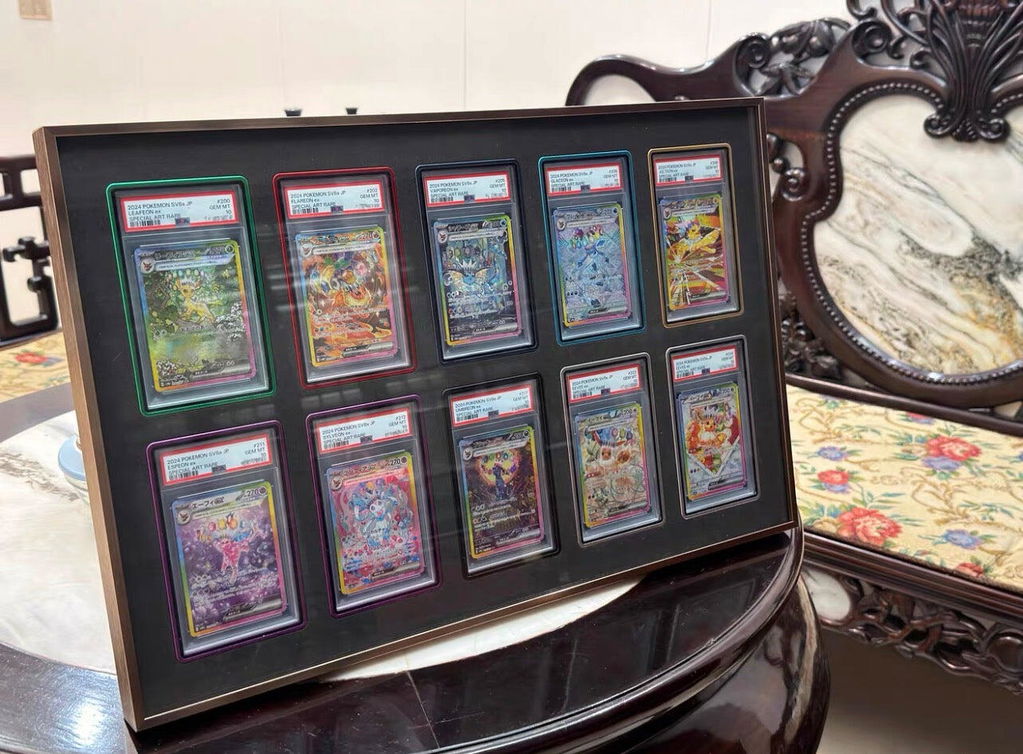
| Framed multi-game display | Wall wash or carefully angled external light | Consistent grid and a unified presentation | Verify case dimensions, mounting and glazing |
| Specialist display with high-performance glazing | Controlled external light with measured exposure | May improve UV filtration or reflection control | More expensive; still does not make visible light harmless |
There is no universally correct rung on this ladder. Some collectors simply need practical storage, while others want their favourite releases to become an intentional part of the room. A suitable lighting plan helps at every price point.
Low-cost ways to improve an existing setup
Before buying new furniture or a complex lighting system, try smaller changes. Move game cases away from direct window light, reduce the brightness of an existing LED strip, turn off unused lamps, angle the light toward a wall and remove strong reflections from the most important viewing position.
A simple timer or smart plug may reduce operating hours. A diffuser may soften the line of LED points reflected in glossy plastic. Rearranging a shelf may help preserve fragile original boxes by positioning them away from concentrated illumination.
These changes can improve the appearance of a collection without requiring specialist equipment. Money is often better spent addressing a real problem than buying an expensive product solely because it is advertised as “museum quality”.
Mid-range lighting choices for a dedicated game room
A dedicated room may benefit from dimmable ceiling lights, a good-quality neutral white shelf strip, concealed wall washes and separate controls for decorative RGB effects. Being able to turn the collection lighting off independently from the general room lighting is particularly useful.
Look for reliable components from reputable suppliers, appropriate power supplies and properly rated fittings. Avoid improvised wiring in enclosed spaces. The goal is a repeatable setup that is easy to use and maintain, not simply the greatest possible number of LED strips.
A carefully planned mid-range arrangement can often provide better visibility and exposure control than a more expensive setup that is always on and aimed directly at collectibles.
Higher-end approaches for carefully curated collections
Collectors displaying expensive or historically significant games may choose specialist glazing, a purpose-built cabinet, adjustable high-colour-rendering fixtures, measured light levels and a disciplined viewing schedule. A consistent wall presentation can also help organise a collection into a visual story by console generation, franchise or release date.
Such measures can improve the presentation and may reduce some preservation risks, but they cannot guarantee that an organic printed object will never change. Even excellent glazing leaves visible light available for viewing, and environmental factors extend beyond lighting alone.
The strongest premium choices are those that solve a specific requirement: unwanted reflections, large display dimensions, unusual case formats, difficulty controlling daylight or the desire for a clean permanent arrangement.
How to measure light at the game case
A lux meter is a practical tool for comparing locations and settings. Measure at the surface where the artwork sits, with the room configured as it will normally be used. If there are several shelves, take readings at different positions rather than relying on a single central number.
Repeat the measurement under daylight and at night, because window light may dominate during the day while LEDs dominate in the evening. Record the LED brightness setting, fixture position and approximate daily operating time. This helps you make consistent decisions later.
A lux meter does not measure UV filtration, and a phone application is not a laboratory instrument. For ordinary home comparison, however, even a basic meter can help reveal which arrangement is unexpectedly bright.
How to check a lamp's UV claim
If a manufacturer claims UV-free or UV-reduced output, look for a product-specific measurement and a defined wavelength range. General-purpose LED products are usually low in UV, but the description alone does not establish how the complete lighting system behaves at the collectibles.
A specialist UV meter or spectral instrument is needed for meaningful measurement. A sheet of ordinary paper changing colour under a lamp is not a reliable way to quantify UV performance.
If the main concern is direct sunlight, room positioning and appropriate UV-filtering glazing are typically more useful than trying to measure a domestic LED's already small UV output without proper instruments.
How to identify glare before mounting the frame
Place a sample game case or finished display where you plan to mount it and stand at your normal viewing position. Turn the room lights on one at a time. Note whether any fixture appears as a bright reflection across the cover artwork or front glazing.
Move or angle the light before drilling holes or installing permanent channels. A small adjustment can make a major difference, particularly for 9-, 12- and 16-game wall displays with large reflective surfaces.
Repeat the test in daylight. Window reflections can be more intrusive than LED reflections, and they may change with the seasons.
A practical lighting plan for a small Nintendo display
Suppose a collector wants to show four Nintendo Switch favourites: a Zelda game, a Mario title, a Pokémon game and Metroid. The collection hangs on an interior wall with no direct sunlight. There is already modest ambient room light.
The simplest solution may be to use that existing lighting. If more emphasis is desired, a dimmable LED aimed at the adjacent wall can add depth without placing a narrow spotlight onto the cases. Good colour rendering will help the mixed covers remain attractive.
This scenario does not inherently demand museum-grade acrylic, an expensive lighting controller or a continuous RGB effect. The sensible solution is the one that lets the collector enjoy the games without adding unnecessary intensity.
A practical lighting plan for a PlayStation collection wall
Imagine a twelve-game display combining PS2, PS3, PS4 and PS5 favourites. Different case formats may require separate fitted arrangements, and the cover artwork may have varying reflectivity. The first priority is to verify how the cases are physically supported.
For lighting, a broad external wall wash could provide even illumination with fewer hot spots than individual spotlights. Place the display away from a bright window, use adjustable intensity and inspect the effect from a normal viewing distance.
If the collection includes a rare paper sleeve or signed edition, consider whether that item should be lit as frequently as the common games. A collector can combine a permanent wall of favourites with protected storage for especially sensitive originals.
A practical lighting plan for an Xbox gaming room
An Xbox collector might use a green-accented room with shelves containing Original Xbox, Xbox 360, Xbox One and Series X cases. The atmosphere is part of the room's identity, but constant saturated green light can make the cover artwork hard to read.
A useful compromise is to keep green RGB illumination behind the shelves and use a modest neutral white source for reading spines. Each system can have its own switch or scheduled scene.
That arrangement separates decorative effect from display visibility. It also allows the collector to reduce or switch off the light directed at the cases when they are not actively viewing the collection.
A practical lighting plan for rare sealed games
A collector owns a factory-sealed game that is valuable mainly because of its original condition. The object is stored away from sunlight and temperature extremes. For occasional viewing, the collector brings it into a controlled room or uses a covered cabinet with external lighting.
The important features are limited viewing time, gentle illumination, minimal handling and avoiding heat or humidity changes. A dark storage arrangement can be the better preservation choice for much of the year.
A specialist display can be attractive if the collector chooses to exhibit the game, but no amount of premium framing should be described as eliminating all risk from permanent exposure.
How to document the condition of a lit collection
Regular photographs can help collectors notice changes in case colour, paper condition or packaging. Use consistent lighting, a stable camera position and neutral white illumination for comparison. An atmospheric RGB photograph is visually attractive but not a reliable record of colour condition.
Record unusual changes such as yellowing, fading along one side, moisture marks or warping. Keep receipts and descriptions for valuable editions and research sale prices using actual comparable transactions rather than promotional asking prices.
Documentation is not a substitute for conservation, but it helps you make decisions about rotation, storage and whether a display location should be changed.
Common LED gaming-room lighting mistakes
- Leaving lights on continuously: Decorative lighting accumulates unnecessary hours when nobody is viewing the collection.
- Assuming low UV means no fading: Printed materials can react to visible light too.
- Using the brightest possible strip: Brightness is not the same as clarity or quality.
- Aiming RGB colours directly at the covers: The result may hide artwork detail and distort colour appearance.
- Ignoring heat near enclosed displays: LEDs, drivers and power supplies still generate heat.
- Installing adhesive tape against original boxes: Lighting should not damage the objects through mounting or maintenance.
- Treating a coating label as a preservation guarantee: UV-filtering and anti-reflective products have specific, limited functions.
- Ignoring daylight: A window can contribute much more exposure than the domestic LEDs.
- Using poor colour rendering to inspect condition: Coloured or low-quality light can make faded packaging difficult to recognise.
- Mounting before testing glare: Large acrylic fronts can reflect fixtures at normal viewing angles.
A step-by-step checklist before installing gaming room LEDs
- Identify the collection: modern plastic cases, retro cardboard boxes, SteelBooks, manuals, sealed or graded games.
- Check daylight: observe the proposed shelf or wall at different times and seasons.
- Choose a viewing purpose: reading spines, viewing face-forward artwork, indirect ambience or temporary photography.
- Select a controllable lamp: suitable output, reliable dimming and colour rendering appropriate to the display.
- Plan safe installation: use rated power supplies, ventilation, secure mounting and manufacturer guidance.
- Avoid direct contact: keep LEDs and adhesives away from original packaging and delicate surfaces.
- Test reflections: evaluate plastic fronts, protective cases, SteelBooks and any outer glazing.
- Measure and reduce brightness: use the lowest comfortable level for the intended viewing task.
- Control the schedule: arrange a switch, timer or scene so lighting is off when unnecessary.
- Review periodically: look for heat buildup, colour change, glare, dust or equipment problems.
Frequently asked questions
Can LED lights fade video game cases?
Yes, prolonged visible-light exposure may contribute to fading of printed game cover artwork or paper packaging, depending on the materials. Many LEDs emit little UV, but visible light and cumulative exposure still matter.
Are LED lights safer than sunlight for displaying games?
Ordinary controllable indoor LEDs are generally easier to manage than direct sunlight, which is far more intense and includes UV and heat. The actual brightness, duration and environment still determine the exposure.
Do LED strip lights emit UV radiation?
Many conventional white and RGB LED strips produce very little UV, but not every product has the same specification. Special-purpose UV LEDs exist, so check the exact product rather than assuming every LED is identical.
Are RGB lights bad for Nintendo Switch games?
Not automatically. RGB lighting may create unnecessary direct visible-light exposure if it is bright and continuously aimed at the cases. Using RGB as indirect wall lighting is often a better way to create atmosphere without overwhelming the artwork.
Can blue LED lights damage PlayStation cover art?
Visible blue wavelengths can contribute to light-driven changes in sensitive materials, but there is no universal claim that every blue LED causes faster fading of every PlayStation cover. Total exposure and material sensitivity matter.
Is warm white better than cool white for preservation?
Colour temperature alone is not a preservation rating. The spectrum, intensity, duration and the object matter. Choose colour temperature for appearance, then control brightness and time independently.
What colour temperature looks best for game displays?
There is no universal best setting. Warm white often suits relaxed rooms and retro collections; neutral white can make cover art easier to judge. Test the actual cases under the proposed light before committing.
Is CRI 90 worth choosing for game cases?
It can improve colour fidelity, especially for varied printed covers. High CRI does not itself prevent fading, and good installation and exposure control are still important.
Why do Nintendo Switch red spines look different under some LEDs?
LED spectra and colour-rendering performance vary, particularly for saturated red. The lamp may change how those colours appear without the cases themselves having changed.
Do LED lights damage sealed video games?
Sealed games can include printed boxes, labels and plastic wrap that may be affected by light and environmental conditions. A seal does not make the underlying materials immune to cumulative exposure.
Are graded video game cases protected from LED light?
Grading enclosures provide physical encapsulation, but a universal UV-blocking percentage cannot be assumed without manufacturer-specific data. Visible light may still pass through clear enclosures.
Do LED lights produce heat inside cabinets?
Yes. LEDs and their electronics generate heat, and enclosed spaces can retain it. External lighting and proper ventilation are often preferable for valuable collections.
Should LED strips be installed inside an acrylic frame?
Not by default. An illuminated frame requires additional electrical, thermal and serviceability design. A separate external light is usually simpler for a collectible wall display.
Is 24-hour LED lighting safe for a gaming room collection?
Continuous illumination accumulates exposure even at moderate brightness. If maximum preservation is a priority, switch the display lighting off when it is not needed.
Can I use a smart plug or timer to protect games?
A timer or smart lighting schedule can reduce unnecessary exposure hours. It complements, rather than replaces, appropriate lamp choice, positioning and safe installation.
Does museum-grade acrylic protect games from LED fading?
Museum-grade glazing may offer strong UV filtering and reduced reflections, depending on the product. It does not remove all visible light, so it cannot guarantee against fading under continuous LEDs.
Are LED spotlights better than LED strips?
Neither is universally better. Spotlights can emphasise a single object but create hotspots and reflections; strips can light shelves evenly but may sit very close to packaging. Placement and controllability matter most.
How many lux should a PS5 game display receive?
There is no experimentally established universal lux limit for every PS5 case and cover print. Use enough light to view the collection comfortably and minimise unnecessary intensity and duration, especially for valuable originals.
Will a black backing protect a video game case from fading?
A dark backing changes contrast and appearance; it is not a UV-filtering specification. The light reaching the printed artwork, surrounding materials and room conditions remain more important.
Are LEDs safe for vintage Nintendo cardboard boxes?
They can be used for occasional controlled viewing, but old printed cardboard may be light-sensitive. Avoid direct sun, intense light and unnecessary permanent illumination. Dark storage can be preferable for preservation.
Does dimming an LED reduce light damage?
Lowering the actual illumination reaching an object reduces visible-light exposure at a given duration. Ensure the dimmer works correctly and does not introduce other quality or electrical problems.
Does anti-reflective acrylic reduce the need for bright lighting?
It can make artwork easier to see by reducing distracting reflections, potentially allowing comfortable viewing at lower illumination. Its effect depends on the glazing and the arrangement; it is not a substitute for sensible light control.
Do game discs need the same lighting care as cardboard boxes?
Discs, labels, packaging and paper manuals have different constructions and sensitivities. Visible packaging often demands the greatest attention to printed-colour fading, but all components should be stored away from excessive heat, sunlight and moisture.
Can I photograph my sealed games under bright LEDs?
Brief, controlled photography is different from constant display lighting. Avoid hot fixtures and excessive handling, and use neutral light if documenting the condition or colour of packaging.
What is the best lighting setup for a premium video game wall display?
A sensible starting point is a wall outside direct sun, controllable diffuse external lighting with good colour rendering, an angle that avoids glare and a schedule that turns lights off when unnecessary. The optimal details depend on the collection and room.
Is a specialist display frame required to protect a video game collection?
No. Appropriate storage, stable indoor conditions, sensible lighting and limited handling can be effective at many budgets. A specialist frame may offer an appealing structured presentation and particular glazing options, but it is one choice among several.
Further technical reading
The following original conservation and technical resources explain the science behind this guide. They are useful when reviewing lighting claims or considering a more permanent installation.
- Canadian Conservation Institute: LED Lighting in Museums and Art Galleries, Technical Bulletin 36. Evidence on LED light quality, fading and exposure.
- Canadian Conservation Institute: Light, Ultraviolet and Infrared. Intensity, dose, UV, colour rendering and conservation lighting.
- Library of Congress: Limiting Light Damage. Cumulative exposure, source selection and permanent change.
- US Department of Energy: LED Basics. Colour fidelity, CRI and how LED products differ.
- Western Australian Museum: Lighting in Museum Exhibits. Practical lighting design and enclosed cases.
- Museums Galleries Scotland: Conservation and Lighting. Display heat, intensity and visitor access.
Final thoughts: light the collection, not the room at any cost
LED lighting can make a gaming room and physical video game display look exceptional. It can reveal the colours of Zelda, Mario, Pokémon, Halo, God of War and many other series, define the lines of a collector wall and bring attention to carefully chosen favourites. But lighting is also one of the environmental factors a collector can most easily control.
The most reliable approach is to separate aesthetic effect from unnecessary exposure. Use direct light only where it helps viewing, illuminate walls rather than sensitive packaging where possible, choose good colour rendering, reduce harsh reflections and switch lights off when nobody is present. Keep valuable originals away from direct sunlight, excessive heat and unstable conditions.
A carefully arranged shelf, a glass-fronted cabinet or a premium aluminium-and-acrylic wall display can all be appropriate choices. The best result is not necessarily the brightest or most expensive. It is the arrangement that allows the collection to be appreciated while respecting the limits of the materials being displayed.
Continue Exploring
These related GameVault guides cover display methods, platform-specific collections, case dimensions and preservation. The links use the planned Shopify article handles.
Video Game Display and Collecting Guides
- How to Display Video Game Cases: The Complete Guide. Compare shelves, stands, cabinets, display frames and other arrangements.
- How to Display Nintendo Switch Games. Zelda, Mario, Pokémon, game-case arrangements and Switch collecting.
- How to Display PlayStation Game Cases. PS5, PS4, PS3, PS2 and PlayStation collecting by generation.
- How to Display Xbox Game Cases. Original Xbox, Xbox 360, Xbox One and Series X collections.
- Video Game Case Sizes Explained. Dimensions, thicknesses and fit considerations.
- How to Display Rare, Sealed and Valuable Video Games. Condition, value, sealed copies and display risks.
UV Protection and Preservation Guides
- UV Protection for Video Game Cases: The Complete Guide. UV, visible light, glazing and preservation.
- Can Sunlight Fade Video Game Cases?. Sun exposure and printed artwork.
- Do Plastic Video Game Cases Block UV Light?. Plastic case and protector specifications.
- Acrylic vs Glass for Video Game Displays. Materials, reflection, weight and UV protection.
Explore Display Collections
- SLABBED™ Studio. Browse video game and trading card display collections, including GameVault™ aluminium frames.

0 comments