


A collection display begins with a simple question: what should someone notice first? For one collector, it may be a single favourite Pokémon card. For another, a complete run of PSA-graded sports cards, nine One Touch holders, or a wall of PlayStation and Nintendo game cases. The right layout makes that intention clear before the viewer reads a label or examines an individual item.
Choosing a trading card display layout, graded card wall arrangement or video game case display grid is not only about counting objects. The size and shape of the holders, spacing between them, the surrounding wall, frame orientation, lighting and the visual rhythm of the collection all affect the result. A 3×3 grid communicates something different from a long 9×1 row, even though both hold nine items.
This guide explores practical layouts for Pokémon, Magic: The Gathering (MTG), Yu-Gi-Oh!, One Piece, sports cards, PSA, CGC and BGS graded slabs, One Touch magnetic holders, and PlayStation, Xbox and Nintendo game cases. It covers inexpensive shelving and individual stands, modular approaches, arranged picture frames and purpose-fitted aluminium wall displays. The goal is to help collectors plan a coherent display at any budget, not to argue that the largest or most expensive frame is automatically best.
Start with what the display is meant to communicate
Before measuring a wall or choosing a frame colour, decide what the collection represents. A single first-edition card may deserve an isolated presentation, while a complete nine-card Pokémon set can be more satisfying when viewed together. A sports card collection might follow one athlete through several seasons. A video game display might represent the releases that defined a particular console generation.
Try describing the purpose in one sentence: “These are my favourite six games,” “This is my entire graded evolution line,” or “These are the fifteen cards I collected over ten years.” A clear description usually suggests a logical layout and prevents a frame becoming an arbitrary assortment of objects.
A themed display need not be expensive. You can create a strong arrangement with existing shelves and simple stands. A coordinated wall frame becomes useful when consistent spacing, a single outer boundary or a more architectural presentation is important.
The difference between capacity, grid and orientation
Capacity describes how many collectibles fit. A grid describes how the spaces are arranged, often written as columns × rows. Orientation describes the overall direction of the display: wide, tall or roughly square.
A 4-grid display might be arranged 4×1 in a horizontal row, 2×2 in a square, or 1×4 vertically. These do not occupy the same wall area even when each holds four items. Equally, six cases in a 3×2 layout can be much easier to place above a desk than six cases in a single long row.
Always read the layout stated in a product's title or specifications. The number alone does not guarantee a particular arrangement. This is especially relevant when comparing graded slabs, magnetic holders and larger video game cases.
Common grid sizes at a glance
| Grid capacity | Possible layout | Visual effect | Useful collecting idea |
|---|---|---|---|
| 1 | 1×1 | One clear focal point | Favourite card or game |
| 2 | 2×1 | Pair and comparison | Before/after, two editions |
| 3 | 3×1 | Short sequence | Evolution line or trilogy |
| 4 | 2×2 or 4×1 | Compact set or long strip | Four-title franchise |
| 6 | 3×2 | Balanced mid-size display | Console favourites or six graded cards |
| 8 | 4×2 | Wide grouped collection | Eight related releases |
| 9 | 3×3 | Symmetrical focal grid | Nine-card set |
| 10 | 5×2 | Panoramic collection | Ten games by generation |
| 12 | 4×3 | Dense but orderly collection | Mixed franchise or collector favourites |
| 15 | 5×3 | Substantial statement | Curated multi-series collection |
| 16 | 4×4 | Large square arrangement | Sixteen games or matching slabs |
| 20+ | Various | Dedicated collection wall | Large card collection or custom project |
These are layout examples, not a claim that every arrangement is available for every holder format. Check actual configurations and wall measurements before choosing a display.
One collectible: when a single-item display is enough
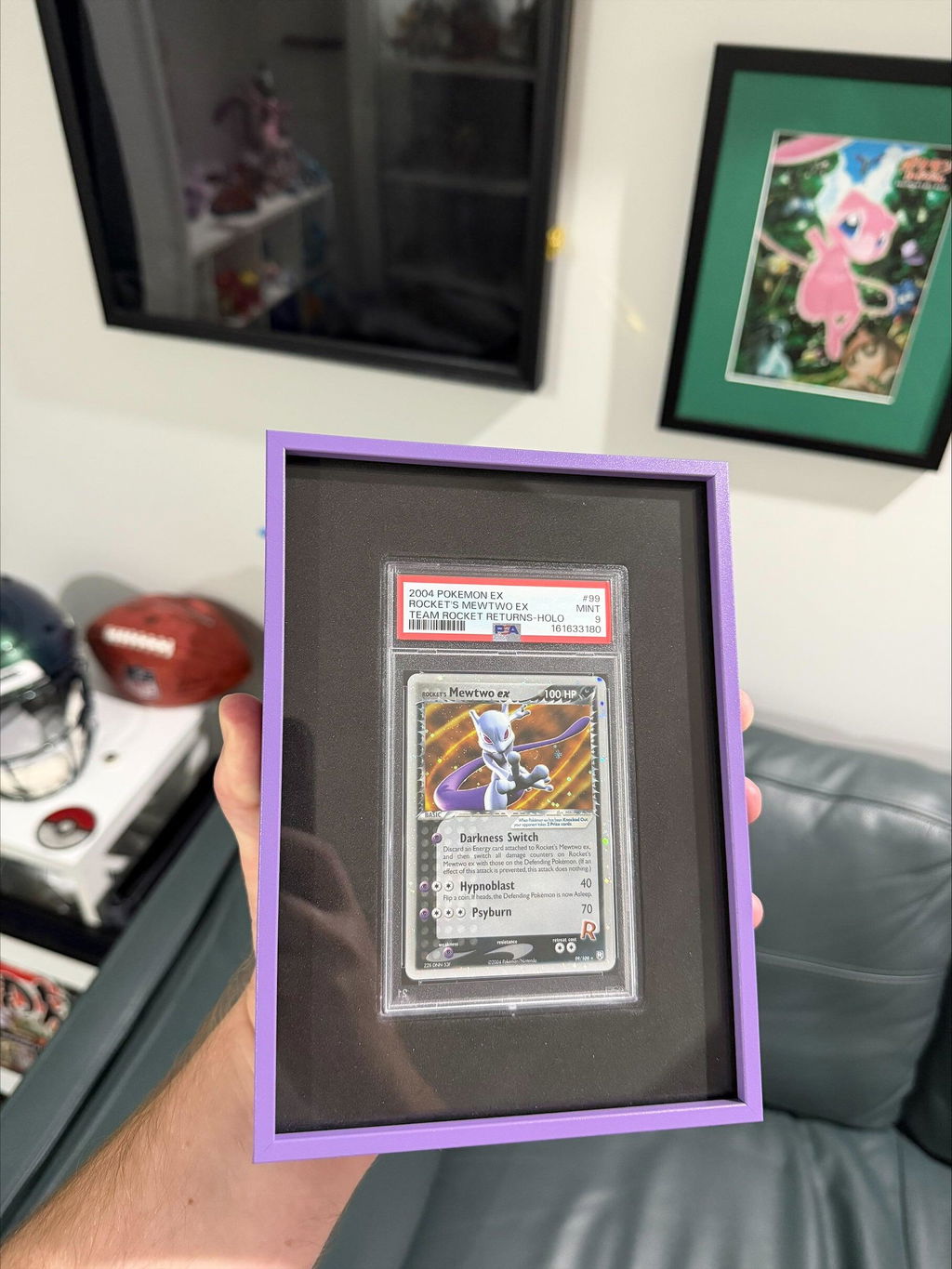
A single graded card display frame or single video game wall display can be effective when the collectible has its own story. It might be a favourite childhood game, the first PSA 10 in a collection, a signed sports card, or a One Touch holder containing a particularly meaningful pull.
A single item gives the viewer fewer competing details. It also makes the choice of background, glazing and frame finish more noticeable. Dark surrounds can create stronger contrast with colourful artwork, while lighter surrounds give a softer appearance. Neither is objectively better: the colour of the object and the room matter.
For a low-cost option, try a small stable display stand on a shelf. For a wall arrangement, an appropriately sized picture frame or fitted display may suit the intended holder. Measure the object first, and avoid forcing a rigid slab or game case into a shallow standard picture frame.
Two-item layouts: pairs, rivals and alternate editions
Two-item displays have a natural narrative. Think of two versions of the same Pokémon, a rookie card beside a later career card, or the original and remastered editions of a favourite game. A horizontal 2×1 layout usually reads from left to right, much like a comparison image.
Pairs work especially well when both items share a similar holder format and size. If one item is an unusually thick One Touch case, or the other is a SteelBook instead of a standard plastic game case, a custom arrangement may be necessary.
To make a pair feel intentional, keep the visible spacing consistent and align the edges rather than guessing by eye. A shelf can achieve this with two identical stands. A fitted frame can establish the spacing as part of the construction.
Three-item displays: evolutions and trilogies
Three is a particularly useful number because it suggests a beginning, middle and end. Pokémon evolution lines are the obvious example, but three-item grids also suit game trilogies, three award-winning cards, or the three most important releases in a collector's personal history.
A 3×1 layout emphasises progression. Arrange by release date, narrative order, generation or visual colour. Do not assume chronological release order and story order are identical for every game series; choose the system that makes sense to the collection and explain it if necessary.
When displaying graded cards, check that the slabs share compatible outside dimensions. A row of PSA holders can look consistent, but mixing PSA, CGC and BGS can change the fit and label alignment. A collection with different holder types may be better shown on adjustable stands or in separate fitted sections.
Four-item displays: square grids versus horizontal rows
Four collectibles create a useful choice: 2×2 for a square composition or 4×1 for a wide strip. A square can work beside a doorway, above a cabinet or on a narrow feature wall. A row can work above a low media unit where the width is available but the vertical space is limited.
Four Nintendo Switch cases might form a compact colour-rich 2×2 set, while four PlayStation games in a row could echo the shape of a television cabinet. With trading cards, a 2×2 arrangement can make equal-value pieces feel balanced rather than ranked.
Do not choose only by how the product looks in a thumbnail. Use masking tape or paper rectangles at the intended outside dimensions to see how much wall the full object occupies.
Five and six: small collections that feel complete
Five items can suit a selected “top five” or a chronological sequence. A 5×1 grid is visually long and can be effective above a desk or console. It is less suitable for every room because the width may be substantial, particularly with DVD- or Blu-ray-sized game cases.
Six items offer more flexible grouping. A 3×2 arrangement has enough structure to show two rows of related releases, or three themes repeated across two periods. A sports card collector could group two seasons of three players; a PlayStation collector could organise six personal favourites by generation.
In a mixed game collection, avoid assuming six cases from different consoles have identical external dimensions or thickness. Similar front sizes do not guarantee a shared fitted opening.
Eight to twelve: the versatile middle of a collection wall
At eight, nine, ten and twelve items, the display begins to function as a collection rather than an individual accent. These sizes suit a curated selection that may be too large for a narrow shelf but not large enough to justify an entire dedicated gaming-room wall.
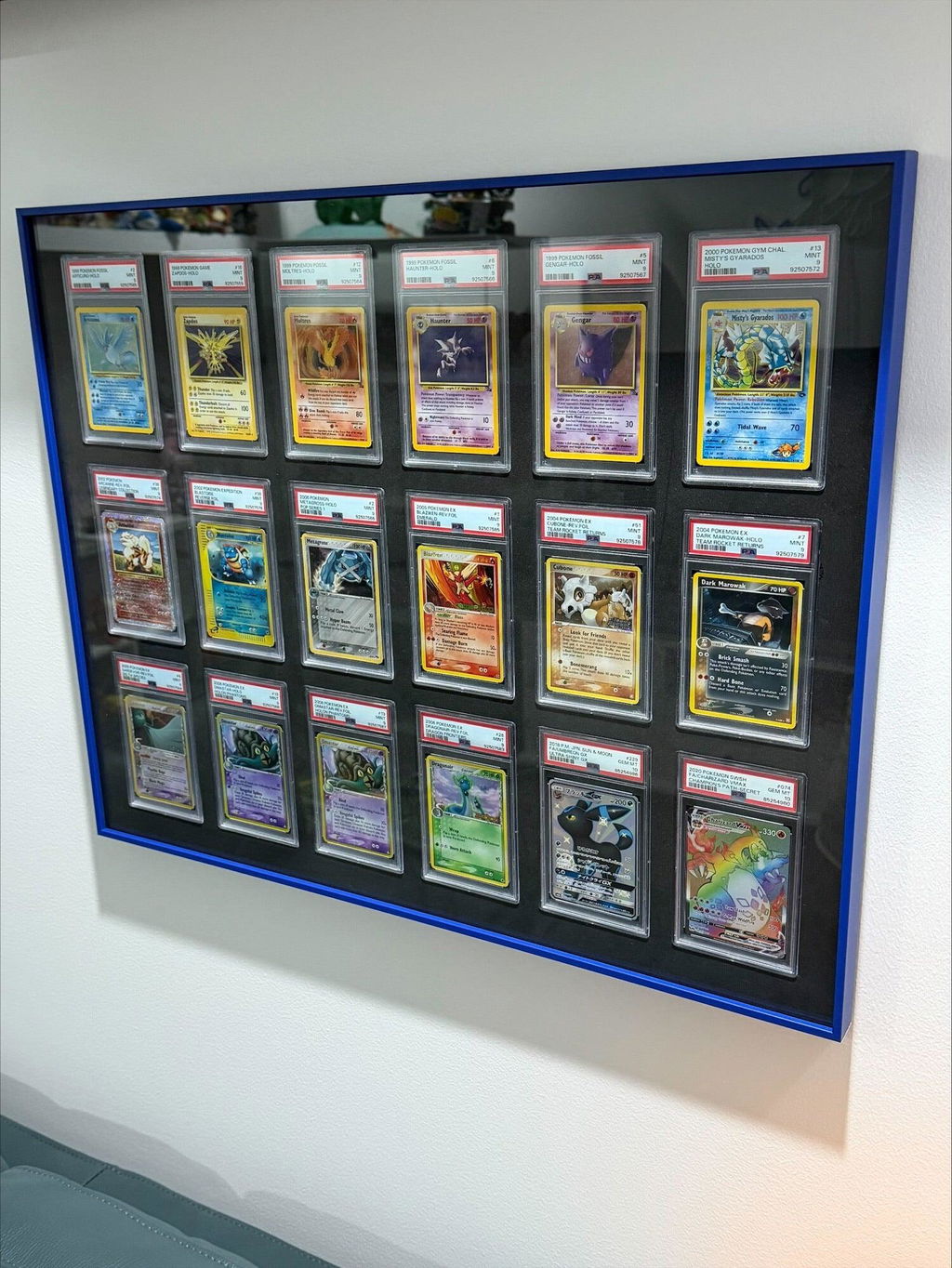
A 3×3 grid gives nine items a strong central position and regular symmetry. A 4×2 arrangement is wider and often better suited to a horizontal wall. A 5×2 layout has a panoramic effect, while a 4×3 layout makes a dense group without pushing to an extreme aspect ratio.
For card collectors, this is often the range where consistent labels, holder orientations and edge spacing become important. For video games, the artwork itself adds substantial variation, so a quiet background can prevent the arrangement feeling visually chaotic.
Fifteen and sixteen: deliberate large-format displays
A 5×3 grid of fifteen or a 4×4 grid of sixteen cases can look substantial. With game cases, in particular, the finished outside dimensions can be much larger than an equivalent grid of PSA slabs. The frame, glazing, backing, support and packaging all need to be considered at the real finished size.
These layouts suit collectors who already know which items belong together: perhaps sixteen releases from one era, a series of related franchises, or a selected set of graded cards. A large grid does not become more compelling simply because every available position is filled. Consistent theme and spacing still matter.
A useful approach is to arrange the cases on the floor first. Photograph two or three sequences, then choose one. That inexpensive planning step can prevent a large finished display from looking accidental.
More than sixteen: when the wall becomes the project
Large PSA, CGC and BGS collections can extend well beyond sixteen items, with configurations reaching dozens or even around a hundred graded cards. The practical challenge changes as the grid grows. Panel span, weight, carrying space, mounting points and wall construction are increasingly important.
Video game case displays scale differently because each game case occupies much more front area and may be thicker. A twenty-four-game wall arrangement is not equivalent in dimensions or handling to a twenty-four-slab display. For particularly large collections, several manageable frames may be more practical than one enormous unit.
Before ordering an oversized display, compare the costs and appearance of one continuous grid against two or three coordinated frames. Multiple frames can simplify relocation, help separate franchises and allow future rearrangement.
Grid shape matters more than an arbitrary number
Collectors often begin with a target count: ten games, twelve cards or thirty slabs. A better starting point is sometimes the wall itself. A wide wall above a sofa may favour a broad rectangle; a wall between doors may favour a tall one. The composition should suit the space rather than requiring the entire room to accommodate it.
Draw the available wall area and mark fixed features such as outlets, windows, shelves and furniture. Estimate the footprint of the complete frame, not just the collective widths of the objects inside. Add a breathing margin around the proposed display so it does not collide visually with other furniture.
For a collection that may grow, leaving a planned expansion zone is better than attaching an unrelated extra frame later because no space was reserved.
How to measure a wall for a display frame
- Measure the clear wall width and height, accounting for fixed furniture and architectural details.
- Obtain the outside dimensions of the finished display, including the aluminium border and any surrounding spacing.
- Use paper or low-tack painter's tape to outline the full rectangle on the wall.
- Stand at typical viewing points: the doorway, desk, sofa or gaming chair.
- Check whether doors, windows, speakers, shelves or cabinets obstruct the view.
- Observe direct sunlight and reflections at different times of day.
- Check the wall material and suitable mounting hardware for the actual finished weight.
Do not assume that a frame with half as many openings will be exactly half as wide. Borders, spacing, profile sizes and layout geometry can affect the outside dimension.
Portrait, landscape or square: choosing a proportion
Landscape layouts tend to relate naturally to media cabinets, desks and wide furniture. Portrait layouts can suit corridors or smaller wall sections with more available height. Square layouts can provide an organised centrepiece, particularly when a room already has strong horizontal lines.
The actual collectible shape also influences the finished proportions. Standard game cases are taller than they are wide, while some graded slabs and holders have different relative dimensions. A 4×4 video game arrangement therefore may not be a perfect physical square despite its four columns and four rows.
Use a rough mockup on the wall before deciding which proportion works. A portrait collection can look striking in an entryway but inconvenient behind a television if it rises too high.
Choosing a display method: from budget to specialist
Not every collection benefits from a wall frame. The most useful comparison is between what each approach actually provides.
| Method | Main advantages | Limitations | Often suitable for |
|---|---|---|---|
| Existing bookcase | Low additional cost, easy access | Spines may dominate, dust exposure | Large everyday game libraries |
| Small individual stands | Flexible and inexpensive | Inconsistent spacing across many items | Single favourite cards or games |
| Floating shelves or picture ledges | Easy to expand and rearrange | Items can be bumped; depth varies | Rotating selections |
| Modular small frames | Flexible wall composition | More mounting points and visual borders | Grouped themes and growing collections |
| Display cabinet | More contained and easily reorganised | Requires floor space; glare and dust still possible | Mixed formats, boxes, handhelds |
| Purpose-fitted aluminium grid frame | Regular openings, unified boundary, coordinated finishes | Higher cost; size and compatibility must be specified | Curated wall displays with a defined item count |
A bookshelf is often the most sensible choice for hundreds of everyday games. Small stands are effective for a handful of prized pieces. Fitted displays make more sense when the layout itself is intended to be part of the room.
Building a display gradually instead of all at once
A collection rarely arrives complete. Starting with two or three meaningful pieces can create a more coherent result than purchasing a large empty layout in anticipation of future acquisitions.
For modular displays, decide whether each frame will be uniform or intentionally varied. Matching outer finishes and consistent gaps can unify different dimensions. If you eventually want one large fixed grid, check that the target count and holder type are likely to remain stable before committing.
Some collectors prefer a rotating display: a few favourites stay visible while the rest are stored safely. Others want a full inventory wall. Neither approach is more serious or legitimate; they answer different needs.
Planning a Pokémon wall by character, set or grading milestone
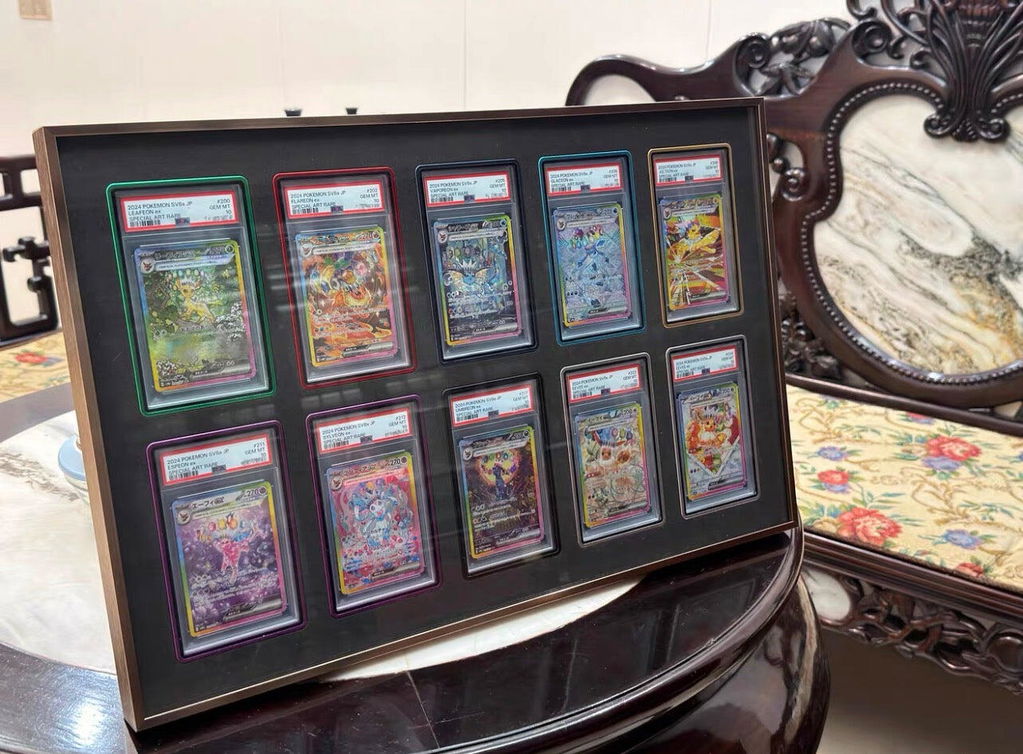
Pokémon collections naturally lend themselves to grids because cards can be grouped in recognisable ways. A three-card evolution line might work in a 3×1 arrangement. A nine-card page-inspired collection can work in a 3×3 grid. Larger walls might group artwork by a favourite Pokémon, expansion, illustration style, language or grading milestone.
Think carefully about label alignment when framing PSA, CGC or BGS slabs. A set that looks consistent inside a storage box may have different label dimensions or holder profiles when placed side by side on a wall.
Collectors do not need to fill every position with their most expensive card. A visually coherent set of affordable favourites can communicate a theme more clearly than an unrelated collection of high-value pieces.
MTG, Yu-Gi-Oh!, One Piece and other TCG displays
Magic: The Gathering collections can be organised around a deck, colour identity, artist, set or favourite commander. Yu-Gi-Oh! displays might focus on a well-known monster line, tournament memories or a particular era of card artwork. One Piece card collections might follow a character, leader, crew or alternate-art theme.
Not every card needs to be graded for a consistent display. A magnetic One Touch holder can suit a collector who prefers the card ungraded but wants an individual rigid holder. What matters for a fitted layout is the actual holder's external dimensions, not simply whether the card game name appears on the product page.
Highly reflective foil and holographic artwork can create additional glare. The relationship between room lighting, holder surfaces and front glazing deserves attention alongside the chosen grid.
Sports cards: telling a story across a wall
Sports card arrangements often have a natural chronological structure: a player's rookie year, peak seasons, championship moments and later career. A horizontal row can communicate a timeline. A 3×3 grid can organise a team by position or represent nine notable performances.
Other themes include one club over several eras, signed cards versus unsigned cards, a favourite player across different manufacturers, or a complete collection of related memorabilia cards. A uniform frame border can help visually connect cards whose artwork and printing styles differ considerably.
Check unusually thick patch or memorabilia cards carefully. They may require a different One Touch thickness or display format from ordinary sports cards.
Graded slabs: do not assume every holder is interchangeable
A PSA slab display layout, a CGC slab arrangement and a BGS holder display may look similar in photographs, but their outer dimensions, thicknesses and labels are not universally identical. Even holders from the same grading company can evolve over time.
For a precise foam-fitted display, select the configuration intended for the actual slab type. If you are combining several grading companies, adjustable shelves or separate purpose-cut displays may be simpler than trying to force different dimensions into one repeated opening.
This is a practical design issue, not merely an aesthetic preference. A holder should sit as intended without unwanted pressure or movement.
One Touch holders: why thickness still matters
One Touch magnetic holders are used for ungraded Pokémon, MTG, Yu-Gi-Oh!, One Piece and sports cards, but they are sold in different thickness capacities and models. Two holders with the same nominal card capacity are not guaranteed to have the same outside shape across brands.
A neat One Touch wall relies on compatible holder dimensions and a layout planned for those holders. Where one collection contains unusually thick cards or a mixture of manufacturers, check external measurements and fit rather than assuming all magnetic cases share one standard.
For a low-cost option, One Touch holders can be placed on suitable stands on a stable shelf. A fitted frame becomes useful when keeping multiple holders in a fixed, repeatable arrangement is the primary aim.
GameVault: using layouts to present physical video games
Video game covers introduce more colour and typography than many graded card labels. A large PlayStation, Xbox or Nintendo wall therefore works best when there is a visible organising idea: one franchise, one console generation, selected personal favourites, matching editions or a consistent release period.
For example, a six-game PlayStation display could follow a favourite franchise across releases. A four-game Nintendo Switch collection might group a few closely related titles. A larger Xbox display might be arranged by generation or series. The best arrangement depends on the collection; the frame cannot supply the theme by itself.
Game case compatibility must be checked carefully. Standard plastic cases, replacement cases, SteelBooks and collector's editions can have different dimensions. A configuration sized for one case format should not be assumed to accept every other format.
Nintendo Switch layouts: colour, spines and franchise identity
Nintendo Switch cases have a recognisable narrow format and bright red spine design. When multiple cases are displayed front-facing, the artwork creates a much more varied colour field than a typical spine-out bookshelf.
A Nintendo-focused arrangement might group Mario, Zelda, Pokémon and Metroid favourites, or separate first-party releases from third-party titles. A two-row grid can create simple visual categories: one row for favourites, another for recent additions.
Switch 2 products and replacement cases should not automatically be assumed to share every dimension with older Switch cases. Measure the packaging and check the display's specified compatibility before choosing a cutout.
PlayStation layouts: franchises and console generations
PlayStation collections can be organised by generation, but remember that PS1 jewel cases, PS2 DVD-style cases and later Blu-ray-style plastic cases are not equivalent formats. A display that fits PS5 cases may not be suitable for original PS1 packaging.
Potential themes include a God of War collection, a selection of Gran Turismo games, favourite Ratchet & Clank titles, or games associated with the PS3 and PS4 eras. Some franchises have appeared on more than one platform and some editions differ by region; check the exact physical release when assembling a historically accurate set.
A reader may prefer to keep entire console generations on shelves and reserve wall space for a smaller group of personal favourites. That is often a better visual result than trying to frame everything.
Xbox layouts: from original Xbox to Series X
Xbox collectors might group original Xbox titles, Xbox 360 favourites, Xbox One games or Series X releases. Halo, Gears of War, Forza and Fable provide familiar franchise themes, although individual games and physical releases vary by platform.
A 4×3 layout can show twelve selected games as one composition, while smaller rows can highlight two or three especially meaningful titles. Mixed-generation arrangements may work visually on shelves, but the outside case dimensions and thickness must be checked for any fitted display.
Limited-edition sleeves, bundled releases and SteelBooks can also change the physical fit. Do not choose a foam cutout solely from the name of the console.
Grid layouts for complete series versus personal favourites
A “complete series” collection and a “personal favourites” collection require different planning. Complete series displays may need to accommodate future releases, regional variants or special editions. A favourites wall is more flexible because the selection is defined by the collector rather than a published list.
For a franchise with more releases than a single grid holds, consider using two coordinated frames, displaying a selected era, or keeping some editions in storage. Mixing standard and collector packaging can introduce dimension differences that are easier to manage on individual stands or shelves.
A useful test is to remove one item and see whether the remaining arrangement still makes sense. If it does, the theme may be strong enough to survive future changes.
How background colour changes the apparent grid
Black backgrounds tend to make the openings and artwork more visually distinct, especially when the collection includes colourful game covers or holographic cards. White backgrounds can make the composition feel lighter and introduce more separation between items.
A coordinated acrylic backboard and EVA foam colour can make the background appear more continuous, particularly around large grid openings. This can be especially noticeable on a white-on-white or black-on-black display. The effect is primarily one of visual consistency; it does not make a particular frame universally better.
If you are comparing materials and finishes, see our <a href="/en-de/blogs/news/how-to-choose-display-frame-colours-aluminium-eva-foam">guide to aluminium frame colours and black versus white EVA foam</a>.
Frame finish and grid size should be considered together
A metallic finish that looks restrained around one graded slab can become a stronger visual feature around a large display. Gold, silver, titanium, copper, bronze and coloured aluminium may each interact differently with the room's lighting and the artwork inside.
As grid size increases, the perimeter and repeating internal background can begin to influence the overall look more than the finish of any one individual object. For a room with many other visual features, a neutral frame may keep the collection as the focus. In a simpler room, a warmer metallic finish can act as an intentional accent.
The important choice is consistency. A display can use several different sizes without looking disjointed when the outer finishes and spacing feel related.
The role of spacing, alignment and breathing room
Regular spacing gives a multi-item display its rhythm. When two items sit visibly closer together than the rest, the eye often notices the irregularity before the details of the collection.
Spacing is not just a manufacturing detail. It also affects how separate cards are perceived as one collection. Tight spacing produces a dense visual field; generous spacing gives each item more independence. The correct balance depends on artwork density, holder size and the desired viewing distance.
When arranging loose frames manually, use a tape measure and level rather than relying on sight. Paper templates can help reproduce equal gaps before drilling any mounting holes.
How to group different frame sizes on one wall
You do not need one enormous frame to create a collection wall. Two matching small frames beside a larger central one can be more adaptable and easier to transport. A common finish can unify them even if their internal grids differ.
Plan the wall as one composition. Decide on a consistent outer gap between frames, align the top or centre line, and avoid letting one frame appear accidentally higher than its neighbours. Mixed sizes can look deliberate when the geometry is intentional.
Where the collection itself is likely to change, several coordinated frames may make future updates easier than a single fixed arrangement that must hold everything.
Room placement: above a desk, sofa, media unit or shelf
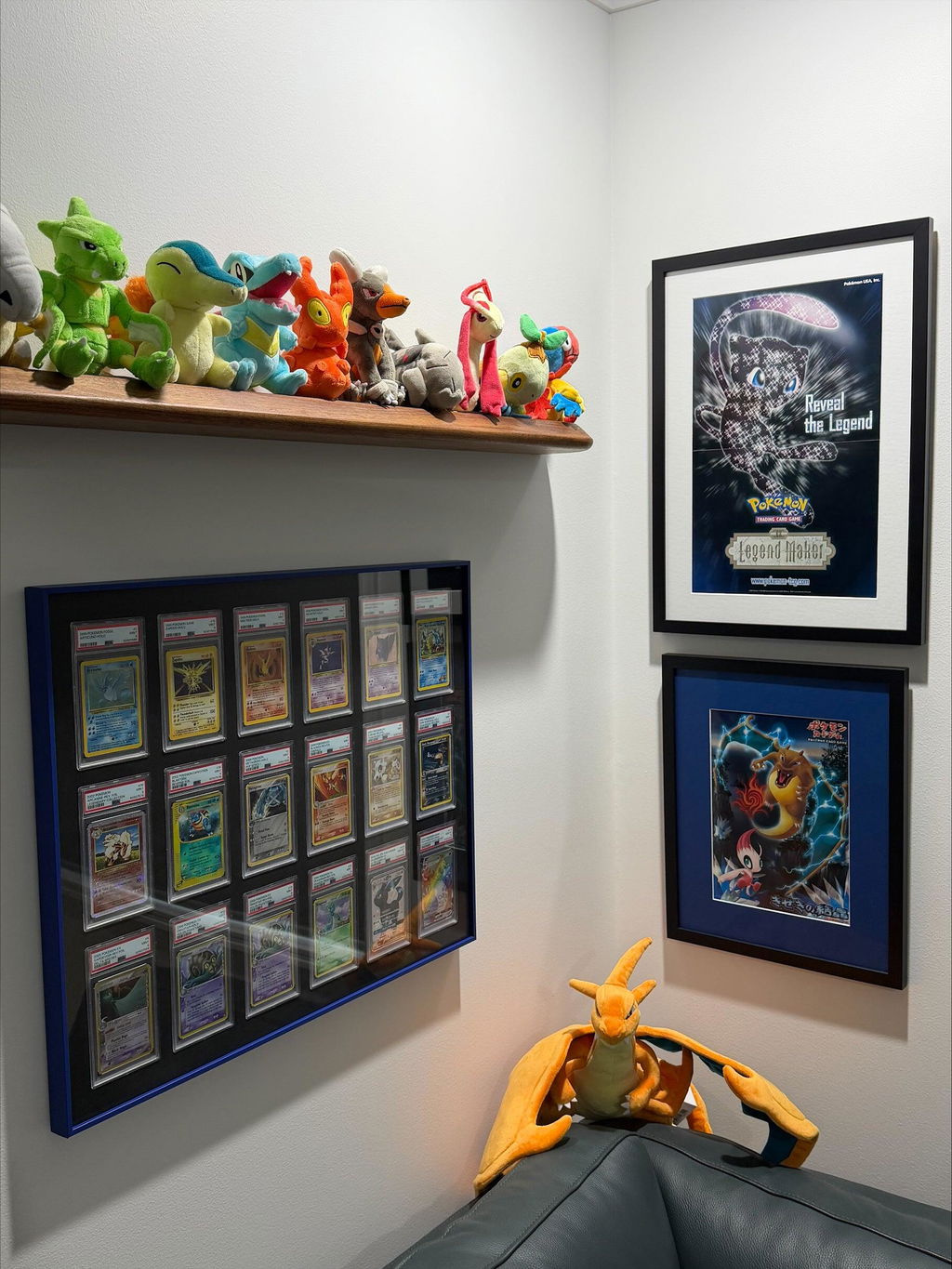
The furniture beneath a display influences how its proportions are perceived. Above a wide media unit, a horizontal arrangement usually feels natural. Beside a bookcase, a tall grid may help fill a narrow section. Over a desk, a medium-width frame can provide a focal point without dominating the work area.
Allow enough clearance for monitors, speakers, cabinet doors and everyday movement. Heavy or large framed objects need appropriate wall anchors and mounting practices. Do not choose mounting hardware based on appearance alone; the wall type and actual finished weight matter.
For valuable cards or games, also observe windows and room lighting. A wall with beautiful daylight may expose printed covers to prolonged light, even when a display uses UV-resistant glazing.
Lighting and reflections on larger displays
Larger glazed displays can reflect more of a room because they present a larger continuous surface. A window, ceiling fixture or bright LED strip opposite the wall may be visible in the front panel.
Acrylic and glass both have products with different reflection-control properties. Anti-reflective museum-grade materials can reduce reflections, but glazing specifications, air gaps and object positioning matter. Lower-reflection glazing does not eliminate the need to consider the wall's lighting conditions.
For a deeper explanation, see <a href="/en-de/blogs/news/acrylic-vs-glass-video-game-displays">Acrylic vs Glass for Video Game Displays</a> and <a href="/en-de/blogs/news/uv-protection-video-game-cases-sunlight-acrylic-preservation">UV Protection for Video Game Cases</a>.
Valuable collectibles: display value and preservation are separate questions
A rare sealed game, a highly graded Pokémon card or a signed sports card may justify careful display planning, but market value alone does not tell you what frame to buy. Condition, handling risks, light exposure and insurance considerations deserve their own evaluation.
Loose, complete-in-box, factory-sealed and professionally graded video games are distinct collecting categories. Their cases and packaging may differ significantly in size and sensitivity. Equally, a PSA slab and a magnetic One Touch holder serve different purposes.
It can be entirely reasonable to display a replica cover or a less valuable edition while keeping a very fragile original in protected storage. A visually impressive collection wall does not require every important object to be exposed continuously.
Common mistakes when planning a wall display
- Choosing capacity before checking outside dimensions and wall clearance.
- Assuming all PSA, CGC, BGS or One Touch holders fit the same opening.
- Treating PS1, PS2, PS5, Xbox and Nintendo game cases as interchangeable.
- Selecting a huge grid before deciding which items actually belong together.
- Ignoring glare from windows and direct lighting.
- Using inconsistent spacing between separate frames without intending an asymmetrical composition.
- Choosing mounting hardware without considering weight and wall construction.
- Planning around current games but forgetting how future releases may change the set.
- Confusing an attractive display with a complete preservation system.
Most of these problems can be avoided with a measured wall outline, a clear theme and a few photographs of different arrangements before anything is mounted.
Three realistic collection-wall plans
A small graded Pokémon collection
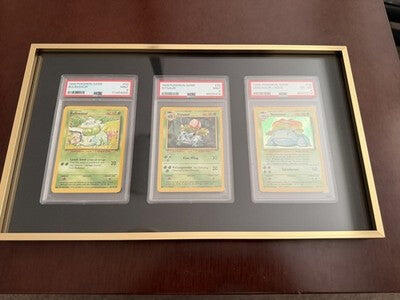
A collector has three PSA-graded cards forming an evolution line. A 3×1 display establishes the order clearly and fits comfortably above a narrow cabinet. The collector could instead use three small stands on a shelf if they want to change the selection frequently. In either case, keeping the slab format consistent helps the arrangement look deliberate.
A mixed PlayStation and Nintendo gaming room
A collector wants to show twelve favourite PlayStation cases and four Nintendo Switch games. Rather than forcing the different case sizes into one continuous grid, they can use separate platform-specific displays or a cabinet with adjustable shelving. Matching outside finishes can tie the two groups together. The smaller Nintendo format then becomes a distinct collection rather than a fit problem.
A larger sports card wall
A collector has thirty or more graded sports cards spanning multiple seasons. One large continuous display may be visually striking, but weight, handling, panel span and safe mounting become central decisions. Several coordinated smaller grids could make updates and relocation easier. The right answer depends on the room and whether the collection is expected to grow.
A practical checklist before choosing a layout
- Decide whether the display is thematic, chronological, value-focused or purely personal.
- Count the items you genuinely want visible, not the entire collection you own.
- Confirm every holder or game case format and measure anything unusual.
- Choose an arrangement based on the available wall shape.
- Check the full outside dimensions, not only the internal openings.
- Compare inexpensive stands, shelving and cabinets before committing to wall mounting.
- Decide whether black or white background material suits the artwork.
- Consider how the chosen aluminium finish interacts with the room.
- Check light exposure, reflections, handling and mounting requirements.
- Leave room for sensible changes if the collection is likely to expand.
Frequently asked questions
What is the best layout for displaying graded Pokémon cards?
There is no universal best arrangement. A 3×1 row works well for an evolution line, while a 3×3 grid can suit nine related cards. Larger graded sets may benefit from wider or multi-frame arrangements depending on the wall and holder format.
Is a 3×3 grid better than a long row of nine cards?
A 3×3 arrangement is compact and symmetrical. A 9×1 row is much wider and may suit a narrow strip of wall above furniture. They hold the same number of cards but have very different visual effects.
How many cards should I display on one wall?
Display as many as the space, mounting system and visual theme can comfortably support. A few selected favourites may be clearer than an entire collection squeezed into one small area.
Can I mix PSA, CGC and BGS holders in one display?
They can appear together on adjustable stands or suitably configured displays, but do not assume they have interchangeable dimensions. Purpose-fitted openings should match the actual holders.
Can One Touch holders use the same layout as PSA slabs?
The layout count may be similar, but the holders differ physically. Use a configuration made for the relevant external dimensions rather than treating the openings as interchangeable.
What is the best grid size for a Nintendo Switch collection?
That depends on whether the collector is showing a few favourite games or a broader series. Four, six, nine or twelve can all work visually, but the available wall space and selected case format should determine the final arrangement.
Are game cases too large for a 16-grid frame?
Not inherently, but sixteen cases create a substantial physical display. The outside size, glazing, mounting, transport and wall clearance should be checked before ordering or constructing one.
Can PlayStation, Xbox and Nintendo cases share a single fitted frame?
Not automatically. Different formats and generations can have different dimensions and thicknesses. A mixed collection may need separate fitted sections, custom sizing or adjustable shelving.
Should I frame a valuable sealed game or keep it in storage?
That depends on the game's materials, condition and the owner's priorities. Display increases visibility but may also add handling and light-exposure considerations. Controlled storage can be a better option for particularly fragile or important pieces.
Is black EVA foam better than white EVA foam?
Neither is universally superior. Black tends to emphasise contrast and darker presentation; white creates a brighter surround. The artwork, room lighting and frame finish are more useful deciding factors.
Why would someone choose aluminium instead of a cheap shelf?
Shelves are often the better storage solution for many items. An aluminium grid frame offers a single visual boundary, coordinated finishes and fixed item positioning, which can be useful when presentation rather than storage capacity is the main goal.
Should every collectible be displayed in a separate frame?
No. Individual frames make rearrangement easier, but multiple objects in one grid can create a more unified presentation. The choice depends on whether flexibility or a fixed collection composition matters more.
Do larger frames always need thicker acrylic?
Larger spans may require different panel thickness or support, but suitable construction depends on the actual dimensions and design. UV filtering and physical rigidity should be evaluated separately.
How much spacing should I leave between individual wall frames?
Use a consistent gap appropriate to the wall and frame sizes, then view the full arrangement from normal room distance. There is no universal spacing measurement that works for every combination.
Can I change the items in a finished display later?
That depends on the product's access method and whether the replacement objects share the same dimensions. Confirm the intended holder or case format and how the display is opened before planning regular changes.
Is one very large grid better than several smaller ones?
A large grid can look cohesive, while several frames offer flexibility for future collections, transport and rearrangement. Neither is always better. Weight, wall space and the desired visual theme decide the trade-off.
How should I arrange games from one series?
Release order is easy to understand, while narrative order, console generation and personal ranking are other valid approaches. Choose one rule and use it consistently, especially when a franchise spans multiple platforms.
Does a more expensive display protect a collection automatically?
No. Price is not a preservation specification. Glazing performance, wall placement, humidity, mounting, materials and handling are separate matters that need to be evaluated.
Further reading
For practical background on display materials, holder formats, game-case dimensions and preservation, the following existing SLABBED educational guides explore those subjects in detail:
- The Ultimate Trading Card Display Guide
- How to Display Graded Cards on a Wall
- How to Make a One Touch Trading Card Wall Display
- How to Display Video Game Cases
- Video Game Case Sizes Explained
- UV Protection for Video Game Cases
Final thoughts
The best collection wall is not necessarily the largest grid or the most expensive frame. It is the arrangement that makes the contents meaningful, suits the space and respects the physical requirements of the objects inside.
A single PSA slab or video game case can be effective when it tells an important story. A neatly planned 3×3 grid can bring nine pieces together without competing for attention. A much larger aluminium display can turn a curated collection into a substantial room feature, while inexpensive stands, shelves and cabinets remain practical choices for collections that change often.
Start with the items, plan the layout on the actual wall and choose materials only after the proportions and fit are clear. That process usually produces a better result than selecting a grid size first and trying to force the collection to suit it.
Continue Exploring
The following guides and collections provide more detail on colour choices, collectible formats and practical ways to present a collection.
Collector design guides
- How to Choose Display Frame Colours — Compare aluminium finishes, black versus white EVA foam and colour-matched backing.
- Beyond Trading Cards: Different Collectibles You Can Display — Explore graded slabs, One Touch holders and physical video game cases.
- The Ultimate Trading Card Display Guide — Compare ways to organise and display TCG collections.
- How to Display Nintendo Switch Games — Nintendo collecting, layouts and display methods.
- How to Display PlayStation Game Cases — PS5, PS4, PS3 and PS2 collections.
- How to Display Xbox Game Cases — Original Xbox, Xbox 360, Xbox One and Series X displays.
Explore display collections
- CardVault® Aluminium Trading Card Displays — Different layouts and finishes for trading card collections.
- SlabVault® Graded Slab Displays — Configurations designed for graded card holders.
- MagVault® One Touch Displays — Displays for selected magnetic card holders.
- GameVault™ Video Game Displays — Displays for selected physical video game case formats.

0 comments