


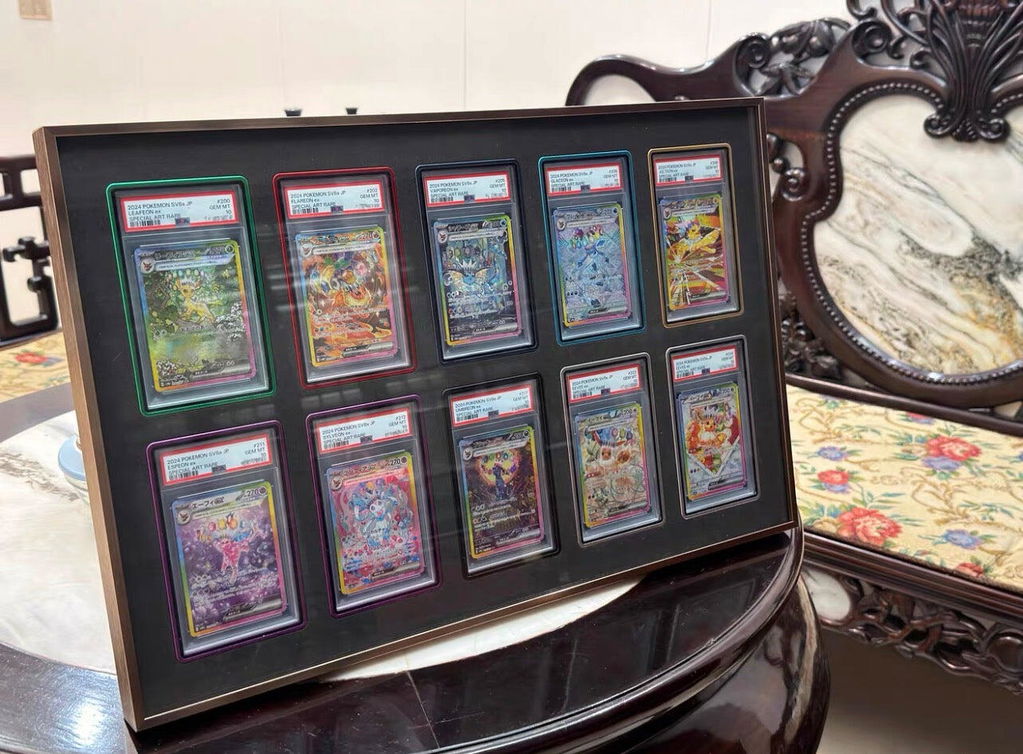
When comparing wooden trading card display frames, it is easy to focus on the colour of the wood and the number of cards a display can hold. Yet two display cases that look similar in photographs may be made from very different materials. One might be machined from birch plywood, another might use painted medium-density fibreboard (MDF), and a third might be assembled from solid timber or made from plastic with a wood-effect finish.
These differences influence how the display is manufactured, how it accepts a finish, how much it weighs and how it responds to changes in its surroundings. They also influence which designs are practical for a small group of PSA graded Pokémon cards or a much larger collection of sports cards, CGC slabs, BGS slabs or One Touch magnetic card holders.
This guide explains plywood, MDF, solid wood and other common display materials from a collector's perspective. It considers the strengths of each material, the reasons we selected birch plywood for our wooden trading card displays at SLABBED™ Studio, and the circumstances in which aluminium or frameless acrylic construction may be more appropriate.
What does a wooden trading card display actually mean?
The word wooden describes an appearance or a broad family of materials, not a single manufacturing specification. A traditional picture frame made from timber strips, a veneered MDF shadow box and a plywood body with individual card recesses can all reasonably be described as wooden displays. Their internal construction is different, even when the surface colours are similar.
It is useful to distinguish the body of the display from its decorative finish and its protective glazing. The body positions and supports the holders; the finish determines much of the visual character; the acrylic or glass front determines how the collection is viewed through the cover. A photograph of a dark walnut-coloured frame cannot answer all three questions.
Before comparing prices, look for a description that identifies the actual body material, the finish, the holder compatibility and the display orientation. Those details are more useful than a general description such as luxury wood or premium construction.
Birch plywood vs MDF vs solid wood at a glance
| Material | Internal construction | Typical appearance and finishing | Considerations for card displays |
|---|---|---|---|
| Birch plywood | Bonded layers of wood veneer | Natural face grain and exposed layered edges; can be stained or painted | Suitable for a continuous recessed body; veneer variation and flatness need consideration |
| MDF | Compressed wood fibres bonded with resin | Generally uniform surface; often painted, laminated or veneered | Useful for consistent opaque finishes; edges and moisture exposure require care |
| Solid timber | Natural wood, sometimes joined into a wider panel | Distinct species-specific grain and character | Attractive for rails and small displays; movement across grain needs consideration |
| Veneered MDF | MDF core with a thin decorative wood veneer | Real wood grain on the surface | Machined recesses may expose the fibreboard underneath |
| Particleboard | Bonded wood particles | Often covered by a laminate or decorative veneer | Economical for some cabinets and backing panels; exposed edges need suitable treatment |
| Plastic | Varies by polymer and manufacturing method | Can be transparent, opaque, textured or moulded | Practical for stands and repeatable shapes; physical and optical properties vary by grade |
These are broad tendencies rather than a ranking. Panel grade, thickness, design, workmanship and the intended use all affect the performance of a completed display. The USDA Forest Products Laboratory Wood Handbook is a useful starting point for understanding wood as an engineering material and the properties of wood-based panels.
What is birch plywood?
Birch plywood is an engineered wood panel manufactured by bonding thin wood veneers into a thicker sheet. Adjacent layers are commonly arranged with their grain directions crossing one another. This arrangement changes the way a panel behaves compared with a wide piece of natural timber whose grain predominantly runs in one direction.
The exposed face presents the appearance of wood, while the side of the panel reveals the layers. The precise lay-up, core species, adhesive, thickness and quality of the veneers depend on the specification. A birch face does not by itself identify every internal layer, so the supplier's panel description matters.
The APA plywood overview explains the principle of cross-laminated veneer construction. For Australian collectors interested in the wider use of this material, WoodSolutions' plywood guide provides an introduction to its applications.
Is plywood real wood or artificial wood?
Plywood contains real wood veneers. It is engineered rather than a single continuous piece of natural timber. Both descriptions are important: a stained plywood face can show genuine wood grain, but the sheet also contains bonded layers and should not be confused with a solid hardwood board.
This is why we describe our wooden displays as birch plywood rather than solid birch timber. Our display body is made from a single piece of plywood, meaning the body is not assembled from a set of separate perimeter rails. The board itself remains a laminated wood product.
Why plywood is used in furniture and cabinetry
Furniture designers often need a broad surface with a consistent thickness and enough rigidity to function as a panel. They may also want to expose the edge of the material deliberately, rather than hiding the internal construction behind a moulding or edge band. Plywood can meet these design objectives in a way that is visually different from a traditional timber frame.
In a trading card display, the wooden body can become the background, the border and the support for individual holders. Instead of attaching a separate decorative wooden surround to an insert, the recesses can be formed directly in the panel. This makes the material visible between cards as well as around the outer perimeter.
Why we chose birch plywood for trading card displays
Our original ranges focused on aluminium frames and frameless acrylic construction. Both are suitable for collectors who want a structured presentation on a wall. Introducing wood was an opportunity to create a different kind of display, particularly for collectors who prefer to arrange cards on furniture using a supported freestanding design.
We chose birch plywood for its relatively smooth face, fine grain and suitability for decorative staining. Its pale natural appearance provides a useful starting point for a variety of colour finishes, while the layered body can remain visible around the outer edges and machined sections.
We also wanted the wood itself to form the individual holder compartments rather than functioning only as a decorative border around another material. The wooden trading card display collection uses this approach throughout its different layouts. The choice was made for this particular design, not because plywood is automatically the best material for every kind of frame.
What is MDF and how is it different from plywood?
Medium-density fibreboard, also known as MDF, is made from processed wood fibres rather than intact veneers. The fibres are consolidated with a binder into a panel. The resulting surface is generally even, without the natural face grain associated with a plywood veneer or piece of solid timber.
This makes MDF useful when the desired result is a painted or otherwise opaque surface. It is used in furniture, doors, cabinetry and decorative panels. According to WoodSolutions' MDF guide, common forms include unfinished boards and boards with decorative overlays; ordinary interior MDF has limitations in damp conditions.
Why MDF is often used for inexpensive wooden frames
Manufacturers can use uniform sheet stock and apply a repeatable coating or decorative film. When the wood grain is not part of the design, paying for a visible natural veneer may offer little practical benefit. An inexpensive painted MDF frame can therefore be a sensible way to present a few cards, provided that the support and glazing are appropriate.
Cost also reflects production scale. A standard frame that is manufactured in large batches needs fewer individual setup and finishing decisions than a wooden display prepared for a particular holder type, layout and stain. The material alone does not determine the price of the finished product.
Can MDF have a premium finish?
Yes. A carefully prepared painted MDF cabinet or display can have a smooth and visually consistent surface. Some high-quality furniture uses MDF precisely because the designer wants a uniform coating rather than visible wood grain. A properly applied two-component coating, for example, may create a refined opaque finish.
The distinction is what the collector wants from the wood. A black painted panel and a black stained birch panel may appear similar from a distance, but the second can retain visible wood texture and variations beneath the colour. Neither effect is inherently preferable. They are different design choices.
What happens when MDF and plywood are machined?
Machining reveals the composition beneath a panel's surface. In MDF, a recessed pocket exposes the fibre structure of the board, which may require different sealing and sanding from the original face. In plywood, a cut can intersect several veneer layers, showing grain changes and bond lines.
A display with a single large insert opening has relatively little exposed internal geometry. A display containing dozens of separate compartments has many more internal edges and surfaces. If natural material is intended to remain visible, the appearance of those machined surfaces is part of the finished design.
Solid timber: where does it make sense?
Solid timber frames can be particularly attractive when the species itself is part of the purchase. Oak, walnut, maple and other woods have different colour, grain and physical characteristics. A collector may prefer a frame made from the same timber as a desk, a cabinet or another piece of furniture.
Traditional timber rails are also well suited to a conventional picture-frame shape. For a broad display body with numerous recesses, the designer must think about grain direction, panel width, the orientation of joints and how material movement is accommodated. A large body may need multiple boards joined together rather than one unusually wide piece.
Does solid wood always mean higher quality?
No single construction label establishes the quality of a finished display. A poorly dried timber panel with inadequate support is not necessarily more useful than a carefully chosen plywood panel. Equally, a well-made solid timber frame with suitable glazing may be an excellent display for a particular card arrangement.
Compare the complete design instead of treating the material description as a hierarchy. For instance, a narrow timber surround and a thick plywood body can serve very different functions even if both have a similar walnut colour.
Wood movement and dimensional stability
Wood exchanges moisture with the surrounding air. As its moisture content changes, its dimensions can change as well. In natural timber, the response is generally different along and across the grain. Cross-oriented veneer layers in plywood help moderate some of this movement, but do not eliminate it.
This matters when an acrylic cover is fitted into a wooden recess. The wood and the acrylic are different materials; they do not respond identically to environmental changes. A small difference in flatness that might be inconsequential on a painted cabinet door can be more apparent when a clear sheet sits against a broad recessed surface.
For practical care advice, the Canadian Conservation Institute's guide to wooden objects explains the relationship between moisture changes and wood.
Can plywood bow or warp?
Yes. Even when cross-laminated construction is selected for dimensional stability, a panel can develop curvature from internal stresses, storage conditions, machining or changes in moisture. A wider display can make a small deviation more visible than it would be in a compact single-card display.
Our wooden product descriptions disclose possible variations in flatness, especially for large layouts. These may also influence how evenly the removable acrylic sits. We inspect and prepare the wood, but cannot manufacture natural material into a guarantee of permanent perfect flatness.
Place a large wooden card display on a strong, appropriate support rather than forcing a curved panel flat with improvised clamps or weights. If a variation prevents a cover or holder from seating safely, stop using the display in that configuration and seek advice from the manufacturer.
Does plywood thickness determine strength?
Thickness is only one part of the answer. The dimensions of the panel, its veneer arrangement, the depth of removed material and the location of supports all matter. A thick body with large recesses is not mechanically identical to an unmachined sheet of the same overall thickness.
Compare the completed product and intended support conditions. A small display holding three graded cards can sit on furniture that would not be appropriate for a much larger grid with dozens of holders and a broad acrylic cover. The combined weight and size are relevant, not just the thickness of the wooden edge.
Understanding plywood grades, knots and veneer repairs
Plywood is available in different grades and specifications. Surface appearance, permitted repairs, internal construction and adhesive performance are not all described by one universal grade label. A face selected for decorative use can still contain natural differences in grain and colour. A panel intended for another purpose may prioritise different properties.
The APA guide to sanded plywood is a useful illustration of why veneer quality and intended applications should be considered separately. It is not a certification of any particular trading card display.
Why do machined wooden recesses sometimes look different?
A cut can reveal a different layer of wood, a knot, a repaired section or a local variation within the material. The wood grain inside a pocket does not necessarily match the face that surrounds it. A change in colour inside a recess therefore cannot be identified reliably from colour alone.
Some locations may also be more prone to small chips or splinters than others. Grain orientation and the material encountered by the cutting tool affect the resulting surface. Careful preparation can improve the finish, but two pieces of natural wood cannot be expected to behave identically during machining.
It is worth distinguishing a minor cosmetic characteristic from a problem affecting fit, stability or safe handling. Natural grain and small surface variations are different from a sharp edge that could damage a holder or a recess that cannot safely accommodate the intended slab.
Why plywood edges are often left visible
Layered edges are a recognisable feature of plywood furniture. The alternating lines can form part of a deliberate design, especially where the body has a visible thickness. Some designers prefer to conceal the layers with edging or paint, while others prefer the contrast between the flat face and the exposed edge.
For a wooden card display, visible layers can be especially noticeable along finger-access cutouts and the perimeter of card pockets. A stain may make some layers darker than others. Collectors who prefer a completely homogeneous colour may instead favour an opaque painted surface, aluminium or another material with a more uniform appearance.
Why wood stains behave differently on birch plywood
A stain colours the wood without necessarily concealing its underlying pattern. Absorption may differ across the face grain, end grain, veneer boundaries and repaired areas. Sanding and surface preparation can influence the final appearance, as can the stain formulation and application method.
Birch is a useful base for decorative colour, but its relatively even-looking untreated face does not guarantee that every area will absorb stain uniformly. A sample made from the same panel is more informative than a photograph of the stain on a different species. The final colour can also change when a clear protective finish is applied.
Walnut, oak and mahogany stains are not different wood species
A walnut-coloured birch plywood display remains a birch plywood display. Stain names commonly describe a desired tone or visual reference, not the composition of the body. This is an important distinction when comparing a stained wooden frame with one manufactured from solid walnut or oak.
Our wooden range offers No Stain, Black, Cedar, Jarrah, Mahogany, Maple, Oak, Teak Oak and Walnut. These choices provide different appearances using the same underlying display construction. For examples of matching those tones with furniture and card artwork, see our wooden Pokémon and trading card display ideas guide.
Stain, varnish and paint compared
| Finish | Visual role | What a collector should consider |
|---|---|---|
| Unfinished wood | Natural face and exposed layers | More susceptible to marks from handling; allows personal finishing |
| Wood stain | Changes tone while allowing some wood character to remain | Colour varies with substrate, absorption and preparation |
| Clear varnish | Protective surface film, with sheen depending on formulation | Care and cleaning depend on the coating |
| Opaque paint | More uniform colour with reduced visible grain | Preparation, edge sealing and coating quality matter |
| Decorative laminate | Repeatable colour or pattern | Look at edge treatment and exposed recesses |
These categories can overlap. A stained display may also be varnished; a coloured finish may combine several functions. The Canadian Conservation Institute's furniture finishes guide provides further background on the care of coatings.
Can collectors finish their own wooden card display?
An unfinished wooden body allows the collector to choose a stain or coating that matches existing furniture. This is useful when a room has a particular colour scheme that is difficult to match from a standard palette. It also appeals to people who already enjoy woodworking and furniture finishing.
Our No Stain option is supplied without stain or varnish. Remove all holders and acrylic before working on the body, test the chosen product on a suitable sample if possible, and follow its preparation and curing instructions. Do not return valuable cards to the display until the finish has cured as directed and the recesses are clear of dust and residue.
Veneered MDF and wood-effect displays
A display made with veneered MDF may have real wood on its visible face. That is different from a printed wood-effect film, although both can be convincing in product photographs. A thin veneer on an MDF substrate can be a sensible construction for flat cabinet surfaces where a consistent backing material is desired.
For recessed trading card compartments, the important question is whether the decorative surface continues into the pockets or whether the core is exposed. Ask for photographs of the edges, the back and the internal openings if the construction is important to you. There is nothing inherently wrong with a decorative surface, provided it is described accurately.
Plastic card displays: where they are useful
A simple plastic card stand can be an economical and practical choice for a single graded slab. It is often compact, easy to reposition and does not require a large display body. Moulded plastic can also be well suited to consistent shapes produced in quantity.
Plastic covers many different polymers and manufacturing methods. An acrylic protective sheet, an injection-moulded stand and a 3D-printed holder should not be treated as equivalent. A transparent component may be selected for optical properties, while an opaque component may be selected for toughness, geometry or cost.
A wooden display becomes relevant when the collector wants the body itself to contribute to the arrangement, with a natural surface around a group of cards. It is a different visual and physical solution, rather than a necessary upgrade from every plastic accessory.
Why manufacturing methods influence the finished price
Cutting the recesses is only one part of preparing a wooden card display. The design must account for the holder format, the arrangement of the openings, access for removal, the outer cover and the finished footprint. Material selection, preparation, sanding, staining and varnishing also contribute to the finished result.
We use precision CNC machining to form the wooden body for the chosen layout, followed by individual preparation and finishing. This is useful for repeatable holder geometry while allowing different configurations to be made to order. It does not eliminate the natural variations of the wood encountered during cutting.
A basic standard-size plastic stand and a made-to-order wooden multi-card display are therefore difficult to compare using material cost alone. The number of components, finishing operations, glazing, manufacturing scale and delivery requirements are relevant. A collector can reasonably decide that some of those features are not necessary for a particular collection.
What does a fitted recess contribute to card presentation?
Individual recesses create defined positions for cards rather than leaving their alignment to a series of separate stands. The surrounding wood also creates a consistent border between holders. This can be useful for displaying a set of Pokémon illustrations, a group of basketball rookie cards or several related Magic: The Gathering cards together.
Fit should be based on the holder rather than the dimensions of the printed card. PSA, CGC and BGS slabs differ in their external profiles, and magnetic holders may vary in thickness. A display designed for one holder format is not automatically compatible with another.
Why our wooden displays are freestanding rather than wall-mounted
Our wooden body uses shallow card recesses and a removable clear acrylic cover that sits below the surrounding surface. Both the holders and the cover rely on gravity to remain seated. They are not mechanically secured to the body. The weight of the wooden construction is another reason the display is not intended to be hung on a wall.
A gentle viewing angle on a suitably rated, stable stand allows the cards to be viewed without the display being positioned upright. Wall mounting, fully vertical positioning and steep angles are unsuitable for this design because holders and the cover may become dislodged and fall out. Remove them before moving the display. Stands are not included, so choose support appropriate to the complete size and weight.
This is a difference between designs, not an intrinsic rule about all wooden frames. A conventional wooden shadow box with mechanically secured contents and suitable hanging hardware may be designed specifically for a wall. For collectors who need that type of presentation, our aluminium trading card frames and frameless acrylic displays are relevant alternatives.
Does a wooden body offer UV protection to cards?
The opaque body surrounds the cards, but the visible face receives light through the clear cover and the holders. The UV performance of that optical path depends on the actual glazing and holder specifications. A wooden body, an MDF body and an aluminium frame cannot be assigned different front-facing UV filtration percentages simply from their structural materials.
Clear acrylic provides a physical barrier to direct contact and can reduce dust settling on holders. Specialist acrylic may provide additional UV filtration and reduced reflections. Those optical characteristics should be evaluated independently from the choice of wood.
As an example, Perspex Online's PLEXIGLAS® Gallery & Museum AR listing reports high visible transmission and low reflectance for a particular coated acrylic. The wavelength range and product data should be checked when comparing UV claims. No acrylic makes prolonged direct sunlight a suitable location for valuable cards.
Comparing wooden, aluminium and frameless acrylic construction
| Consideration | Wooden recessed body | Aluminium frame | Frameless acrylic |
|---|---|---|---|
| Visual character | Natural grain and selectable stains | Metallic perimeter and defined edges | Minimal visible perimeter |
| Holder positioning in our designs | Individual pockets in the wooden body | Purpose-cut insert inside the frame | Purpose-cut insert between panels |
| Presentation in our ranges | Supported freestanding at a gentle angle | Designed for wall mounting | Designed for wall mounting |
| Material characteristics | Natural grain, veneer and flatness variations | Metal profile and applied finishes | Clear panels and exposed acrylic edges |
| Care priorities | Wood finish, stable support and cover care | Frame finish, secure mounting and glazing care | Panel surfaces, secure mounting and glazing care |
The table describes our three construction approaches rather than every product on the market. The advantage of having a choice is that a collector can select a material and format based on the room and the collection. A wooden display in a cabinet and an aluminium frame on a nearby wall can work together without either needing to replace the other.
Which material suits a small graded Pokémon collection?
A three-card evolution line or a small collection of favourite illustration rares can be displayed effectively using individual stands, a compact wooden body or a small wall frame. A wood finish may be attractive if the display is going on a timber desk or sideboard. Separate plastic stands may be preferable if the collector frequently rearranges the cards.
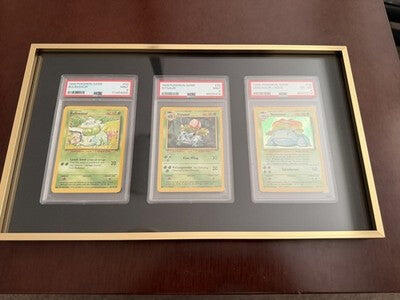
A three-card wooden display is one example of a fitted group arrangement. Choose the holder format before choosing the finish, because the colour of the wood cannot compensate for an incorrectly sized compartment.
What about large sports card collections?
A collection of graded baseball, basketball, football or soccer cards can grow into a substantial display. Start by deciding how much furniture or wall space is available and how often the arrangement will change. Large wood panels take up considerable supported surface area when viewed at a gentle angle.
A wall-mounted aluminium or frameless acrylic arrangement may make more efficient use of room space, especially when the collection contains many cards. Conversely, several smaller wooden displays can make sense for curated groups of favourite players, teams or seasons. The complete trading card display guide explores other ways to arrange collections.
Material selection for valuable or frequently handled cards
A collector who regularly removes a One Touch holder for closer viewing may value easy access more than the appearance of a permanently closed display. A collector who wants a stable wall arrangement may prioritise a design that mechanically retains the components. Choose according to the intended routine, not simply the retail price of the cards.
Keep raw cards in appropriate protective holders rather than placing them directly into wooden recesses intended for encapsulated cards. Wood finishes, adhesives and other construction materials should not be presumed suitable for direct archival contact with paper unless supported by specific evidence.
How to care for wooden trading card displays
Keep the display indoors in a relatively stable, dry environment away from strong sunlight, heating vents and damp surfaces. Dust gently using methods appropriate for the finish, and avoid flooding exposed edges or recesses with cleaning liquid. Treat the wooden body and clear acrylic separately, since a cleaner suitable for one material may not be suitable for the other.
The Australian Institute for the Conservation of Cultural Material's wood and furniture guide offers practical background on care of wooden objects and their finishes. For a removable acrylic cover, follow the specific sheet supplier's cleaning recommendations and avoid dragging grit across the surface.
What to ask before buying any wooden card display
- What material forms the body: solid timber, plywood, MDF, veneered MDF or another product?
- Does the finish show real wood grain, a decorative veneer or a printed pattern?
- Are the card compartments fitted to the external holder dimensions?
- How are the holders and glazing retained, and what orientations are suitable?
- Does the product need a separate stand or specific wall hardware?
- What natural variations can be expected in the finish or flatness?
- What acrylic grade is supplied, and what optical properties are documented?
- Can the holders be removed without pressing on or damaging them?
- Does the completed display fit the available space and its supporting furniture?
These questions apply to inexpensive and expensive displays alike. A straightforward answer about materials and intended use is often more valuable than a long list of unmeasurable quality claims.
Frequently asked questions about wooden trading card display materials
Is birch plywood better than MDF for a wooden Pokémon card display?
Birch plywood is particularly suitable when the design calls for visible natural grain, a stained finish and a layered edge. MDF can be a reasonable alternative when the objective is a smooth, opaque painted surface. The completed design and holder support matter in both cases.
Is plywood the same as particleboard?
No. Plywood is constructed from veneers, while particleboard is manufactured from bonded wood particles. They can both be used as engineered panels, but have different internal structures and finishing considerations.
Is birch plywood a hardwood?
Birch is a hardwood species in the botanical sense. Birch plywood is an engineered panel, and its physical properties depend on its full construction, not merely the word hardwood.
Is walnut-stained plywood made from walnut?
No. Walnut stain describes the finish colour. A walnut-stained birch plywood display still uses birch plywood as its structural body.
Can MDF be stained like natural timber?
Some finishing products can colour MDF, but an unveneered MDF surface does not have the natural grain pattern of timber. If a real wood appearance is important, consider the actual substrate and decorative surface rather than the stain name alone.
Do wooden displays weigh more than aluminium frames?
Not necessarily in every comparison. Total weight depends on material volume, thickness, the construction design, glazing and number of holders. A substantial wooden body can be heavy, even though aluminium itself has a higher material density than many woods.
Why can the inside of a plywood recess have a different colour?
Machining may reveal different veneer layers, grain orientations, repairs or other internal characteristics. Colour alone is not sufficient to diagnose the cause of an individual patch.
Can large plywood card displays be perfectly flat?
They can be flat when produced, but permanent perfect flatness should not be assumed. Natural material variation, machining and environmental changes can influence panel shape. Proper support is particularly important for large layouts.
Does varnishing make a wooden display waterproof?
A suitable coating helps protect the surface during ordinary use, but it does not establish that the completed display is waterproof. Follow the finishing product's care instructions and avoid sustained moisture exposure.
Are wooden PSA slab displays safe to hang on a wall?
Only when the specific design is intended for wall mounting and securely retains the holders and cover. Our recessed wooden range is gravity-based and is not suitable for vertical or wall-mounted display.
Does a wooden display protect cards better than a plastic display?
Protection depends on the support geometry, glazing, environment and holder compatibility. A well-designed plastic stand may be perfectly adequate for a particular card. Wood primarily provides a different structural and decorative approach in our range.
Can I use a PSA wooden display for CGC or BGS cards?
Check the selected holder format. Graded slab dimensions and shapes are not necessarily interchangeable. Never force a holder into a compartment that is too small or assume a loose fit is safe at an angle.
Is clear acrylic a type of plastic?
Yes. Acrylic is a plastic material commonly known as PMMA. Its clarity and available specialist optical grades make it useful as display glazing, even when the supporting body is wood or metal.
Should I choose wood or aluminium for a large collection?
Decide whether the collection will sit on suitable furniture or occupy a wall. A supported wooden layout offers a natural material appearance, while our aluminium frames are intended for wall presentation. Compare the actual footprint and support needs before deciding.
Is unfinished birch plywood a good choice for custom colours?
It can be useful if you want to select your own finish. Test the finish on suitable material, follow its application and curing directions, and keep the acrylic and card holders away from the finishing work.
Further technical reading
- USDA Forest Products Laboratory: Wood Handbook: wood structure, moisture, composite panels and finishing.
- APA: Plywood: an introduction to veneer-based panel construction.
- WoodSolutions: Plywood: engineered wood panel applications.
- WoodSolutions: Medium Density Fibreboard: composition, finishes and typical uses.
- Canadian Conservation Institute: Basic care of wooden objects: environmental conditions and handling.
- AICCM: Wood and furniture: practical care guidance.
Final thoughts: selecting a material that suits your collection
Birch plywood, MDF and solid timber are different ways of using wood in a display. Plywood offers a natural surface and a layered panel construction, MDF is useful for uniform decorative finishes, and solid timber brings its own species-specific character. Plastic, aluminium and acrylic can also be appropriate when the design has different requirements.
We introduced birch plywood because it allows us to make a wooden body with integrated card compartments and several stain options, offering collectors another way to present their cards alongside furniture. The same features are not necessary for every collection. Someone who wants to hang dozens of slabs on a wall may be better served by a different construction.
Understanding how a display is made helps collectors compare products on their actual features, rather than judging them solely by price or appearance.
Continue Exploring
- Wooden Trading Card Display Frames: The Complete Guide
- Wooden Pokémon & Trading Card Display Ideas
- The Ultimate Trading Card Display Guide
- Premium Aluminium Trading Card Display Guide
- How to Choose the Right Trading Card Display Frame
Explore Displays
For examples of the three construction approaches discussed in this guide, explore our wooden birch plywood displays, aluminium trading card frames and frameless acrylic displays.

0 comments