


Choosing a trading card display is not quite the same as choosing a protective card holder. A PSA slab, CGC case, Beckett holder or One Touch magnetic case already performs a particular job around the individual card. The outer display determines how those holders are arranged, supported and viewed within a room. Its construction also affects how the collection can be accessed, where it can be placed and how much visual attention the surrounding material receives.
Collectors searching for wooden Pokémon card frames, aluminium graded card wall displays or frameless acrylic trading card cases will often encounter products that look broadly similar in photographs. Once the differences in construction, mounting and materials are understood, however, it becomes easier to decide which design belongs in a particular collection.
This guide compares wooden, aluminium (also spelled aluminum) and frameless acrylic trading card displays. It begins with wood, explains why we introduced a birch plywood range alongside our existing wall displays at SLABBED™ Studio, and examines the practical differences between these approaches. The aim is to help collectors make a decision based on the cards, available space and desired presentation, rather than assuming that one material is always better than another.
Three materials, three approaches to displaying trading cards
A display can use several materials even when its name identifies only one. A wooden card display may have an acrylic cover. An aluminium frame may contain a foam insert and two acrylic panels. A frameless acrylic display may also contain a coloured insert that is important to the way the cards are presented. It is useful to identify which component forms the main body, which positions the holders and which provides the viewing surface.
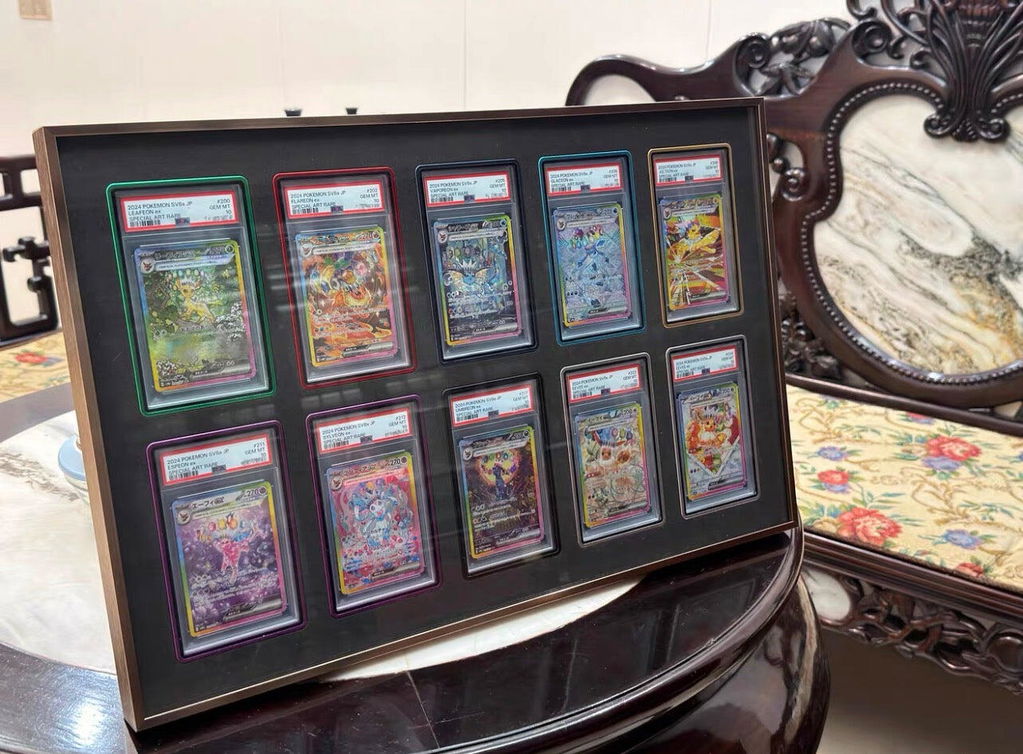
In our three ranges, these responsibilities are distributed differently. The wooden body contains the individual holder recesses. The aluminium system uses a metal perimeter and an internal layered assembly. The frameless design removes the surrounding metal profile and uses a layered acrylic and foam construction instead. All three can present a carefully arranged grid of cards, but they are not interchangeable structures.
| Consideration | Wooden birch plywood display | Aluminium wall frame | Frameless acrylic wall display |
|---|---|---|---|
| Main construction | Single-piece machined plywood body | Metal perimeter around internal layers | Front and rear acrylic panels with fitted foam core |
| Holder positioning | Individual recessed wooden compartments | Purpose-cut semi-rigid foam core | Purpose-cut semi-rigid foam core |
| Front acrylic | Removable panel seated below surrounding wood surface | Clear panel retained within framed assembly | Clear panel forming the visible front of layered assembly |
| Intended presentation in our range | Supported freestanding display at a gentle angle | Wall-mounted | Wall-mounted |
| Colour choices | Wood stains or unfinished birch plywood | Metal frame, foam and rear acrylic options | Foam and rear acrylic options |
| Visual character | Visible grain and wood between cards | Defined metallic perimeter | Uninterrupted layered appearance |
These distinctions describe the construction of our ranges, not every wooden, metal or acrylic product on the market. A conventional timber picture frame may be designed for wall hanging, for example, whereas our recessed wooden display is not.
Why we introduced a wooden trading card display range
Aluminium has long been a practical material for the type of structured wall display we make. Frameless acrylic offers another way to present the same kinds of collections without a prominent metal border. Neither approach, however, provides the appearance of a continuous natural wooden surface around every card.
Many collectors display their favourite Pokémon cards or sports cards in a home office, living room or cabinet rather than on a dedicated collection wall. Their furniture may be oak, walnut, painted timber or a mixture of finishes. A metallic frame may not be the appearance they are looking for, even if it would accommodate their holders. A wooden display provides a different relationship between the cards and the room.
There was also a functional reason for developing the wooden range. We wanted the wood itself to form the individual compartments rather than serving only as a decorative border around a separate insert. That creates a layout in which the surface, the edges of the recesses and the spaces between cards all contribute to the presentation. The result is a different type of display, not a replacement for our wall frames.
Why birch plywood rather than a conventional solid timber frame?
Birch plywood is an engineered wood panel made from bonded veneers. We selected it for its relatively smooth face, fine grain and suitability for decorative staining. Its pale natural surface provides a useful starting point for light, warm and dark colour finishes, while the exposed layers can remain part of the appearance of the display.
The APA plywood guide explains how alternating veneer directions contribute to dimensional stability. This is one reason plywood is useful in panel-based construction. It does not mean a plywood display is immune to bowing, nor that a particular finished display inherits a structural rating merely because the raw material is plywood.
A solid timber frame can be attractive, particularly where the grain of a selected species is the main decorative feature. MDF can provide a uniform surface for an opaque painted finish. The purpose of using birch plywood in our wooden card display is to combine a machined panel with a visible natural wood finish. For a more detailed discussion of these differences, see our guide to birch plywood, MDF and solid wood.
How recessed wooden card compartments work
Each wooden display starts with a single piece of birch plywood. Precision CNC machining forms the individual holder compartments and the surrounding recess for the removable acrylic cover. The wooden material remains visible between the cards and around the outside of the arrangement. The body is then prepared and, for stained options, individually stained and varnished.
A useful distinction is between a fitted compartment and a locking compartment. A holder may fit neatly into a recess without being restrained against falling forward. In our wooden design, the card holders and the acrylic cover are seated under their own weight. They are not mechanically secured. The display is intended to be supported at a gentle viewing angle, not hung on a wall or positioned fully upright.
For a collector who wants to access a small group of cards on a desk, this arrangement can be convenient. The removable cover allows access without dismantling a surrounding metal frame. Set the display flat on a stable surface before removing the acrylic or changing cards. When returning it to a stand, ensure that the body is supported and all components are seated. Do not lift the display by the cover.
What natural wood variation means in practice
Wood is attractive partly because its appearance varies. Two pieces of birch plywood can have different grain patterns, knots, colour transitions and exposed veneer characteristics. Machined recesses may reveal the inner layers rather than the same surface seen on the original sheet. Local texture, brittleness, small voids and minor chipping can also vary according to the veneers and the direction of the cut.
Preparation and sanding improve the finished surface, but they cannot make every piece of wood identical. Larger wooden panels may also show some bowing or variation in flatness. These characteristics are explained in our wooden trading card display listings. Someone who particularly values uniform colour and geometry might prefer a metal or acrylic construction, while another collector may specifically want the natural appearance of wood.
Natural variation is not a reason to ignore functional fit or safe support. A display should still be used only when the acrylic and holders seat appropriately. If a panel or stand cannot support the arrangement securely, the collector should resolve that problem before placing valuable cards inside.
Wood stain versus aluminium colour versus acrylic colour
Colour behaves differently in each material. Stain colours interact with the wood beneath them; the grain and veneer structure continue to influence the appearance. A metal finish produces a more consistent visual boundary around the collection, although lighting, surface texture and manufacturing batches can influence how that finish looks. Coloured foam and rear acrylic create a different kind of contrast because the colour is distributed within or behind the card layout.
In our wooden range, the nine options are No Stain, Black, Cedar, Jarrah, Mahogany, Maple, Oak, Teak Oak and Walnut. The stain names indicate the colour finish, not the species used for the display. A walnut-finished display is still birch plywood. Stained options are varnished, while No Stain is supplied without stain or varnish for collectors who prefer to apply their own finish.
Aluminium and frameless acrylic displays allow the insert and rear acrylic colours to be selected separately where offered. The aluminium version also has a choice of perimeter finish. In a wooden display, by contrast, much of the surrounding visual character comes from the wood itself. This is why a dark wooden finish and a black aluminium frame need not look similar, even when both are photographed against a dark background.
How an aluminium trading card wall frame differs
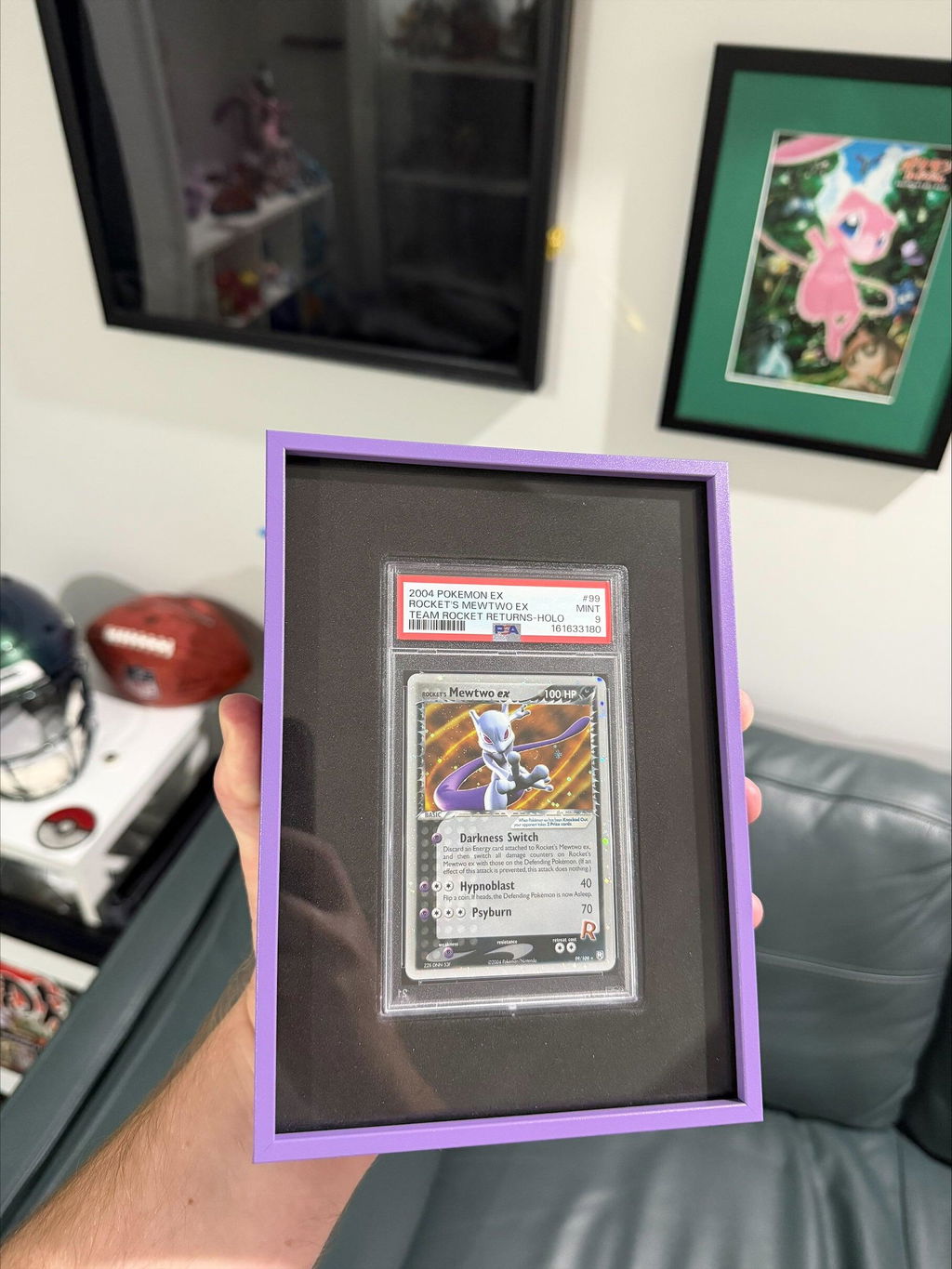
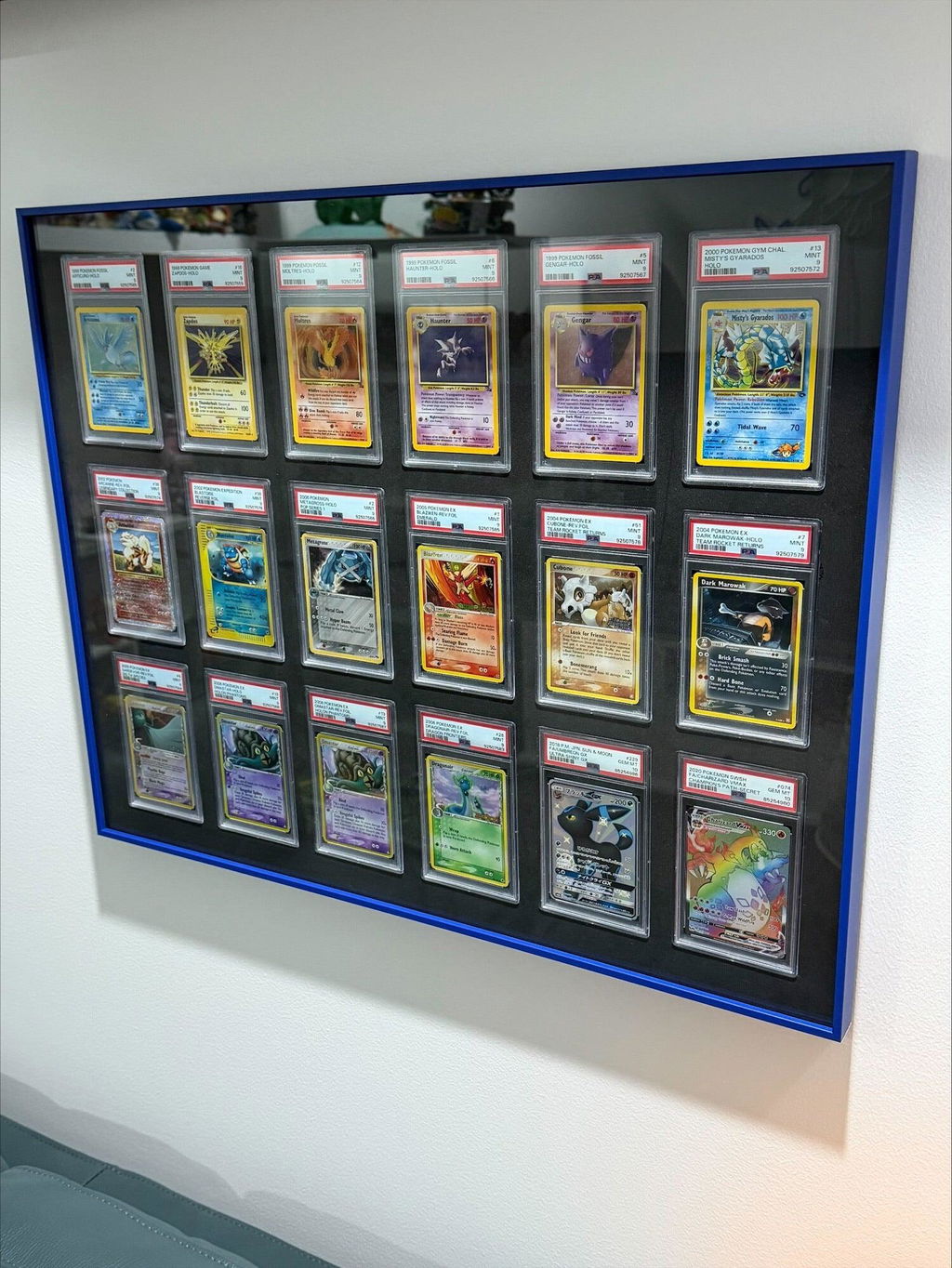
An aluminium frame uses a perimeter profile to enclose and support the internal arrangement. In our design, the cards in their protective holders are positioned by a precision-cut semi-rigid foam core between acrylic panels. The external metal edge creates a clear boundary between the card display and the wall.
This arrangement separates the decorative outer frame from the holder support material. It allows collectors to select a metal finish while choosing the insert and backing colours to suit their cards. It also allows the wood-free structure to be used where a continuous metallic outline is preferred over natural grain.
Aluminium profiles can be designed in different cross-sections, with their geometry contributing to stiffness and the way adjacent components fit together. A slim profile can therefore serve a structural as well as visual purpose. The Aluminum Extruders Council's technical FAQs provide background on why profile design and fabrication vary by application. The material name by itself is not a measure of the load capacity of a completed frame.
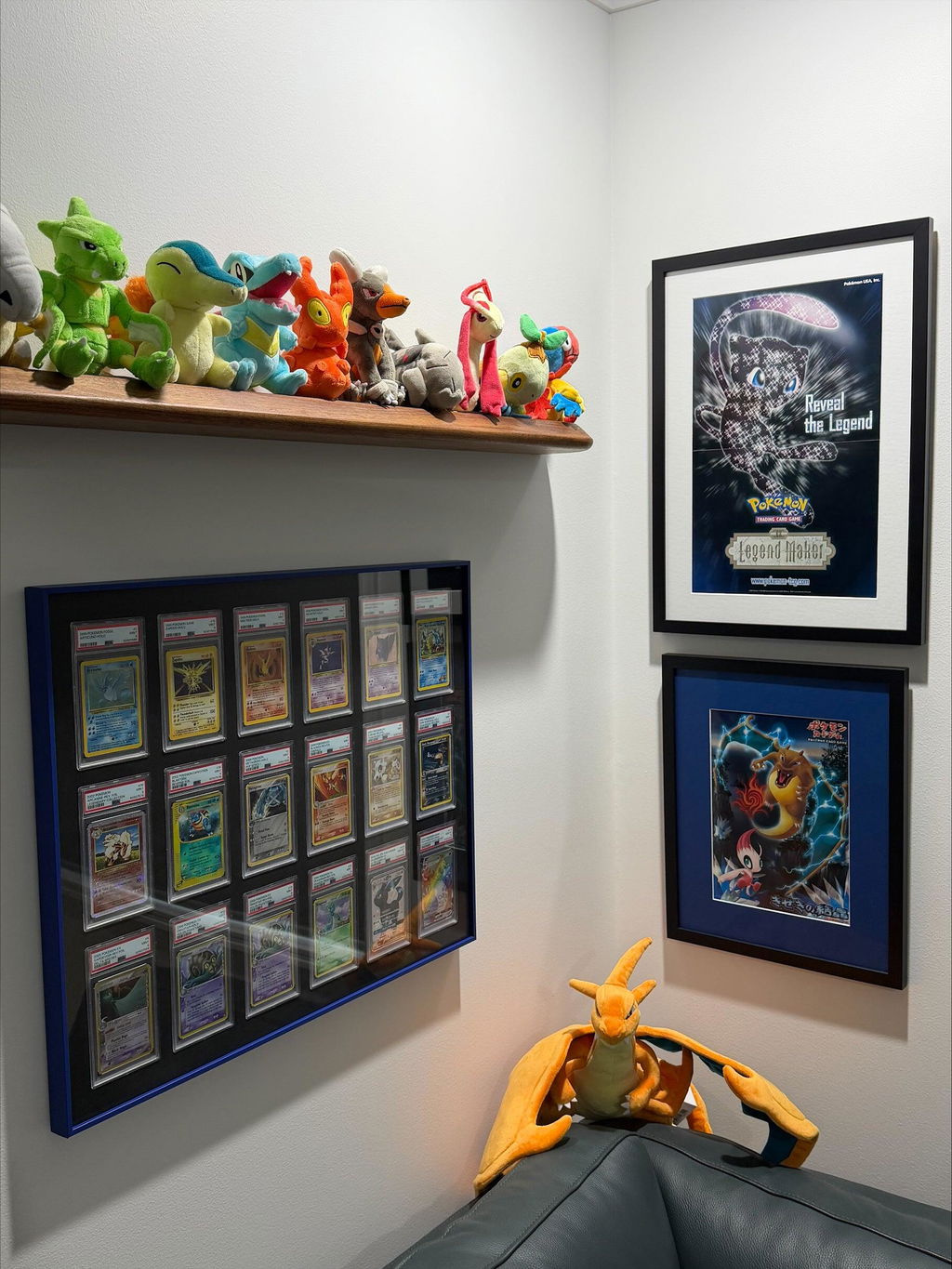
For a collector assembling a dedicated wall of graded Pokémon cards, a metal perimeter offers visual definition and a consistent way to relate separate displays to each other. Explore the aluminium trading card wall frame range for examples of the different configurations. As with any wall display, the complete loaded weight and suitable mounting method matter more than the apparent lightness of the empty profile.
What makes a frameless acrylic trading card display different?
Frameless does not mean unsupported. In our frameless construction, the clear front and rear acrylic panels surround a fitted foam core, forming a layered assembly. There is no separate aluminium perimeter. The visible outer edge comes from the layers themselves, while the insert positions the holders in the selected layout.
The absence of a metal border changes how the collector sees the cards. On a wall, the colour and arrangement of the insert may become more prominent, and the display can have a less pronounced outline than a conventional frame. This can suit a modern office or a collection wall already containing other forms of artwork.
A frameless display is also not necessarily entirely transparent. The rear acrylic and foam colours can be important elements of the design. A black core with a light backing creates a different appearance from a white core with a dark backing, particularly where a clear holder reveals part of the rear panel. The same principle applies to the layered aluminium range.
Our frameless acrylic trading card displays are designed for wall presentation. The term acrylic display also covers individual tabletop stands and other products on the market; those should be assessed separately because their support and retention methods may be quite different.
Which display material works best for a desk, shelf or cabinet?
For a wooden trading card desk display, start by measuring the available depth as well as the width. A display on a stand occupies space in front of and behind its viewing surface. The support must be stable, appropriate for the completed weight and positioned so the card holders and cover remain seated. A suitable stand is not included with our wooden displays because collectors may already have their own presentation arrangements.
A small display on a sideboard may be easier to appreciate than a large one placed at the back of a shallow shelf. Check the sightline from where people normally sit or stand. Allow enough clearance to access the cards and to remove the display without catching the acrylic against the furniture above it.
For a cabinet, consider the door opening and the depth of each shelf. The external dimensions of the display may fit the shelf while a stand pushes the arrangement too far forward. If the cabinet has glass doors, test reflections from both the cabinet and the display cover. Changing the position of a lamp may produce a more noticeable improvement than changing the display material.
Which display material works best on a collection wall?
For a wall-mounted display, the first question is whether the completed product was designed for that orientation. The wooden recessed displays in our range are not suitable for wall mounting or fully vertical placement. Their gravity-retained components can become dislodged. Our aluminium and frameless acrylic ranges are the relevant alternatives for collectors who want the cards on a wall.
Choose the mounting location by considering the complete frame dimensions, the type of wall, the weight of the loaded display and the manufacturer's hardware guidance. A plasterboard wall, masonry wall and timber-supported wall can require different mounting arrangements. Do not assume a fastener used for a small picture is suitable for a large multi-card display. For substantial installations, seek appropriate mounting advice.
A wall frame can free up furniture space and create a consistent view of many cards. It is also a relatively fixed display position, so it is worth checking how daylight falls on the wall over the course of a day. A well-positioned wall frame can work alongside a small wooden display on a cabinet, rather than requiring the entire collection to use one material.
Does the number of cards change the choice of display material?
Yes. A material that works well for one or three cards may need a different supporting structure when the arrangement expands to dozens of holders. The combined weight of the body, acrylic, insert and loaded cases matters. So do the overall dimensions and how the assembly will be moved.
For a large wooden graded card display, consider whether a stable surface can accommodate the entire piece and whether the stand supports it appropriately. Larger plywood panels can exhibit more noticeable deviations from flatness. A large aluminium or frameless wall display faces different considerations, particularly panel span, wall loading and installation access. A catalogue layout is not a substitute for assessing the physical space.
It can be more practical to split a collection into several coordinated displays. A collector could divide Pokémon cards by expansion, sports cards by season or a One Piece collection by character group. Several modest arrangements also make it possible to change one display without handling the entire collection.
| Example collection size | Wooden display consideration | Aluminium or frameless consideration |
|---|---|---|
| 1–3 cards | Small supported stand or cabinet feature; easy to curate | Single or small grouped wall feature |
| 4–9 cards | Desk or sideboard depth and viewing angle become more important | Compact grid can form part of a larger wall arrangement |
| 12–24 cards | Check furniture capacity and support across the display | Assess mounting hardware, loaded weight and wall dimensions |
| Several dozen or more | Substantial supported surface; consider splitting into groups | Plan wall structure, panel handling and installation before purchase |
These are planning examples, not load ratings or recommendations for a particular stand. Actual dimensions depend on the holder format and selected layout.
PSA, CGC, BGS and One Touch: fit matters more than the material
Graded slabs and magnetic holders are not interchangeable simply because they contain standard-sized trading cards. Their external width, height, thickness and corner profiles can differ. A fitted compartment or foam opening needs to accommodate the actual case, including any compatible protective sleeve that the collector intends to retain.
In a wooden display, the case sits within the machined compartment. In an aluminium or frameless display, the selected foam core positions the case within the layered assembly. These support methods feel different when a card is inserted or removed, but the central requirement is the same: the case should fit without being forced into the opening or pressing against the front panel.
PSA, CGC and BGS all have their own encapsulation systems. Ultra PRO One Touch holders also come in different versions and thickness ratings for different cards. Do not assume that a thick sports memorabilia card in a magnetic holder fits a recess intended for a standard holder. Check the product selector and the actual measurements, especially where larger layouts have more limited holder choices.
Our wooden graded card display guide discusses the holder-specific considerations in more depth. For wall arrangements, the graded slab displays and One Touch displays are useful starting points.
Is a wooden Pokémon card frame more protective than aluminium or acrylic?
The body material is only one part of the answer. A wooden surface may give a particular appearance and support the holder in a particular way. An aluminium perimeter may support a wall-mounted layered assembly. Acrylic may provide both a transparent viewing surface and part of the structure in a frameless design. None of these descriptions, by itself, establishes a numerical UV filtration rating or a controlled storage environment.
For light protection, the relevant component is the glazing through which the light reaches the card, together with the properties of the card's own holder. For dust and accidental contact, consider the way the outer assembly covers the holders. For impact or physical security, consider support, installation and whether the enclosure is actually designed and tested for that purpose.
Collectors sometimes treat the outer frame as a substitute for the slab or magnetic holder. In our displays, the cards are intended to remain in their compatible protective holders. The outer display provides arrangement and an additional viewing surface. It is not a grading holder, an airtight conservation enclosure or a climate-controlled cabinet.
Clear acrylic is a shared feature, not a reason to rank the bodies
One of the reasons to compare the body and glazing separately is that all three of our ranges offer a clear acrylic front. The included premium clear PMMA acrylic is selected for optical clarity and supplier-rated UV resistance. The supplier specifies up to 92% visible-light transmission. An optional PLEXIGLAS® Gallery & Museum anti-reflective acrylic upgrade is also available where offered in the selector.
The optional grade has different documented optical properties, including reduced reflection and higher visible-light transmission. These are properties of the specific glazing, not of the underlying wood, metal or acrylic body. Read the acrylic technical specifications and the supplier's product documentation when comparing these options.
The Canadian Conservation Institute's glazing guidance is a useful introduction to the distinction between ordinary and specialist framing materials. A quoted UV percentage should be interpreted together with the specified wavelengths. Different types of clear plastic should not be assumed to have identical transmission curves.
Why reflections can differ between wooden and wall-mounted displays
The angle of the viewing surface changes which parts of the room appear as reflections. A wooden display leaning gently backwards may reflect a ceiling light or a bright window behind the viewer. A vertical frame may instead reflect a lamp across the room. These differences can arise even when the same acrylic grade is used.
Before selecting anti-reflective glazing, try to identify where the light is coming from. An alternative shelf or lamp position may make the cards easier to see. Specialist anti-reflective coatings can reduce reflections from the outer panel, but the clear holder around the card still has its own surfaces. A gap between the glazing and artwork may also affect perceived sharpness with certain glazing products.
For holographic Pokémon cards, sports parallels or foil Magic: The Gathering cards, the preferred lighting direction may depend on which visual effects the collector wants to see. Moderate, adjustable lighting can be more useful than maximising brightness. The display should be viewed comfortably rather than relying on intense illumination.
How sunlight and room conditions affect all three ranges
The Canadian Conservation Institute's guidance on light, ultraviolet and infrared explains why cumulative exposure matters for sensitive objects. Visible light can contribute to colour changes even when ultraviolet radiation is filtered. Direct sunlight also introduces heat. These issues apply to printed trading cards in all three display constructions.
A wooden display on a desk by a sunny window is not automatically better protected than an aluminium frame on a shaded internal wall. Equally, an upgraded acrylic front is not a reason to expose a rare card to prolonged direct sunlight. Decide where the display will live and how the room is illuminated before deciding whether an optical upgrade is appropriate.
Wood introduces another consideration: it responds to moisture conditions in the surrounding air. Plywood's construction reduces some movement, but substantial changes in room conditions can still influence its shape. Keep wooden displays in stable, dry indoor conditions, and avoid storing them beside heaters, in damp garages or in areas prone to condensation. A metal or acrylic display does not make the cards inside immune to humidity or heat either.
Matching a wooden card display with existing furniture
Start with the surfaces already present in the room. A walnut desk and a pale timber bookshelf do not need to be matched exactly. A dark stain can create a deliberate contrast against lighter furniture, while unstained or lightly finished birch can work with neutral colours. Consider whether the wood is intended to blend into the room or form a distinct feature around the collection.
For a small display of vintage Pokémon cards, a warm cedar, mahogany or walnut colour can complement a traditional room. A black stain may suit a modern desk with dark computer equipment while still allowing some wood texture to remain visible. A maple or oak colour can work with lighter interiors. None of these is a rule about which colour belongs with a particular franchise.
Remember that stain reference images are guides to appearance, not exact colour standards. The result depends on the original plywood, preparation, lighting and varnish. Consider a representative finished sample if matching an existing piece of furniture is especially important.
When a metal frame works better visually
A metallic perimeter can make a card arrangement read as a single framed piece from across a room. In an office with dark furniture and black hardware, a black metal frame may connect with other elements already present. A metallic gold or silver finish can create a more obvious boundary around a collection, particularly when it is displayed against a plain wall.
For collectors with several adjacent wall frames, a consistent perimeter can also help organise the overall arrangement. This is a visual preference rather than proof of better preservation. The same arrangement could look quite different in a freestanding wooden construction because wood would be visible between the card holders rather than primarily around the outside.
When a frameless acrylic display makes sense
If a collector wants the colour of the cards and their backing to dominate, removing the metal border is a useful option. The appearance can be particularly effective with repeated illustration cards, sports parallels or a set that already has a consistent colour scheme. The exposed edges of the layered assembly become part of the design.
A frameless wall display is also worth considering in a room that already contains several framed artworks. The absence of a conventional perimeter can distinguish the trading card arrangement without introducing another metal finish. It does not mean the display disappears into the wall; the selected rear panel and core remain visible features.
How to choose a display for different Pokémon collections
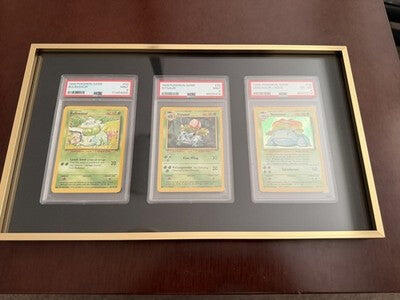
A three-card evolution line, such as Charmander, Charmeleon and Charizard, provides a natural example of a small wooden display. The cards can be positioned together on a supported cabinet or desk, with the visible wood separating each illustration. The arrangement becomes a small individual feature rather than part of a complete wall installation.
A larger collection of original 151 Pokémon, vintage holographic cards or modern illustration rares may be better suited to a coordinated set of wall grids if furniture space is limited. Aluminium can introduce a defined boundary around each group. Frameless acrylic can allow the colours of the cards and insert to become the main focus.
A collector with both vintage and modern Pokémon cards might deliberately use two materials. A small wooden display could present a favourite vintage sequence, while a larger wall frame contains modern graded cards. There is no technical requirement to use the same outer display material simply because the cards belong to the same trading card game.
For additional layouts, including Eeveelutions and character collections, see our wooden Pokémon and trading card display ideas guide.
Choosing between wood, metal and acrylic for sports cards
Sports card collectors often arrange cards by player, team, season, rookie year or championship. A small wooden display can suit a group of favourite baseball or basketball cards on a desk, especially if the room already contains sporting memorabilia or timber furniture. A wall display can accommodate a larger series of cards without occupying the same horizontal space.
For collectors of Topps, Panini and other sports cards, check the holder rather than assuming the publisher determines fit. A graded rookie card and an ungraded thick memorabilia card can require quite different external cases. If a collector wants both in the same display, confirm that the particular arrangement is intended to accept the relevant holders.
Team colours can influence the choice of a stain or backing. A black wooden finish can provide contrast against bright jerseys, while an aluminium or frameless frame with a coloured core can introduce a more deliberate connection to team colours. The finish is a presentation choice; the actual support and glazing remain separate considerations.
What about Magic: The Gathering, Yu-Gi-Oh! and One Piece?
These collections offer different reasons to group cards. A Magic collector may display favourite artists, alternate artworks or cards connected to a particular deck. A Yu-Gi-Oh! collector might group signature monsters or early releases, while a One Piece collector may build an arrangement around characters, crews or alternate-art cards.
Small themed groups often suit a wooden freestanding card display, particularly when the collector wants to change the arrangement occasionally. A larger wall-mounted display can present a more extensive sequence. The visual contrast between the selected core or wood and the card illustrations may matter more than whether the frame has a metallic perimeter.
Check the holder dimensions before deciding on a layout. Yu-Gi-Oh! cards, for example, have different underlying dimensions from many standard-size trading cards, but a fitted display is sized around the external protective holder. Do not assume compatibility from the game name alone.
How do MDF and inexpensive plastic displays fit into the comparison?
A simple plastic stand is a sensible option when the aim is to hold one slab at a comfortable angle. It may be inexpensive, compact and easy to move. It usually performs a different function from a multi-card arrangement with a common protective front panel. A painted MDF display can also be a reasonable choice when a uniform opaque finish is desired.
When shopping for a wooden trading card frame, distinguish actual plywood or timber from a wood-effect printed surface or a veneer applied to a different core. The difference may be difficult to judge from the front photograph alone. Ask how the body is made, what is visible at the edges, how the holders are supported and what glazing is included.
Material selection is one reason we introduced birch plywood rather than simply applying a wood-effect finish to our existing frame. It allows the wood to form the compartments and retain its natural surface character. That does not make a plastic stand or painted MDF frame unsuitable for a collector who wants a different appearance or has a smaller budget.
What are you paying for in a made-to-order card display?
Price can reflect the material required for a selected size, preparation of the parts, layout-specific machining or cutting, finishing, assembly and transport. A single-piece wooden display requires more than creating the openings: the surrounding surface, holder compartments and acrylic seating area must work together, and the finish needs to be prepared and applied as appropriate. Aluminium and frameless assemblies have their own component and assembly requirements.
Customisation can also change the way a product is produced. A stock plastic stand can be manufactured in a large run of identical items. A made-to-order display with a particular holder format, layout and colour combination may involve preparing a different set of components for each order. Neither production model is inherently a sign of poor quality. They serve different purchasing requirements.
Compare complete products rather than comparing the cost of a raw sheet of wood with the price of a finished display. At the same time, do not treat a high price as evidence of stronger UV filtering or better holder fit. Ask for the specifications that matter to your collection. A small, affordable stand may be the right decision if a protective multi-card arrangement and finish customisation are not needed.
Changing cards and maintaining the display
Consider how often the display will be opened. The removable acrylic cover of the wooden range makes it possible to access holders with the display resting on a suitable flat surface. Wall frames may require removal from the wall and access to the internal assembly, depending on the model. Follow the instructions for the particular display instead of attempting to pull a holder past the front panel.
When changing a large arrangement, plan a clean working area with enough space to support the complete display and the removed parts. Place the acrylic somewhere it will not be scratched or bent, and handle graded slabs by their edges. Photograph the arrangement first if you want to return every card to the same position.
Cleaning wood, aluminium and acrylic
Use care methods suited to the particular surface. A finished wooden display should not be saturated with water, and any cleaning product should be compatible with its coating. Unfinished birch is more susceptible to visible marks from spills and handling. Do not apply a new stain or finish while card holders or acrylic remain in the body; allow any finish to cure fully according to its instructions before reassembly.
For the acrylic front, follow the sheet or coating manufacturer's guidance. PLEXIGLAS® cleaning guidance explains the importance of gentle cleaning methods. Avoid dragging grit across the surface, and do not assume that an ordinary glass cleaner or solvent is suitable. Specialist anti-reflective coatings may require different care from standard acrylic.
| Area to maintain | What to check | What to avoid |
|---|---|---|
| Wooden body | Surface finish, flatness and secure seating on the support | Standing water, high heat and unsuitable cleaners |
| Aluminium perimeter | Condition of finish, connections and mounting components | Abrasive cleaning and unsupported handling of large frames |
| Frameless acrylic assembly | Panel condition, connections and mounting support | Impact to exposed edges and excessive force on panels |
| Front glazing in all ranges | Dust, scratches and coating-specific instructions | Dry rubbing with grit present and incompatible solvents |
| Card holders | Fit, condition and clearance from adjacent components | Forcing cases into incorrectly sized openings |
Four practical collector scenarios
A renter with a small Pokémon collection
A collector has six favourite graded cards but cannot drill into an apartment wall. A suitable supported wooden display on a sideboard offers a way to present the cards together. Check the furniture depth, stand capacity and viewing angle before choosing the layout. If the available space is especially narrow, several individual stands may be more practical.
A sports collector planning a dedicated collection wall
A collector has several dozen graded baseball and basketball cards and wants them visible from a distance. An aluminium or frameless wall display may be the more appropriate starting point because the arrangement will not require a large horizontal surface. The choice between them can then be based on the desired border and backing appearance. Mounting and loaded weight must be considered before deciding on the final grid size.
A home office with existing timber furniture
A collector wants to present a favourite One Piece sequence beside a computer monitor. A small wooden display in a complementary stain can connect with the existing desk without introducing a prominent metallic edge. Check that the display does not obstruct the screen or access to cables, and place it where it cannot easily be knocked. An individual stand remains a useful option for cards that change frequently.
A collector combining several materials in one room
A room contains a larger graded Pokémon set, a few favourite vintage cards and a group of sports rookies. The larger set can occupy an aluminium wall frame, the vintage cards can sit in a wooden arrangement on supported furniture and the sports cards can occupy a separate frameless wall grid. Consistent spacing, a limited colour palette and sensible lighting can relate the three displays without requiring identical construction.
A decision checklist before choosing a display
- Identify the actual card holder formats and any unusual dimensions.
- Decide whether the collection belongs on supported furniture or a wall.
- Measure the available width, height and depth, including any stand.
- Account for the loaded display weight and the capacity of the support or wall installation.
- Choose the surrounding material according to the room and collection.
- Compare front glazing specifications separately from body construction.
- Consider how often the cards will be changed and what access is required.
- Check sunlight, glare, heat and humidity at the intended location.
- Review the manufacturer's fit, installation and care guidance before ordering.
Frequently asked questions about wooden, aluminium and acrylic card displays
Is wood better than aluminium for displaying Pokémon cards?
Wood can provide natural grain and a furniture-like appearance, while aluminium offers a defined metal perimeter. In our ranges, wood is suited to supported freestanding presentation and aluminium to wall mounting. Which is better depends on the intended location and the appearance you want.
Is birch plywood real wood?
Yes. Plywood is manufactured from bonded wood veneers. It is an engineered wood material rather than a single solid timber plank. Birch plywood retains natural wood characteristics, which can be visible on its surface and machined edges.
Is a walnut-finished wooden card display made from walnut timber?
Not in our wooden range. Walnut describes the selected stain colour applied to the birch plywood body. The same underlying construction is used for the other stain options.
Can I hang a recessed wooden trading card display on the wall?
Not our recessed wooden design. Its acrylic and card holders rely on gravity to stay in their shallow compartments. Vertical positioning or steep angles can allow components to fall out. Choose an aluminium or frameless wall-mounted display if that is the intended location.
Do I need a stand for a wooden PSA card display?
A suitable stand is useful for presenting the display at a gentle viewing angle. It is not included with our wooden displays, allowing collectors to select their preferred arrangement. It must support the complete loaded display and maintain secure seating of the holders and acrylic.
Does a frameless acrylic display still have a backing?
Yes, our frameless designs use front and rear acrylic panels around a fitted foam core. Frameless refers to the absence of the surrounding metal profile, not the absence of structural components.
Do aluminium displays use acrylic too?
Yes. Our aluminium range combines a metal perimeter with front and rear acrylic panels and a purpose-cut foam core. The material name identifies the outer frame rather than every component in the assembly.
Can wooden displays accommodate CGC and Beckett slabs?
Compatible wooden configurations are available for CGC and BGS holders. Check the selector for the specific layout and case type; not every holder is offered in every size.
Are One Touch displays the same as graded card displays?
They may share a similar external design, but magnetic card holders and graded slabs have different dimensions and purposes. The recess or insert must match the actual case.
Which material blocks more UV light?
The front glazing and the card holder determine the relevant optical transmission, not simply whether the body is wood or metal. Compare the documented acrylic grades and their wavelength-specific performance.
Is museum-grade acrylic worth considering on a wooden display?
It may be useful for collectors seeking particular UV-filtering or reflection-control properties. Assess the glazing documentation and the intended viewing angle. Sensible placement away from direct sunlight remains important.
Will a wooden display always be completely flat?
No. Wood and plywood can exhibit variations in flatness, particularly across larger dimensions. Stable indoor conditions and suitable support are important. Confirm the holders and acrylic remain properly seated before use.
Can I stain a wooden trading card display myself?
Our No Stain option is supplied without stain or varnish. Remove all cards and acrylic before finishing, follow the finish manufacturer's instructions and wait until the coating is fully cured before reassembling the display.
Which display is best for a large graded card collection?
Start with available space and support. A large wall arrangement may be more practical when furniture space is limited. A large wooden display requires an appropriately sized and supported surface. Splitting cards into several coordinated displays is another option.
Can I combine wooden and metal card displays in the same room?
Yes. Wood can serve as a small supported feature on furniture while aluminium or frameless acrylic presents larger groups on the wall. Coordinating colours and spacing can make the different materials feel connected.
Does a more expensive trading card display guarantee better protection?
No. A higher price may reflect materials, customisation, preparation or assembly. Protection depends on the specific glazing, holder fit, support, room conditions and design. Compare these separately from price.
Technical references and further reading
The following resources help explain the underlying materials and conservation principles. They are not independent certification or load testing of our finished displays.
- APA: Plywood: veneer construction and dimensional stability.
- Austral Plywoods: Plywood Characteristics: panel properties and veneer arrangement.
- Aluminum Extruders Council: FAQs: extrusion design and fabrication background.
- Canadian Conservation Institute: Light, ultraviolet and infrared: light exposure and deterioration.
- Canadian Conservation Institute: Glazing Materials for Framing Works on Paper: glazing comparisons.
- PLEXIGLAS®: Cleaning and maintenance: care of acrylic surfaces.
- Perspex Online: PLEXIGLAS® Gallery & Museum AR: grade-specific supplier information.
Final thoughts: choose the display for the collection and the room
Our decision to make wooden trading card displays alongside aluminium and frameless acrylic was driven by differences in how collectors want to present their cards. Birch plywood offers natural grain, selectable finishes and a body that forms the individual holder compartments. Aluminium provides a defined perimeter around a structured wall arrangement. Frameless acrylic removes the metal border while retaining a fitted layered design.
Each approach can serve a useful purpose. The best choice begins with the case type, intended viewing position and available support, followed by the appearance and glazing properties that matter to the collector. There is no reason to replace a suitable existing display simply because another material has become available.
Continue exploring
- Wooden Trading Card Display Frames: The Complete Guide: construction, wood finishes and acrylic.
- Wooden Pokémon & Trading Card Display Ideas: practical arrangements for desks, shelves and collector rooms.
- Birch Plywood vs MDF vs Solid Wood: material selection and natural variation.
- Wooden Graded Card Displays: PSA, CGC, BGS & One Touch: holder compatibility and fit.
- Why Premium Aluminium Trading Card Display Frames Are Worth It: metal frame construction and practical considerations.
Explore display materials
For examples of the constructions discussed in this guide, compare the wooden birch plywood collection, aluminium trading card wall displays and frameless acrylic displays from SLABBED™ Studio. Each range is made to order, with configurations and holder options shown in its respective product listings.

0 comments