


A plastic video game case is the first layer of protection most collectors ever use. It holds the disc or cartridge, keeps printed artwork together and makes a collection easier to organise. But a common question is whether that case also protects the game from ultraviolet radiation. Do plastic video game cases block UV light, or can PlayStation, Xbox and Nintendo cover artwork still fade inside them?
The short answer is that some plastics reduce some ultraviolet radiation, but an ordinary game case should not be assumed to provide a verified level of UV protection. The transparent cover sleeve, the coloured case, the paper artwork and any external protective box are different materials. Their behaviour depends on composition, thickness, additives and wavelength. An official-looking blue PS5 case, a green Xbox case or a red Nintendo Switch spine is not, by itself, a UV-filtration specification.
This guide explains how case materials work, what UV transmission percentages actually mean, why printed game sleeves can fade, and how to compare inexpensive storage with dedicated UV-filtering acrylic and specialist display frames. It applies to PS5, PS4, PS3, PS2, Original Xbox, Xbox 360, Xbox One, Xbox Series X, Nintendo Switch, Nintendo Switch 2, sealed games, SteelBooks and retro game packaging. The emphasis is on making informed preservation decisions, not treating any product label as a lifetime guarantee.
The essential distinction: protecting the case is not the same as protecting the cover artwork
When collectors say a game is protected, they may mean several different things. A case can shield a disc from fingerprints, keep a manual with the correct edition, protect paper against direct handling and make stacked storage more convenient. These functions are real and useful, but they do not establish how much UV reaches the artwork behind the transparent sleeve.
A case might be made of a polymer that survives sunlight reasonably well, yet still transmit some wavelengths that contribute to fading of printed artwork. Conversely, a protective layer that absorbs UV may itself undergo changes after prolonged exposure. The key question is not simply whether a material is called 'UV-resistant'. It is what the material is protecting, against which wavelengths and under what conditions.
This matters to collectors with valuable factory-sealed games as well as ordinary used games. A sealed copy of a desirable PS2 title may have a very different preservation priority from a replaceable PS5 game sleeve. Both can benefit from avoiding direct sunlight, but the reason for spending more on external protection may be different.
Do ordinary PlayStation, Xbox and Nintendo game cases block UV?
There is no single published percentage that can reasonably be assigned to every standard console case. Official packaging has changed across generations; replacement cases are made by numerous suppliers; and the clear outer sleeve may differ from the coloured structural body. Even two cases that appear identical can use different formulations or thicknesses.
The Canadian Conservation Institute's guidance on ultraviolet filters explains that clear rigid plastics commonly reduce some UV, often because the material itself needs protection from radiation. This is not the same as certifying a game case as conservation-grade glazing.
For a particular PS5, Xbox 360 or Switch case, the most accurate answer comes from the actual supplier's spectral transmission data. In the absence of those measurements, treat the case as physical packaging with uncertain UV-filtering performance, not as a proven substitute for light management.
What are video game cases actually made from?
Video game packaging does not use one standard plastic. Common packaging polymers in the broader market include polypropylene (PP), polyethylene (PE), polystyrene (PS), polyethylene terephthalate (PET), polycarbonate (PC) and acrylic (PMMA), but this list is not proof that a particular console's official case uses any one of them.
The structural case, transparent film-like cover sleeve and aftermarket display protector may be different polymers. A collector cannot reliably identify a formulation just by looking at the colour or flex of the package. A recycling mark, supplier specification or manufacturer documentation is stronger evidence, though even a polymer name alone does not reveal its precise UV transmission curve.
This matters because UV behaviour is formulation-specific. Additives, coatings, pigments, surface treatments and thickness can change how a polymer interacts with light. One aftermarket clear protector may have deliberately added UV absorbers; another may be sold solely for dust and scuff protection.
The different layers in a modern disc game case
A modern physical disc release often has several elements: the moulded case body, a paper cover insert, a thin transparent outside sleeve, internal clips and a disc-retention mechanism. Some editions include booklets, printed maps or promotional inserts. None of these layers should be assumed to share identical material properties.
From the front, light may travel through the transparent sleeve before reaching the ink and paper of the printed cover. The coloured case body is commonly behind the paper insert, meaning it may do little to filter the light arriving at the artwork. The rear of the case and spine can present different paths for light exposure.
That explains why a brightly coloured case body does not automatically protect the full cover image. The location of the filtering material matters as much as its name. Protection on the back of an insert cannot undo light that has already reached the printed front.
Why the transparent sleeve is the part collectors should question
On many disc-style cases, the artwork is visible through a thin clear sleeve. The sleeve keeps the paper in place and reduces direct handling, but its primary intended function may not be UV filtration. It may have impressive clarity without a documented cutoff wavelength.
If a vendor claims that a replacement case is UV protective, ask whether the claim refers to this sleeve, the entire assembly or the plastic body. A coloured case body could have quite different optical properties from a transparent outer film. A claim about the polymer's resistance to yellowing also does not prove that the clear sleeve protects the ink beneath it.
For a collector buying replacement PS3 or Xbox 360 cases, two visually similar products can therefore behave differently. Ask for wavelength-dependent transmission data, not merely the words 'high quality', 'archival', 'durable' or 'UV-resistant'.
Blue PlayStation cases: does the colour itself block UV?
The blue colour commonly associated with PS4 and PS5 packaging is a visual identification feature, not a reliable rating for UV filtration. Colour tells you that the plastic absorbs or transmits portions of visible light in a way that produces its appearance. That observation alone does not tell you what happens at 320, 350, 380 or 400 nanometres.
Moreover, the main cover artwork usually sits behind the transparent sleeve, not behind an opaque blue panel. Even if a blue sidewall reduced light entering from the edge, that would not establish the amount of UV entering through the clear front. The relevant question for printed artwork is the transmission of every material between the light source and the print.
For an indoor PS5 collection, keeping the cases away from direct sun is generally a simpler first improvement than trying to infer protection from the blue plastic.
Green Xbox cases: are they more UV protective?
The same limitation applies to green Xbox cases. An Original Xbox case, an Xbox 360 case and an Xbox One or Series X physical release may vary in shape, colour and construction. None of those visible differences by itself supplies an independently measured UV-blocking percentage.
Collectors sometimes display Xbox collections with all their green spines aligned. The visual effect can be excellent, especially for a run of Halo, Forza, Fable or Gears of War titles. But a neat green shelf near a bright window still exposes the printed inserts to light. The spine and front cover may receive different amounts depending on orientation.
If the collection includes rare, signed or sealed copies, evaluate the actual display location and any protective glazing rather than treating brand colour as a conservation feature.
Red Nintendo Switch cases and the question of UV protection
Nintendo Switch's compact, red-spined packaging makes it especially attractive for wall displays and colourful game collections. However, the red plastic does not certify UV filtration for the printed cover art. The artwork is generally viewed through its own transparent layer, and packaging construction can vary across editions or aftermarket replacements.
A Switch shelf containing Zelda, Mario, Pokémon, Metroid and Animal Crossing may show considerable variation in cover artwork, printing stock and colour sensitivity. Different covers may change differently under the same lighting. Matching spines may also make subtle fading more visually obvious once one title has spent years in a brighter position than its neighbours.
For Switch 2 releases, do not assume the outer packaging shares every material or dimension characteristic of earlier Switch cases. Measure and verify the specific case when planning an exact-fit display.
Clear game protectors, sleeves and aftermarket box protectors
A transparent protective box can be useful for resisting surface abrasion, dust and handling. Rigid protectors and flexible sleeves are popular for collectible video games, especially cardboard boxes, sealed copies and complete-in-box editions. But the phrase 'game protector' describes a purpose, not a UV performance standard.
A standard PET or other clear plastic box without a documented UV specification should not be assumed to block a particular percentage of UVA. Some suppliers may offer true UV-filtering formulations; others may not. The right comparison depends on the exact product, sheet thickness and testing method.
For collectors choosing between an inexpensive clear box and a more costly certified UV-filtering protector, start by asking what the extra cost buys. If it only improves thickness or scratch protection, it may still be useful, but thicker and UV-filtering are different claims.
What about factory shrink wrap on sealed games?
Factory wrapping can be critical to the collectibility and authenticity of a sealed release. It can also shield the surface from fingerprints and some dust. But it should not be interpreted as verified UV protection without supporting data for that specific wrapping material.
The film may be thin, may change as it ages and may be part of the collectible's original condition. Removing it simply to add another protective layer can seriously alter what a sealed-game collector values. The sensible approach is to protect the entire unopened object using appropriate storage or a non-abrasive external enclosure, while avoiding unnecessary light and heat.
A sealed PS2 or Xbox title with a valuable original wrapper deserves more cautious handling than an everyday used case, but it is still subject to the same basic physics of light transmission.
SteelBooks, metallic packaging and special editions
SteelBooks are not ordinary plastic game cases. Their metal panels may block light from passing through the metal itself, while surface coatings, printed artwork, internal plastic parts, paper sleeves and external slipcovers have their own vulnerabilities. A metal surface can still show scratches, wear, coating changes or other damage.
Collectors also encounter lenticular covers, foil-stamped boxes, cardboard collector editions and unusual packaging formats. A single UV-blocking figure for ordinary case plastic tells you little about these materials. Protective strategies must consider each element that light can actually reach.
For a special edition intended as a display piece, focus on avoiding abrasion and controlling the room environment before deciding whether a specialist external glazing system is worthwhile.
UV radiation explained: UVA, UVB, UVC and visible light
Ultraviolet radiation falls outside the visible spectrum. For ordinary indoor displays, the longer UVA wavelengths are particularly relevant, although even visible light contributes to fading of sensitive printed materials. A UV-filtering material might reduce one UV band strongly while transmitting more radiation nearer the visible boundary.
| Band | Approximate wavelength | Relevance to video game cases |
|---|---|---|
| UVC | 100–280 nm | Solar UVC is largely absorbed by the atmosphere before reaching ordinary homes. |
| UVB | 280–315 nm | Much is reduced by atmosphere and ordinary window materials; direct sunlight still requires care. |
| UVA | 315–400 nm | Particularly relevant when comparing indoor daylight and UV-filtering glazing. |
| Visible light | Approximately 400–700 nm | Makes cover art visible but can also contribute to fading over prolonged exposure. |
For a practical comparison, ask whether a sheet filters only shorter UV wavelengths or also reduces longer UVA towards 400 nm. The Canadian Conservation Institute's technical guidance on light explains why wavelength and cumulative exposure both matter.
Why UV filtering does not eliminate every cause of fading
Printed game covers may contain dyes, pigments, coatings and paper that respond to both UV and visible light. Strong daylight can also increase temperature inside or around display materials. The original print process and its history can influence how quickly changes appear.
This is why a legitimate '99% UV-blocking' front panel does not guarantee a PlayStation cover will never fade. The remaining visible-light component and the duration of exposure continue to matter. A shaded room with modest lighting can be a less demanding environment than a brightly sunlit window even if both use the same glazing.
The Library of Congress's guidance on limiting light damage emphasises that light exposure is cumulative. The most sensible plan controls both intensity and time rather than relying on one product label.
What does 'UV-resistant' actually mean on a game case listing?
The terminology needs careful reading. 'UV-resistant' sometimes means the plastic is engineered to resist weathering, yellowing or loss of its own strength under sunlight. In other contexts it means less UV passes through to the contents. Those are related, but distinct, properties.
'UV-stable' often emphasises durability of the material itself. 'UV-blocking' and 'UV-filtering' usually suggest transmission reduction, but the claim is only useful when the manufacturer defines the tested wavelengths and performance. 'Archival' may refer to chemical stability and storage suitability, not UV filtering.
A collector can therefore make a poor comparison by choosing a protector labelled UV-resistant over one with published transmission data. If protection of original game artwork is the priority, measured transmission through the finished product is more informative than a general adjective.
How to read a percentage such as 90%, 95% or 99% UV blocking
A filtration percentage needs a test range. A material described as blocking 99% below 380 nm is not necessarily blocking 99% at 390 nm. Another product might report a weighted or integrated result over a specified spectrum rather than a uniform percentage at every wavelength.
Consider a simplified example. If 100 units of the UV energy covered by a particular test arrive at a sheet, a 95% reduction leaves 5 units under those test conditions. A 99% reduction leaves 1 unit. Those numbers are meaningful only when the materials were tested in comparable ways. They say nothing directly about the visible light transmitted to the artwork.
Look for the wavelength range, test method, thickness and exact material identity. The number alone is not enough to compare two game protectors or framing sheets.
How to read a UV transmission graph for a plastic protector
A supplier's spectral transmission graph typically places wavelength in nanometres on the horizontal axis and the percentage transmitted on the vertical axis. Start at the lower UV wavelengths and move right towards 400 nm. Observe where the material stops blocking strongly and starts allowing more light through.
A curve close to zero transmission at 300 nm, 330 nm and 350 nm but substantially higher at 390 nm shows a different protective profile from a curve staying low almost to 400 nm. A claim such as 'blocks below 330 nm' should not be reinterpreted as 'blocks all UVA'.
If you have two data sheets, compare readings at the same wavelengths, and confirm whether the samples are the same thickness as the protector you plan to use. A graph from a different product family is not proof of the case you are buying.
UV cutoff wavelengths and why 330 nm is not the same as 400 nm
Suppliers sometimes refer to a 'cutoff' wavelength. In practice, transmission curves usually change across a transition region rather than switching instantaneously at one perfect point. The definition may depend on the threshold used in the test.
A material filtering effectively below around 330 nm can still let through a meaningful proportion of longer-wavelength UVA. A specialist sheet providing high filtration near the 400 nm boundary is addressing more of the UV region. Neither is a complete solution to fading from visible light, but the distinction matters when comparing technical products.
For a valuable game collection, read the actual spectrum rather than equating two differently worded cutoff claims.
Why thicker plastic does not automatically mean better UV protection
Thickness can affect the amount of radiation absorbed by a material, but it also affects rigidity, handling, fit and cost. A thick ordinary protective box is not automatically equivalent to a thinner product formulated specifically to filter a broad UV band.
For example, a rigid box may protect a sealed PS2 game from knocks and pressure better than a thin sleeve. That benefit is valuable even if UV filtering is not documented. Conversely, a thin specialist film may be engineered for UV reduction but may offer little protection against bending or crushing.
Choose the right property for the risk. Physical impact protection, optical filtration and long-term chemical compatibility are separate considerations and should be checked separately.
Does a clear game case protect the paper cover from dust and handling?
Usually, to some extent. The transparent sleeve helps keep printed inserts in place and reduces direct skin contact. The case can also support the paper so it is less likely to be creased during ordinary storage.
However, grit or dust trapped between a tight protector and the case may still scratch surfaces when the game is inserted or removed. Some plastics can create static charge, while unsuitable materials or adhesives may cause long-term problems for sensitive packaging. Avoid pressure, sticking, heat and direct adhesive contact with valuable original artwork.
This makes a good case an important part of everyday care even when it offers no independently verified UV filtration. Physical protection is useful; it simply should not be marketed as something it has not been shown to do.
Can a game case yellow while the cover art stays bright?
Yes. The case plastic, printed insert and outer protective box can age differently. Some plastics undergo yellowing, haze, embrittlement or surface changes through light exposure, heat and oxidation. Paper and inks may change independently.
A yellowed clear protector does not prove that the artwork beneath is irreversibly damaged, and a protector that remains clear does not prove that the artwork has received no harmful light. These are separate observations. If the plastic is deteriorating, replacing an inexpensive aftermarket protector may be easier than replacing an original game cover or historically important factory packaging.
For a high-value item, document its condition before changing the enclosure and avoid cleaning methods that might damage the collectible.
Do game case plastics protect discs and cartridges from sunlight?
Cases can reduce handling and keep media organised, but disc and cartridge preservation is a different question from artwork fading. Optical discs involve layers, substrates, reflective surfaces and adhesives; cartridges involve plastic housings, labels and electronic components. Heat, moisture and handling can all matter.
An opaque case body can physically prevent light from reaching a stored disc when closed. That is different from claiming the transparent outer sleeve filters UV reaching the cover art. A cartridge inside an opaque box may receive little light, while the printed exterior box remains exposed.
If preserving working media is the priority, use manufacturer handling guidance and stable indoor storage rather than drawing conclusions about disc longevity from a case's colour.
Plastic cases versus clear acrylic display frames
A frame and a game case perform different functions. The original case is the package for one game. A surrounding wall display can organise one or many cases and may add a separate front glazing layer. The UV performance of the outer layer depends on its own specification, independently of the packaging inside.
| Feature | Ordinary game case | Standard clear acrylic display | Specialist UV-filtering display acrylic |
|---|---|---|---|
| Main purpose | Holds game and artwork together | Presents a collection behind a clear front | Adds specified UV reduction alongside presentation |
| UV performance | Usually not quantified for collector display | Depends on exact acrylic grade | Should be supported by defined supplier testing |
| Impact and handling | Helps protect an individual game | Can reduce handling and dust at collection level | Similar physical benefits, depending on construction |
| Visible-light fading | Not eliminated | Not eliminated | Not eliminated |
| Cost and complexity | Usually included with game | Requires a display product or construction | Higher-cost glazing option where offered |
A well-positioned collection on a shelf can be entirely appropriate. A specialist aluminium display is a presentation choice for collectors who want consistent spacing, a more deliberate wall arrangement and an optional documented glazing specification. It is not the only legitimate way to protect games.
Acrylic, polycarbonate, PET and other clear plastics compared
Names such as acrylic, polycarbonate and PET refer to broad material families, not one guaranteed set of UV properties. Acrylic is commonly selected for clear framing because of optical clarity and relatively low weight. Polycarbonate can offer strong impact resistance. PET is used for many types of packaging and protective film. Actual UV transmission depends on each product's formulation and thickness.
| Material family | Typical use in displays or packaging | Key question before assuming UV filtration |
|---|---|---|
| Acrylic (PMMA) | Clear display glazing and rigid panels | Is this the exact UV-filtering grade and thickness tested? |
| Polycarbonate (PC) | Impact-resistant clear panels and protectors | What does the manufacturer's transmission curve show? |
| PET and related films | Sleeves, flexible films and box protectors | Is UV filtering explicitly specified for this film? |
| Polypropylene (PP) | Packaging and moulded parts | Does the actual formulation protect the contents or primarily itself? |
| Polystyrene (PS) | Some rigid plastic packaging | Is the particular product suitable for long-term storage and display? |
These examples describe possible applications, not a material identification for every PlayStation, Xbox or Nintendo case. Do not extrapolate from a generic polymer category to a console's retail packaging.
Acrylic versus glass for external game display protection
Both acrylic and glass have roles in display construction. Acrylic is usually lighter and more impact-resistant than ordinary glass at comparable thickness. Glass is generally harder and more resistant to everyday scratching. Both materials are available in basic and specialist UV-filtering grades.
A large multi-game wall frame may benefit from acrylic's lower weight, while a smaller, stationary cabinet could use suitable glass. The correct choice depends on panel span, support, transport, glare, cleaning requirements and the documented UV filtering of the actual sheet.
The Canadian Conservation Institute's technical bulletin on conservation materials discusses glazing, acrylic, polycarbonate and UV filters in detail. The crucial principle is to compare actual products, not assume all glass or all acrylic has one consistent filtration percentage.
Does museum-grade acrylic stop fading completely?
No. Specialist museum or conservation glazing can provide very high reduction of specified ultraviolet wavelengths. Some products also use anti-reflective coatings to improve viewing clarity. These are useful capabilities, but no UV percentage guarantees immunity from damage caused by visible light, heat or long exposure.
An expensive sealed game displayed in a bright sunlit room may still be exposed to an unnecessarily challenging environment even behind high-quality glazing. A less expensive but well-positioned frame away from direct sun may be a more sensible setup than a costly product placed in a poor location.
Choosing museum-grade acrylic is best treated as an optional specification upgrade for collectors who value its measurable properties, not a universal requirement for every physical game collection.
Why anti-reflective acrylic is not the same as UV-filtering acrylic
Anti-reflective glazing reduces reflections from room lights, windows and objects opposite the frame. UV-filtering glazing reduces ultraviolet transmission. Some specialist products combine both properties, but the terms describe different functions.
This distinction matters for physical video games because the viewer may be looking through two or more clear layers: the frame front and the original case sleeve. Anti-reflective coatings on the outer panel can reduce some reflections, but they do not automatically eliminate reflections from surfaces deeper inside the display.
Some matte anti-glare materials diffuse light and may soften detail when the object is separated from the front panel. Coated anti-reflective acrylic can behave differently. Read the reflectance and optical specification rather than assuming every 'anti-glare' product looks the same.
Do multiple plastic layers add up to 100% UV protection?
No. Light passing through successive layers can be reduced further, but simply adding printed headline percentages is not valid. If one product filters mostly shorter UV and another filters longer UV, their combined spectral behaviour depends on the actual wavelengths involved.
Two layers each advertised as 90% UV blocking do not justify a claim that the display provides 180% protection. Nor can the total be confidently stated as a simple round number without comparable test data. The proper calculation would use the transmission of each material at each relevant wavelength and account for the measurement conditions.
For everyday collectors, it is enough to understand that a documented outer frame layer can provide an additional barrier. It does not remove the need to control how much light reaches the display.
How to choose a genuine UV-filtering protector for a video game
Before purchasing a protective case, ask for the manufacturer, exact product name, polymer type if available, sheet thickness and UV transmission data. A written claim of 'UV protection' is more informative when it includes a percentage and tested wavelength band. A spectral graph is better still.
Look for clarity about whether the data applies to the full clear enclosure or just one component. Determine whether coatings or additives could require special cleaning, and whether the protector fits the original game without excessive pressure. A sealed game with delicate shrink wrap should not be forced into a tight box.
If the seller cannot provide meaningful documentation, the product may still be useful for dust and handling protection. Simply treat its UV performance as unverified rather than assuming the most favourable interpretation.
A quick checklist for reading supplier UV claims
- Exact product: Is the test for the actual protector you are buying?
- Wavelength range: Does the percentage refer to 300–380 nm, near 400 nm or another band?
- Test method: Is it an integrated figure or readings at specific wavelengths?
- Thickness: Is the tested sheet the same thickness as the finished enclosure?
- Component: Does the claim cover the clear front, coloured body, film or full assembly?
- Visible clarity: Is the material clear, hazy, matte or anti-reflective?
- Cleaning and aging: Are there coatings or special maintenance requirements?
- Fit: Will the protector hold the case without crushing, rubbing or adhesives?
This checklist applies equally to a PS5 protective case, a Nintendo Switch acrylic box, a valuable retro cartridge protector and a large wall display glazing sheet.
PS5 and PS4 collections: practical preservation decisions
Most PS5 and PS4 game cases are fairly practical to store upright on a shelf. For everyday games, a shaded wall, stable temperature and careful handling often represent excellent value. Extra individual protectors are a personal choice, particularly for limited editions, signed artwork or sealed releases.
If you want a more curated PS5 or PS4 wall, consider how many games will be visible, whether the paper covers will face the room, and whether windows or LED strips shine directly on them. A frame may make the artwork more prominent, but that increases the importance of lighting conditions.
When selecting exact-fit cutouts, measure the particular cases. Replacement packaging, steelbooks and collector editions may differ from standard cases and should not be treated as interchangeable on appearance alone.
PS3 and PS2 collections: older packaging, different risks
PS3 collections can contain several generations of case design, different transparent sleeves and aftermarket replacements. PS2 collections frequently use DVD-style cases and may include cardboard sleeves, special editions or unusual regional packaging. Older materials may already have experienced years of handling, heat or sunlight.
For an ordinary PS2 shelf, low-cost improvements include removing direct sun, using stable shelving and avoiding pressure on worn case hinges. For valuable complete-in-box or factory-sealed editions, protect original inserts, stickers, wrappers and manuals. Some collectors choose independent outer boxes to avoid handling the original package.
A protector should be selected for that item's exact thickness. Forcing an unusually thick PS2 case or slipcover into a standard protector can cause physical damage that outweighs its intended benefit.
Original Xbox, Xbox 360, Xbox One and Series X cases
Xbox collections can include green plastic cases, transparent components, printed paper art and special releases that differ from normal retail cases. The familiar green plastic is a branding feature and should not be taken as proof of specific UV filtering.
For large collections, spine-facing bookcases use little wall space and make titles easy to retrieve. Front-facing arrangements show off favourite covers, including Halo and Gears of War series artwork, but also expose more of the artwork to room light. Neither layout automatically wins: the best option depends on whether the priority is access, visual impact or long-term preservation.
Collectors displaying a rare or signed Xbox title should inspect the light path and the condition of any external case or wrapper rather than relying on the coloured housing.
Nintendo Switch and Switch 2 case display considerations
Nintendo Switch cases are compact and often displayed as brightly coloured arrangements. Their smaller footprint allows more covers to fit in a given area than full-size disc cases, although the exact fit depends on the edition and any protective box around it.
Switch 2 packaging introduces another format to check. Compatibility should be established from the actual case rather than assuming a standard Switch cutout will fit every new release. If a physical release uses special packaging, multiple cartridges or a larger collector edition, measure that specific item separately.
For Zelda, Mario, Pokémon, Animal Crossing and Metroid collections, strong visual consistency is appealing. Keep the main paper artwork away from direct window exposure and avoid excessive lighting merely to intensify the colours.
Rare sealed and graded games: when preservation takes priority
For an expensive game, the packaging itself may be a significant part of the collectible's value. Factory seal integrity, original labels, sticker placement, condition, region and edition can all matter. Display decisions should therefore be made with the actual object and its documented condition in mind.
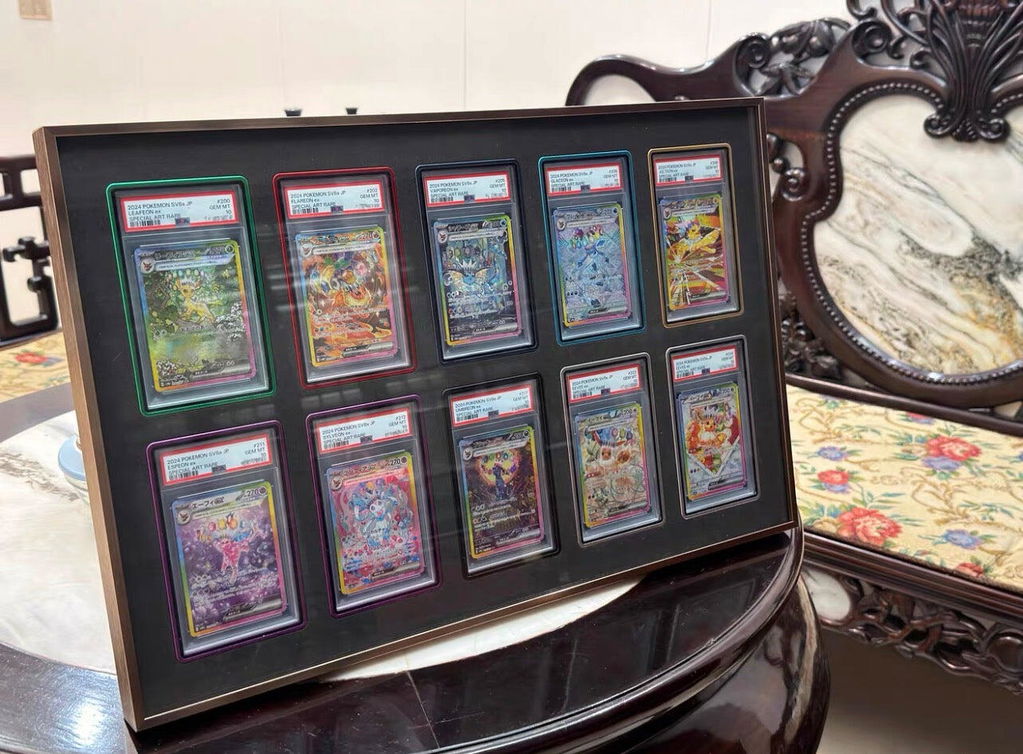
A graded-game holder may provide a protective outer enclosure, but its existence does not establish a universal UV-filtration percentage. Ask the grading company for the material and any published spectral specifications if those are important to your collection. As with graded trading cards, encapsulation is not a licence to place valuable materials in direct sun.
If maintaining near-original condition is the priority, dark storage with periodic display may be more conservative than permanent front-facing exhibition. A reproduction cover or a less valuable duplicate can be used for a display while the original is stored safely.
Can UV exposure change a collectible game's resale value?
Potentially. Game values can depend heavily on edition, region, completeness, original packaging, surface condition, sealing and buyer preference. Discolouration or fading can affect appearance and may influence what a collector is willing to pay. However, there is no defensible universal percentage loss in value for every sun-faded game.
Compare actual completed sales of similar editions and conditions rather than assuming the most expensive online listing represents market value. Distinguish loose games, complete-in-box examples, factory-sealed copies and professionally graded examples. A protector or display does not itself increase a game's market value.
For a high-value item, photograph the game in consistent lighting before it goes on display, retain evidence of provenance and periodically inspect for changes.
Low-cost ways to protect game cases without new equipment
The best first improvements often cost little or nothing. Move a bookcase away from a sunlit window, avoid radiators and heaters, close blinds during bright periods and reduce unnecessary display lighting. Keep cases upright with enough support that they do not warp or collapse under pressure.
A bookcase with its game spines facing outward can create a clean and practical collection. A closed cabinet may reduce dust and handling. For a small collection, inexpensive stands can highlight a favourite title while the others remain in a darker location.
None of these changes requires museum-grade materials. They address the environment first, which is usually the foundation of sensible collection care.
Mid-range options: individual protectors, cabinets and display stands
An individual rigid case protector can be convenient for valuable sealed releases and cardboard boxes. A cabinet creates a consistent, tidy area and can reduce incidental touching. Open acrylic stands allow front-facing presentation without dedicating a whole wall.
These products have different limitations. A clear cabinet door can still transmit light unless its glazing is appropriately specified. A protector may be good at resisting scuffs without measurable UV filtering. A clear stand does not place a filtration layer across the entire front of the printed game cover.
Choose based on the actual risk you want to reduce. For a collection primarily threatened by overcrowding and abrasion, a better shelf may be more valuable than a sophisticated UV coating.
When premium aluminium wall frames make sense
A dedicated aluminium wall display is worth considering when a collector wants several cases presented in a consistent grid rather than stacked or shelved individually. It can create uniform spacing, a deliberate focal point and fewer opportunities for visitors to pick up individual games. Some designs also provide an independently specified clear acrylic front.
The premium comes from presentation, materials, larger glazing panels, custom fit and assembly, not a promise that every collector needs such a product. A carefully chosen low-cost display can be perfectly appropriate for ordinary collections. A specialist frame may appeal more to someone displaying a complete franchise, valuable special editions or a group of sentimental favourites.
If a frame uses premium clear acrylic or offers museum-grade glazing as an option, compare the actual supplier data. No external frame should be described as eliminating fading or making fragile original paper safe in all lighting conditions.
Comparing display approaches by budget and purpose
| Approach | Cost position | Useful strengths | Limitations to remember |
|---|---|---|---|
| Existing shelf away from sunlight | Lowest | Convenient, accessible, little extra expense | Artwork may be less prominent; no extra front layer |
| Bookcase or closed storage | Low to moderate | Good organisation and dust reduction | Bright rooms and poor ventilation can still present risks |
| Individual clear protective boxes | Low to moderate per game | Handles, scuffs and dust can be controlled | UV filtering depends on the specific box |
| Glass-front cabinet | Moderate to high | Attractive grouped presentation | Glazing and lighting performance require checking |
| Custom or aluminium wall frame | Higher | Consistent layout, dedicated presentation and optional specialist glazing | Dimensions, mounting, cost and environment matter |
The point is not that the most expensive method is always correct. It is that collectors should match the display to the value, condition, dimensions and personal significance of the games.
Does a UV-protective display frame make sense for a cheap game?
It can, but not necessarily for financial reasons. Someone might want to display the PS2 game they played every weekend as a child, or a favourite childhood Pokémon release, even if its resale value is modest. A frame is then largely an aesthetic and sentimental purchase.
For a purely practical collection, inexpensive shelves may be the better fit. More expensive framing is easier to justify when visual presentation, limited wall space, consistent grids and material specifications matter personally to the owner.
A sensible collecting budget separates money spent acquiring games from money spent presenting them, without assuming that every game needs museum-style treatment.
Should you remove a paper cover from its original case before framing?
Usually there is no need to separate a normal game from its case merely to display the artwork. Removing paper inserts adds handling, risks creasing and can create problems keeping the right artwork with the right game. For sealed items, opening the packaging may materially alter the collectible.
For some very rare games, displaying a high-quality reproduction while preserving the original in a suitable enclosure is a legitimate alternative. Clearly distinguish reproductions from originals in any collection documentation or sale description.
If the plan is to display an entire original case, use a design that suits the case dimensions rather than trying to force the object into a smaller opening.
Is it safer to keep valuable games in a dark cabinet?
If reducing light-driven change is the dominant priority, dark storage is an effective way to lower exposure. That does not mean every collectible must remain hidden forever. Collecting also involves enjoying the art, history and personal meaning of the object.
A compromise is rotational display: exhibit a few favourites for limited periods and store the most light-sensitive or valuable originals appropriately at other times. The acceptable balance is a personal decision informed by the object's condition and the owner's priorities.
The Library of Congress's paper preservation guidance notes that prolonged light exposure can cause irreversible change and that a facsimile may be appropriate for especially valuable paper objects.
Can LED strips, RGB lighting and gaming-room lights damage cases?
LED lighting often produces relatively little UV compared with some older light sources, but the visible-light component still contributes to total exposure. Very bright or continuously illuminated setups are different from moderate lighting switched on occasionally for viewing.
Avoid positioning high-output lights immediately against paper artwork or plastic cases, especially where heat could build up. Diffuse illumination and thoughtful angles often make cover artwork easier to see than direct spotlights or strongly reflective RGB setups.
The safest practical strategy is to use no more light than needed for viewing, and switch decorative lighting off when the collection is not being enjoyed.
Sunlight through windows, blinds and UV window films
Ordinary windows reduce portions of UV but still transmit visible daylight and some longer-wavelength UV, depending on the glass. A game collection beside a window can receive substantial exposure even though it is indoors.
Blinds, curtains and placing the display on a shaded wall are often useful first steps. Specialist window films may reduce selected UV wavelengths, but their performance should also be read from supplier data. Do not assume a tint, security film or ordinary window automatically prevents all relevant light damage.
Watch the wall at different times of day and seasons. The position of direct sun can change significantly, particularly on walls that only receive a short period of afternoon light.
Heat, humidity and plastics: risks beyond ultraviolet light
Light is not the only concern for plastic and paper packaging. High heat can affect the shape of a case, adhesive stability and the condition of paper. High or fluctuating humidity can encourage mould or dimensional changes in vulnerable packaging. Very dry, hot environments can also be problematic for some materials.
Store collections in a stable indoor environment, away from direct heat sources, damp walls and poorly controlled storage areas. Avoid sealing damp items in boxes or placing valuable paper packaging against adhesives or unknown materials for years.
Good preservation is environmental management, not a single acrylic rating. The Canadian Conservation Institute discusses material selection and enclosure considerations for collections.
What about dust, scratches, static and cleaning?
Plastic cases and protectors often become scratched through abrasive cleaning, grit and frequent handling. Clean only according to the relevant material's instructions, remove loose dust carefully and avoid harsh solvents or abrasive pads. Acrylic glazing is typically more vulnerable to scratching than ordinary glass, and specialist coated products may require particular care.
Do not spray cleaner directly into seams or onto valuable paper inserts. A clean, appropriate soft cloth and conservative handling are usually preferable to aggressive polishing. If a graded or sealed collectible has historical or monetary significance, avoid untested cleaning treatments.
Dust protection is a useful feature of many enclosures, but it should not be confused with an airtight or climate-controlled environment.
How to photograph and monitor a game collection for fading
Photograph valuable games before displaying them, using consistent lighting and camera settings where practical. Record the front, back, spine, seals, stickers and any existing condition issues. Revisit photographs periodically to look for changes, but be careful: camera exposure and white balance can create apparent colour differences.
A useful comparison includes an unexposed or less-exposed reference copy of the same print edition when available. Different regional versions, reprints and legitimate colour variants can look different even without damage.
If a cover appears to be fading, move it out of strong light rather than trying to correct the colours through cleaning or restoration products.
Can sun-faded game cover art be restored?
Light-driven colour changes are often permanent. Storing a cover in darkness can slow further exposure but does not reverse chemical changes already made to its dyes or pigments. Replacing a printed insert with a reproduction changes what the physical edition contains and may affect its value to collectors.
For a normal, low-value used game, a carefully labelled reproduction may be acceptable for personal display. For a collectible complete-in-box, signed, sealed or historically significant copy, originality matters and professional conservation advice may be more appropriate than an amateur restoration attempt.
The best strategy is to avoid the damage before it happens rather than depend on a later fix.
Three practical preservation scenarios
Everyday PS5 and Xbox games in a family room
A bookcase holds games upright a few metres from a shaded window. These are mostly frequently played, easily replaceable titles. A well-supported shelf, modest room lighting and careful handling may meet the family's needs without extra protectors on every game. Any frame or decorative stand is an optional visual choice.
A colourful Nintendo Switch franchise wall
A collector wants to display Zelda, Mario, Pokémon and Metroid covers together. The visual artwork is the purpose of the display, but one wall receives late afternoon sun. Moving the arrangement to a consistently shaded wall is likely to be a more important first decision than relying on the red cases. A dedicated frame with documented glazing can then be assessed for presentation and additional filtration.
A valuable sealed PS2 or Original Xbox game
The factory wrapper, original stickers and condition are central to the collectible. The owner uses a properly fitted external protector, keeps the game away from direct sun and documents its condition. If it is exhibited, the display location, exposure duration and any external glazing specification are considered together. A reproduction display may be preferable if preservation is the overriding objective.
Common mistakes when assessing game case UV protection
- Assuming that the blue, green or red plastic of a console case provides a measured UV rating.
- Confusing protection against plastic yellowing with protection of the paper artwork inside.
- Believing a transparent PET protector blocks 99% of UV without a product-specific test.
- Treating a case's physical thickness as evidence of museum-grade filtration.
- Comparing two UV percentages without checking their wavelength ranges.
- Forgetting that visible light contributes to fading even when UV is reduced.
- Ignoring direct sunlight, indoor heat and changing seasonal light patterns.
- Forcing unusual cases, SteelBooks or sealed editions into tight generic protectors.
- Assuming a graded-game enclosure has identical UV performance to a trading-card slab or framing acrylic.
- Spending heavily on specialist glazing while hanging the collection in a sunlit window.
Before buying a UV-protective game case or display: final checklist
- Identify the exact item: PS5, PS4, PS3, Xbox, Switch, Switch 2, SteelBook, sealed or special edition.
- Measure its width, height and depth, including any external protective box.
- Decide whether the main problem is scratches, dust, pressure, sunlight, reflection or presentation.
- Look for product-specific UV transmission data if filtering is important.
- Check which wavelengths are covered by a stated UV-blocking percentage.
- Separate anti-reflective claims from UV-filtering claims.
- Choose a wall or shelf without regular direct sunlight.
- Avoid unnecessary heat and overly bright continuous lighting.
- Test fit carefully before putting a valuable original in a rigid protector.
- Photograph valuable items and review their condition periodically.
Frequently asked questions: UV protection and video game cases
Do ordinary PS5 game cases block UV light?
They may reduce some wavelengths, but there is no dependable universal percentage for ordinary PS5 cases. The transparent cover sleeve and coloured case body may differ in material. Use product-specific data for any quantified claim.
Does the blue PS5 or PS4 case protect the cover artwork?
The colour alone does not establish UV performance. Most visible cover art is viewed through a separate clear sleeve, whose UV transmission needs its own specification.
Are PS3 cases UV resistant?
The term could refer to the plastic's resistance to damage or to actual UV filtration. Different original and replacement PS3 cases may vary, so avoid assuming one performance rating for all.
Does a PS2 game case block sunlight damage?
An opaque section can block light from passing through that section, but printed art seen through a clear sleeve can still receive light. Keep valuable PS2 packages out of direct sun.
Do green Xbox cases block UV rays?
A green case body is not a UV certificate. The clear sleeve and artwork need to be considered separately, and an overall rating requires relevant test data.
Does an Xbox 360 case protect its paper cover from fading?
It protects the cover from some handling, but that does not guarantee resistance to fading from UV and visible light. Display conditions remain important.
Are Nintendo Switch cases UV protective?
Do not assume that the red case means the paper insert has verified UV protection. Avoid prolonged direct sunlight and check specifications for any aftermarket protector.
Are Nintendo Switch 2 cases the same for UV protection?
A different generation should not be presumed to have identical materials or dimensions. Verify the exact case or protector before making compatibility and filtration claims.
Does a clear plastic protective box block UV?
Some products may offer measured filtration, but a generic clear box should not be assigned an invented blocking percentage. Ask the manufacturer for documentation.
Is PET plastic automatically UV blocking?
No uniform UV percentage applies to all PET products. Formulation, additives, coatings and thickness affect performance.
Is polypropylene automatically better than PET for UV protection?
No reliable universal ranking follows from those names alone. Compare actual product specifications and the wavelengths relevant to your display.
Does UV-resistant plastic always protect the game inside?
No. The description may refer to resistance to damage of the plastic itself. The supplier should specify whether transmission to the contents has been measured.
Do thicker plastic cases filter more UV?
Thickness may affect absorption, but it does not turn an unspecified material into a certified conservation filter. Verify the exact product.
Does factory shrink wrap block ultraviolet light?
Its UV filtering should not be assumed without documentation. Factory wrapping is important for sealed-condition collecting, so protect the whole original package conservatively.
Do graded video game cases block UV?
A grading enclosure provides physical encapsulation, but a universal UV rating cannot be assumed for every company or holder type. Check product-specific information.
Can an ordinary plastic case turn yellow in sunlight?
Some plastics can yellow or otherwise deteriorate after exposure, depending on their formulation and environment. Yellowing of the case does not prove the cover art has changed in the same way.
Does acrylic block more UV than a plastic game case?
A specialist UV-filtering acrylic may offer documented filtration that an ordinary game case does not, but actual performance depends on the exact products rather than the broad material names.
Is museum-grade acrylic necessary for all games?
No. Many collections are appropriately stored on ordinary shelves away from direct sunlight. Specialist glazing is an optional choice where its properties are useful.
Does 99% UV protection mean a game can never fade?
No. UV percentages apply to particular tests and do not eliminate fading caused by visible light or other environmental effects.
Can LED lighting damage game cover artwork?
Visible light from LEDs contributes to total light exposure even when UV output is low. Keep brightness and duration moderate.
Does window glass stop game covers fading?
Windows reduce some wavelengths but still transmit visible light and some UV. Direct daylight remains an important exposure risk.
Is a glass cabinet enough protection for sealed games?
A cabinet may reduce touching and dust, but UV and visible-light performance depend on its glazing and placement. Do not assume ordinary clear glass is conservation-grade.
Can sun-faded game artwork recover in dark storage?
No. Dark storage reduces additional exposure but does not reverse already altered pigments or dyes.
Should I frame original cover art separately from the case?
For ordinary games, displaying the original complete case often avoids unnecessary handling. For very valuable originals, a reproduction cover may be preferable while the genuine packaging stays in suitable storage.
Are clear protectors safe for valuable sealed games?
Fit, abrasion, chemical compatibility, temperature and humidity matter. Use appropriate enclosures and avoid forcing original wrappers or stickers into tight boxes.
What is the simplest protection for a physical game collection?
Keep games in a stable indoor environment away from direct sun, concentrated heat and moisture; support them properly and handle them carefully. More advanced products are optional additions.
Further technical reading and original sources
The following conservation sources explain the underlying light, plastics and glazing issues. They do not certify a particular PS5, Xbox or Nintendo retail case; that would require product-specific testing.
- Canadian Conservation Institute: Ultraviolet Filters. Definitions, product types, wavelength testing and the limitations of broad claims.
- Canadian Conservation Institute: Light, Ultraviolet and Infrared. Exposure, intensity, preservation and light control.
- Canadian Conservation Institute: Products Used in Preventive Conservation. Glazing and plastics used in displays.
- Canadian Conservation Institute: Glazing Materials for Framing Works on Paper. Comparison of framing glazing types.
- Library of Congress: Limiting Light Damage. Effects of visible light, UV and cumulative exposure.
- Library of Congress: Paper Preservation FAQs. Light exposure, glazing and original-paper care.
Final thoughts: protecting the artwork is a separate decision from protecting the case
A game case is useful packaging, but its physical strength, colour and apparent clarity cannot establish a numerical UV-protection rating. An ordinary PlayStation, Xbox or Nintendo case may reduce some wavelengths, yet still allow enough light to contribute to deterioration of artwork over time. A protector advertised as UV-resistant may refer to the material itself rather than to the paper cover behind it.
For collectors, the most reliable strategy is to begin with sensible storage and room placement, then select any extra protector or display based on its actual specification. UV-filtering acrylic, anti-reflective glazing, clear game boxes and specialist aluminium frames all have potential uses, but none replaces care with sunlight, heat, humidity and handling.
A valuable game collection can be both enjoyed and treated thoughtfully. Understanding what each layer of packaging actually does is the starting point.
Continue Exploring
For more detailed help with planning physical video game collections, case sizes, sunlight and premium presentation, explore these related educational guides.
Video Game Collection Guides
- How to Display Video Game Cases: The Complete Guide. A broad comparison of shelves, stands, wall displays, layouts and collecting considerations.
- How to Display Nintendo Switch Games. Organising Zelda, Mario, Pokémon and other Switch collections.
- How to Display PlayStation Game Cases. Physical PS5, PS4, PS3 and PS2 collection presentation.
- How to Display Xbox Game Cases. Original Xbox through Series X game collections.
- Video Game Case Sizes Explained. Case dimensions, thickness and compatibility.
- How to Display Rare, Sealed and Valuable Games. Original packaging, valuations and cautious display.
UV Protection and Preservation Guides
- UV Protection for Video Game Cases: The Complete Guide. Our cornerstone guide to filtration, visible light and preservation.
- Can Sunlight Fade Video Game Cases?. Understanding sun damage to cover art and packaging.
Explore Display Collections
- SLABBED™ Studio. Explore our aluminium display collections for physical video game cases and trading cards.

0 comments